Category: Karachi Area Pest Guides

Neighbourhood-specific pest control information for Karachi — DHA, Clifton, Gulshan, PECHS, and more. Local conditions, common problems, and area-relevant solutions.

  • Why Korangi and Landhi Industrial Units Need Quarterly Fumigation Contracts

    Why Korangi and Landhi Industrial Units Need Quarterly Fumigation Contracts

    Karachi’s industrial belt stretches through Korangi and Landhi, housing everything from textile mills and food processing units to pharmaceutical warehouses and packaging facilities. A one-off treatment is not a pest management strategy for a facility like this — it’s a temporary measure that buys a few weeks of relief before the problem returns. Quarterly fumigation contracts exist because industrial environments have a structural tendency to re-infest, and understanding why helps factory owners and warehouse managers build a program that actually protects product, workforce, and compliance status.

    Why Are Korangi and Landhi Industrial Units So Prone to Pest Infestations?

    Food-adjacent industries are the most at risk. Flour mills, food packaging units, spice processors, and cold storage facilities in Korangi attract rodents and cockroaches because they provide a continuous food source. Even non-food industries — textile stores, rubber units, chemical warehouses — provide the harbouring conditions (warmth, clutter, undisturbed spaces) pests need to establish colonies.

    Large loading bays with open shutters are entry points that can never be fully sealed during operational hours. Every delivery that arrives — raw materials, packaging, equipment — potentially carries pests. Cockroaches travel in cardboard boxes. Rodents arrive in grain shipments. Stored Product Insects (SPIs) like grain weevils and flour beetles move between facilities via contaminated raw material.

    Ambient summer highs in Karachi typically sit in the mid-to-high 30s°C and can spike past 40°C during heatwaves — but poorly ventilated industrial interiors with machinery heat and tin roofing routinely run hotter than the air outside, and that heat accelerates pest reproduction cycles further. The same pattern drives the citywide summer pest surge we see across Karachi. A rodent problem that seems manageable in February can become a full-scale infestation by May if left untreated.

    One-Time Treatment vs. Quarterly Contract

    When a unit only calls for pest control once an infestation is visible, treatment is always reactive: populations are already large, product contamination may have occurred, and a single treatment rarely eliminates an established colony. A quarterly contract works differently — it’s a scheduled program of preventive treatment and monitoring every three months, documented for audits, rather than a response after the fact.

    One-time treatmentQuarterly contract
    ApproachReactive — called after pests are seenPreventive — targets harbourage before populations grow
    Site knowledgeStarts from scratch each visitTeam builds site-specific knowledge of entry points over time
    Between-visit monitoringNoneBait stations and glue traps checked regularly
    Spike in pest activityNew call-out at emergency ratesFollow-up visit typically included
    Audit documentationOne-off invoiceOngoing service reports and treatment logs
    Best forA genuinely isolated, one-time issueAny facility handling food, exports, or regular audits

    For a broader look at how the two models compare beyond industrial settings, see our contract vs. one-time treatment guide. General guidance on how often to fumigate in Karachi is also useful if you’re deciding between quarterly and a different interval for a smaller site.

    Pests Most Commonly Found in Korangi and Landhi Industrial Units

    Rodents: Roof rats and Norway rats are the primary species in Karachi’s industrial zones. They cause direct product loss through contamination, damage packaging and wiring, and create serious fire risks. Professional rat control in industrial settings uses tamper-resistant bait stations positioned along rodent runways — the walls, pipes, and beams they travel along — rather than random trap placement.

    Cockroaches: German cockroaches dominate food processing environments; American cockroaches are prevalent in drainage-connected spaces. Both pose serious food safety and contamination risks — our guide to cockroach species in Karachi covers how to tell them apart. Cockroach control in industrial settings typically combines gel baiting in sensitive areas with residual spray treatment in lower-risk zones.

    Stored Product Insects: Grain weevils, flour beetles, and moth larvae are a serious problem for any unit handling agricultural commodities, spices, or processed food. These insects breed inside product and are often invisible to casual inspection until the infestation is extensive. Detection requires systematic monitoring of stock rotation and targeted treatment of incoming raw materials.

    Flies: Industrial food facilities face serious fly pressure, especially during summer. Flies carry pathogens between drains, waste areas, and production surfaces. Treatment involves a combination of UV fly traps, larvicide treatment of drains, and exterior residual spraying.

    Compliance and Audit Requirements

    Food processing facilities operating in Korangi are subject to inspections by PSQCA and the Sindh Food Authority (SFA) — both bodies have sealed factories and issued fines over unhygienic conditions and pest presence in industrial areas of Karachi before. Pest infestation on inspection day can result in production shutdowns, fines, and in serious cases, export certificate cancellations for units supplying international buyers. If your facility exports, our guide to export container fumigation covers the additional certification that shipments themselves require. A documented quarterly fumigation contract — with written service records, monitoring reports, and treatment logs — demonstrates active pest management to auditors.

    Pharmaceutical and FMCG facilities face ISO and GMP audit requirements that specifically address integrated pest management (IPM). These audits expect written pest control protocols, site-specific documentation, and pest sighting logs. A contracted service provider handles all of this as part of the service.

    What a Quarterly Contract Should Include

    Not all fumigation contracts are structured the same. Before signing, ensure the contract includes:

    • Initial site survey and pest risk assessment
    • Written pest management plan specific to your facility type
    • Monitoring (bait stations, glue boards) installed and checked at each visit
    • Written service reports after every treatment, including findings and actions taken
    • Defined response time for emergency call-outs between scheduled visits
    • Treatment that covers both interior and exterior perimeters, loading bays, and drainage areas
    • Separate treatment protocols for different facility zones (production, storage, utilities, canteen)

    Also worth clarifying before you sign: what happens if pests reappear shortly after a visit. Our post on pest control warranty and guarantee terms explains what a reasonable follow-up commitment looks like.

    DIY Prevention Between Treatments

    Contracted fumigation is not a substitute for good hygiene and operational discipline. To reduce re-infestation pressure between quarterly visits:

    • Inspect all incoming deliveries for signs of pest activity before moving them into storage
    • Implement strict waste management — remove waste daily and keep skips covered
    • Seal gaps around pipes, conduits, and wall penetrations in production and storage areas
    • Keep pallet storage off the ground and away from walls to allow inspection access
    • Ensure drainage channels are cleaned regularly — stagnant water in drains is a cockroach and fly breeding site
    • Report any pest sightings to your pest control provider immediately, not at the next scheduled visit

    For facilities with water storage requirements, water tank cleaning should be part of your broader hygiene program — dirty or infrequently cleaned tanks attract pests and pose their own hygiene risks. If your site also runs a warehouse or godown alongside production, our warehouse and godown fumigation guide covers storage-specific risks this article doesn’t.

    Frequently Asked Questions

    How often should an industrial unit in Korangi or Landhi get pest control treatment? Quarterly is standard for most food, pharmaceutical, and FMCG facilities, since it lines up with typical audit cycles and gives enough monitoring time to catch problems before they spread. Lower-risk facilities may be able to space treatments further apart — that depends on what the site handles and stores.

    Do PSQCA or Sindh Food Authority audits actually require a pest control contract? Neither authority mandates a specific contract type by law, but both expect documented, active pest management during inspections. A one-off invoice from months ago doesn’t demonstrate that; ongoing service and monitoring records do.

    What happens if pests are found between scheduled quarterly visits? A properly structured contract includes a defined response time for a follow-up visit at no extra call-out charge, triggered by your monitoring stations or by a reported sighting.

    Is a quarterly contract only worth it for large factories? No — smaller workshops and single-unit warehouses in the same industrial zones face the same shared entry points (loading bays, drainage, incoming deliveries) and benefit from the same preventive approach, usually at a smaller scope and cost than a full factory contract.

    How is industrial pest control different from residential treatment? Industrial sites have continuous entry points that can’t be sealed during operating hours, handle much larger volumes of incoming material, and often need to produce documentation for external auditors — none of which applies to a home treatment.

    Protect Your Facility Year-Round

    Industrial units in Korangi and Landhi operate in one of Karachi’s highest-risk pest pressure environments. A quarterly contract is not an extra cost — it’s operational insurance that protects your product, your workforce, your audits, and your reputation.

    Accurate Fumigation provides quarterly industrial fumigation contracts for factories, warehouses, and processing facilities across Karachi’s industrial zones. To discuss a contract that fits your facility size and compliance requirements, visit our contact page. For pricing information, see our charges page. Don’t wait for the next audit — set up a program that keeps you compliant and protected year-round.

  • Bed Bug and Cockroach Problems in Bahadurabad Apartments: A Localized Guide

    Bed Bug and Cockroach Problems in Bahadurabad Apartments: A Localized Guide

    Bed bugs and cockroaches spread through Bahadurabad’s apartment blocks faster than almost anywhere else in Karachi — and the reason is structural, not behavioral. Shared walls, connected risers, and one building-wide plumbing system turn a single infestation into a floor-wide one within weeks. If you live near Charminar Chowrangi or in a high-rise closer to Sharae Faisal, here’s why that happens and what actually stops it, instead of just moving it into your neighbor’s flat.

    Bahadurabad’s density is what makes it one of Karachi’s most livable neighborhoods — easy access to Tariq Road, good schools, a strong sense of community. It’s also exactly why a pest control service in Karachi gets a specific kind of call from here: not “we saw a cockroach,” but “our neighbor got treated and now they’ve moved into our flat.”

    Why Apartment Density Changes the Pest Equation

    A detached house has natural barriers between it and the next property — a boundary wall, open air, distance. Apartment buildings don’t. Shared walls, common risers, connected balconies, and a single building-wide plumbing and electrical duct system give pests a highway between flats that a standalone house simply doesn’t have. This is also the dynamic driving apartment-heavy areas across the city, from Gulshan-e-Iqbal and Gulistan-e-Johar to older blocks further inland — the building type matters more than the neighborhood.

    Two pests exploit this the most: bed bugs, which travel through cracks, shared furniture, and even electrical conduits between adjoining units, and cockroaches, which move freely through kitchen plumbing risers and shared drainage connecting every floor.

    Bed Bugs in Bahadurabad Apartment Blocks

    How They Actually Spread Between Units

    Bed bugs don’t fly and don’t jump. They spread through direct contact — used furniture brought in from outside, luggage after travel, secondhand mattresses — and, in apartment buildings specifically, through wall voids, baseboard gaps, and shared risers connecting adjacent flats. This is why a single infestation in a Bahadurabad building rarely stays contained to one unit for long if it isn’t treated properly and promptly. For the fuller set of visual and behavioral signs beyond what’s below, our bed bug identification guide covers what to look for at each life stage.

    Recognizing an Infestation Early

    The most reliable early signs are small rust-colored spots on mattress seams and sheets (bed bug droppings), tiny pale eggs and shed skins along seams and headboard joints, and a pattern of bite marks — often in a line or cluster — that weren’t there when you went to bed. A musty odor is sometimes reported in heavier infestations, but it isn’t a reliable early indicator on its own.

    Why DIY Sprays Don’t Solve This

    Off-the-shelf aerosol sprays kill bed bugs on contact but do nothing to eggs hidden deep in mattress seams, box-spring frames, and furniture joints. Bed bugs also disperse when disturbed by spray — in an apartment setting, that often means they move toward a shared wall and re-establish in the neighboring flat instead of dying out. We’ve broken down exactly where the DIY approach holds up and where it doesn’t in our DIY vs professional fumigation comparison. Professional bed bug fumigation treatment is built around multiple treatment cycles specifically because a single pass rarely catches eggs that hatch later.

    Cockroach Problems in Bahadurabad Kitchens

    Karachi kitchens generally deal with two species, and telling them apart tells you where the real source is:

    TraitGerman cockroachAmerican cockroach
    Size & colorSmall (~1.5 cm), tan to light brownLarger (~3–4 cm), reddish-brown
    Where it livesWarm, humid spots near stoves, water heaters, under sinksBuilding drains, risers, and shared plumbing voids
    How it enters your flatComes in with groceries, boxes, or secondhand appliancesComes up through floor drains and pipe penetrations
    Reproduction speedFastest of any common household roachSlower, but sustained by the building’s shared drainage
    What stops itKitchen sanitation + targeted gel baitingGel baiting at entry points + sealing pipe gaps

    In an apartment block, the American cockroach is the one that keeps coming back no matter how clean your own kitchen is, because it’s living in the building’s shared drainage, not just your flat. Our guide to cockroach species in Karachi goes into more detail on both if you’re not sure which one you’re seeing.

    Why Building-Wide Drainage Is the Real Problem

    If your kitchen is clean and you’re still seeing roaches, the source is very often the shared riser or drain line, not anything inside your unit. Roaches travel up through floor drains and gaps around pipe penetrations, especially in older Bahadurabad buildings where pipe seals have degraded over the years — the same aging-infrastructure pattern we see across older Karachi buildings generally. This is also why treating just one flat in a building often gives short-lived results — the roaches simply repopulate from the shared plumbing a few weeks later.

    What Actually Breaks the Cycle

    Effective cockroach control in an apartment setting combines gel baiting at entry points (behind appliances, around pipe penetrations, along baseboards) with sealing visible gaps where pipes pass through walls and floors. Gel baits work better than sprays here because roaches carry the bait back to the nest, affecting others that never made direct contact — important when the source population is in a shared riser you can’t spray directly. What this costs depends heavily on how many units are affected and how far the infestation has spread through the building; our cockroach control cost guide walks through the main factors.

    Getting Building Management Involved

    Because bed bugs and cockroaches in apartment buildings are frequently a building-wide issue rather than a single-unit one, coordinating with your building’s management committee — especially for a shared treatment schedule across affected floors — produces far better long-term results than individual residents treating their own flats in isolation and on different timelines. If management is bringing in an outside contractor for common areas or risers, it’s worth checking they’re using a PPMA-registered pest control company rather than an unlicensed operator, since the quality of chemical handling in shared spaces affects every flat connected to them.

    Frequently Asked Questions

    Can bed bugs travel through apartment walls on their own? Yes. In multi-unit buildings, bed bugs can move through cracks, electrical conduits, and shared wall voids between adjoining units, which is why apartment infestations often need coordinated treatment across neighboring flats rather than a single isolated treatment.

    Why do cockroaches keep coming back even after I clean my kitchen thoroughly? In older apartment buildings, cockroaches — particularly the larger American species — often live in the building’s shared drains and risers rather than in any one kitchen. A spotless kitchen won’t stop roaches that are repopulating from a shared plumbing source.

    Is it normal to still see bed bugs a few days after a treatment? Some residual activity for one to two weeks after an initial treatment is common, since eggs that survived the first treatment can still hatch. This is why professional treatments are typically scheduled as more than one visit rather than a single pass.

    Do I need to throw away my mattress if I have bed bugs? Not always. A mattress can often be treated and encased rather than discarded, depending on how established the infestation is. A technician can assess this during inspection.

    Can I just treat my own flat if my neighbor has an infestation? You can, but if the source is in a shared riser or wall void, or your neighbor’s unit stays untreated, reinfestation is likely. Coordinating treatment timing with affected neighbors gives a much better outcome.

    How is treating an apartment different from treating a house? A house infestation is usually contained to that property. In an apartment block, the same pest can be actively re-entering from a neighboring unit or a shared riser throughout treatment, which is why apartment jobs often need building-level coordination that a standalone house never requires.

    Getting Help

    If you’re dealing with bed bugs, cockroaches, or both in a Bahadurabad apartment, it’s worth getting a proper inspection rather than guessing at the source — especially in a shared building where the real problem may not be inside your own flat at all. You can get in touch here to arrange an inspection, or check our service charges for an idea of what treatment typically involves.

  • PECHS Pest Control Guide: Termites and Rodents in Karachi’s Older Bungalows

    PECHS Pest Control Guide: Termites and Rodents in Karachi’s Older Bungalows

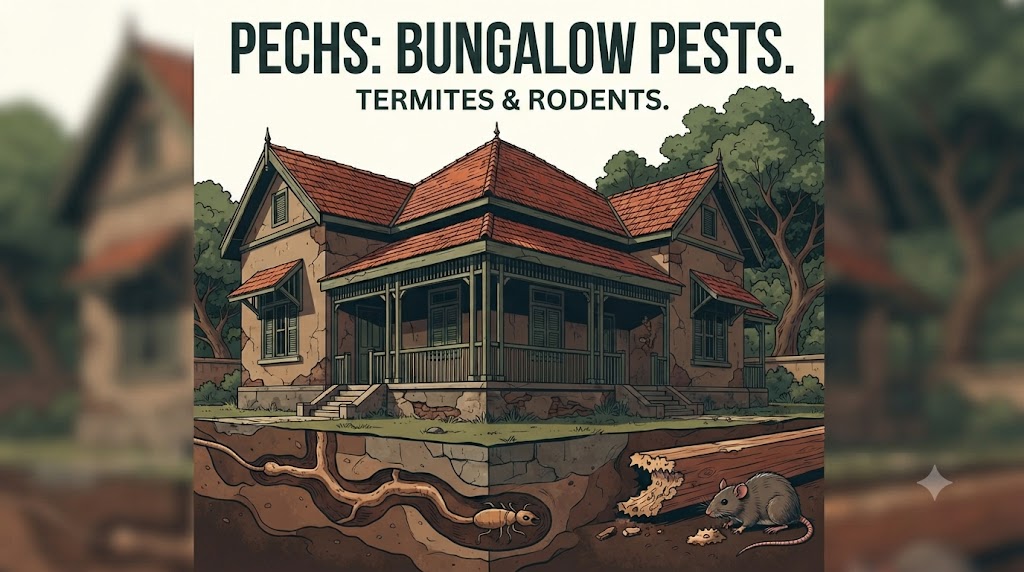
    PECHS is one of Karachi’s older planned neighborhoods, and a large share of its bungalows date back several decades — wooden window frames, old roof timber, mature gardens, and boundary walls that have settled and cracked over the years. Those same qualities that give PECHS its character are exactly what makes it a consistent source of termite and rodent calls for any pest control company in Karachi.

    This guide focuses on the two pests that older PECHS bungalows deal with far more than newer construction elsewhere in the city: subterranean termites working through structural timber, and rodents establishing themselves in gardens, roof spaces, and store rooms that have accumulated clutter over the years.

    Why Age of Construction Matters So Much Here

    Newer buildings are generally built with termite-resistant treatments applied to foundations during construction, and modern rodent-proofing (sealed gaps, mesh screens) is more common. Older PECHS bungalows were built before these were standard practice, and decades of settling, cracking, and garden growth against exterior walls have created far more entry points than a newer property would have. It’s a similar pattern to what we see in why DHA and Clifton homes get termite infestations, though the driver in PECHS is age of construction rather than the proximity to greenbelt landscaping that pushes it in those areas.

    Termite and Rodent Risk at a Glance

    PestMain source in older bungalowsReliable early sign
    TermitesSoil-based subterranean colony near the foundationMud tubes on boundary walls or pillars
    RodentsGarden beds, unused store rooms, degraded drainage jointsGnaw marks, droppings near boundary walls and stores

    Termites in PECHS Bungalows

    Subterranean Termites: The Main Culprit

    The termites most commonly found damaging structural wood in Karachi homes are subterranean termites, which live in soil and travel up into a structure through mud tubes built along foundation walls, rather than living inside the wood itself the way some other termite species do. This is an important distinction because it means the colony’s main nest is typically underground, near or under the foundation — not inside the timber you can see damage on. Colonies also tend to send out winged swarmers around Karachi’s termite season, usually during or just after the monsoon months, so a swarm sighting is a sign an established colony is already nearby rather than a new, unrelated pest.

    Where to Look in an Older Bungalow

    Wooden window and door frames, especially ground-floor frames facing gardens, roof timber in older flat-roof or truss constructions, wooden almirahs and built-in cupboards fixed against exterior walls, and mud tubes — thin brownish tunnels running up foundation walls or pillars — are the areas worth inspecting first. Mud tubes are one of the most reliable visual signs of subterranean termite activity and are often visible on boundary walls even before any wood damage becomes obvious inside the house. Our guide to identifying termite damage has more detail on telling early activity apart from ordinary wood ageing.

    Why “I Sprayed and It Went Away” Doesn’t Actually Work

    Surface sprays kill termites they directly contact but don’t reach the underground colony, which can contain a large number of termites and will simply rebuild any damaged foraging tubes and continue working elsewhere in the structure. Effective termite control targets the colony itself — typically through soil treatment around the foundation perimeter, and in more established infestations, bait stations that termites carry back into the colony. This is a fundamentally different approach from spraying visible mud tubes or damaged wood. Cost for this kind of treatment scales with foundation perimeter and how established the colony is — our breakdown of termite treatment cost in Karachi covers what actually drives the price.

    Rodents in Older Bungalow Gardens and Store Rooms

    Why Bungalows Attract Rodents More Than Apartments

    A standalone bungalow with a garden gives rats and mice far more to work with than a sealed apartment unit: garden beds and compost areas, gaps under boundary walls, store rooms and servant quarters that go unused for stretches of time, and older drainage and sewage lines with degraded joints. Mature gardens in particular — common throughout PECHS — provide both food sources and cover that newer, more sparsely landscaped properties don’t have.

    The Health Risk Worth Knowing About

    Rodents are a recognized carrier of several diseases transmissible to humans, including leptospirosis (spread through contact with water or soil contaminated by rodent urine) and salmonella (through contamination of stored food). This is well-established public health information, not a scare tactic — it’s the reason rodent control in a garden-heavy property matters beyond just the annoyance of seeing them.

    What Effective Rodent Control Actually Involves

    A proper approach to rodent control starts with identifying entry points — gaps under gates, cracks at the base of boundary walls, unsealed vents — because bait alone without sealing entry points tends to just attract more rodents from outside rather than reducing the population inside the property. Bait station placement, sealing of identified entry points, and a follow-up inspection to confirm the population has actually been reduced (not just temporarily suppressed) are the core components. Our rat-proofing guide lists the specific gaps and gate/vent details worth checking on a garden property like this.

    The Garden-Termite Connection Homeowners Miss

    One detail specific to bungalow properties: garden beds, tree stumps, and wood mulch placed directly against exterior walls create an ideal moisture-retaining bridge between soil-based termite colonies and the structure itself. Simply moving garden beds a short distance away from foundation walls and avoiding wood mulch touching the house removes one of the easiest access routes termites use — a small change that costs nothing but meaningfully reduces risk in older properties.

    Frequently Asked Questions

    How do I know if it’s termite damage or just old wood?

    Termite-damaged wood typically sounds hollow when tapped and may show a honeycomb or layered pattern when broken open, along with visible mud tubes nearby. Simple aging or water damage doesn’t usually produce that hollow, tunneled pattern.

    Can termites cause structural damage to a bungalow, or is it just cosmetic?

    Left untreated over years, subterranean termites can compromise structural timber — roof trusses, load-bearing wooden elements, and window/door frames — to the point of requiring repair or replacement, not just surface-level cosmetic damage.

    Do I need to treat the whole property or just the affected room?

    Because subterranean termite colonies operate from the soil around the entire foundation, effective treatment is generally applied around the full foundation perimeter, not just the room where damage was first noticed.

    Are rodents in the garden a serious problem or just something to live with?

    Given the disease risk associated with rodent contamination of food, water, and soil, an established rodent population in a garden or store room is worth addressing rather than ignoring, even if it hasn’t caused visible property damage yet.

    How often should an older bungalow be inspected for termites?

    There’s no universal fixed interval, but older properties with a history of termite activity, mature gardens against the walls, or wooden structural elements benefit from periodic inspection rather than waiting for visible damage to appear.

    Getting Help

    If you own or manage an older bungalow in PECHS and want a proper inspection rather than guesswork, you can get in touch here to arrange a site visit, or read more about our approach before booking.

  • North Nazimabad Pest Guide: Common Infestations in Karachi’s Established Residential Blocks

    North Nazimabad Pest Guide: Common Infestations in Karachi’s Established Residential Blocks

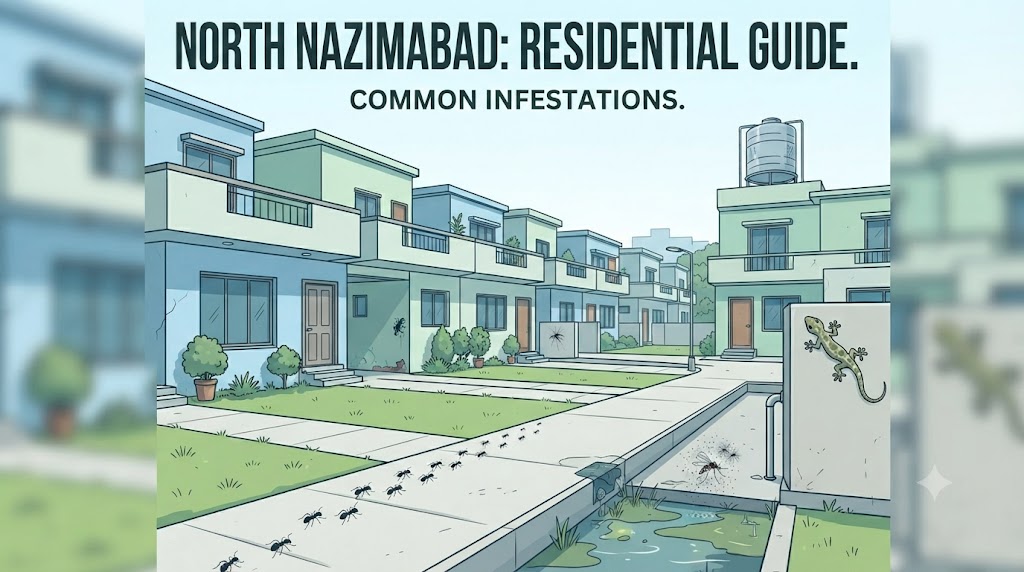
    North Nazimabad is a mixed neighborhood — older bungalows on wider blocks near the main boulevards, smaller houses and apartment-style blocks in denser sections, and a housing stock that spans several decades of construction. That mix means residents here don’t usually deal with just one pest problem; they deal with a rotating set depending on the season and the specific block. A pest control service in Karachi working across North Nazimabad sees a fairly consistent seasonal pattern, and knowing it in advance makes a real difference in how quickly a problem gets under control.

    Why North Nazimabad’s Pattern Is Different From a Single-Building Problem

    Unlike a single apartment tower where an infestation usually has one identifiable source, North Nazimabad’s established residential blocks are a patchwork of individually built houses, shared boundary walls, aging drainage lines running under the streets, and gardens of varying upkeep. Pests here move between properties less through shared risers (like apartment buildings) and more through ground-level routes — boundary walls, drainage, and soil.

    Ants: The Most Underestimated Pest in the Area

    Why Ants Show Up Constantly Here

    Ants are drawn to two things that established residential blocks have plenty of: mature trees and gardens providing outdoor nesting sites, and kitchens with accessible food and moisture. In North Nazimabad specifically, older concrete driveways and boundary walls with settled cracks give ants easy nesting spots close to the house, which is why residents often see trails appearing along the same routes year after year — our guide to ant trails in Karachi kitchens covers how to trace a trail back to its actual nest rather than just the entry crack.

    Ants and Water Storage

    One pattern worth knowing: ants — along with several other pests — are frequently drawn to areas around water tanks and their overflow points, where consistent moisture collects. If your property has ongoing ant activity near a rooftop or ground tank, it’s worth having the tank and surrounding area checked together rather than treating the ant trail in isolation. This is also a good moment to mention that water tank cleaning removes standing organic buildup that can attract pests to the same area repeatedly — our notes on signs your water tank needs cleaning are worth checking if you haven’t had it inspected recently.

    Getting Ahead of an Ant Problem

    Effective ant control generally relies on gel or bait treatments placed along known trails rather than surface sprays, since sprays kill visible ants but don’t reach the nest — and a colony that isn’t addressed at the nest will simply send out new foraging trails within days.

    Seasonal Shifts: What Changes Through the Year

    SeasonWhat tends to rise
    Monsoon (roughly July–September)Mosquitoes around standing water; termite swarmers after rain
    Dry, hot monthsRodents and cockroaches moving indoors toward moisture

    Monsoon Season

    Karachi’s monsoon (roughly July to September) brings a predictable rise in mosquito activity around any standing water — clogged drains, uncovered water storage, or waterlogged garden areas — and mosquitoes are a well-established vector for dengue in Pakistan, which is why standing water management matters beyond just comfort. It’s also the period when termite swarms (winged reproductive termites) are more commonly reported, since subterranean termite colonies often send out swarmers after rain when humidity is high. Our Karachi monsoon pest guide and termite season in Karachi guide both go into this pattern in more depth.

    Dry, Hot Months

    Drier months tend to push rodents and cockroaches toward any available moisture source indoors — kitchens, bathrooms, and areas near water tanks — since outdoor moisture becomes scarcer. This is when residents in North Nazimabad’s older bungalows most often notice rodent activity shifting from garden areas into the house itself.

    Termite Activity in Older North Nazimabad Blocks

    Many of the area’s older houses share the same vulnerability as PECHS bungalows: wooden frames and structural timber aging alongside settled foundations. Mud tubes along boundary walls and hollow-sounding wooden frames are worth checking periodically — our guide to identifying termite damage covers what those early signs actually look like — and if found, termite treatment targeting the underground colony, not just visible tubes, is the approach that actually resolves it rather than just delaying the next swarm.

    Why Block-Wide Awareness Helps

    Because North Nazimabad’s pest patterns move at ground level between adjoining properties rather than through shared building infrastructure, informal coordination with neighbors — noting when someone nearby had a termite swarm or a rodent problem — often gives useful early warning that a similar issue may be approaching your own property from the same direction.

    Frequently Asked Questions

    Why do I keep seeing ants near my water tank specifically?

    Consistent moisture around tank overflow points and connections is attractive to ants and several other pests. Treating the ant trail without addressing the moisture source or tank cleanliness often means the ants simply return.

    Is it normal to see winged termites after rain?

    Yes — subterranean termite colonies commonly release winged reproductive termites (swarmers) during or shortly after periods of high humidity, including monsoon rain. Seeing swarmers is a sign an established colony is nearby, not a new, unrelated pest.

    Do I need separate treatments for ants, termites, and rodents, or is it one visit?

    These typically require different treatment approaches (bait-based for ants, soil/colony treatment for termites, bait stations and entry-point sealing for rodents), so a proper inspection is used to identify which pests are actually present before deciding what’s needed.

    Does cleaning my water tank actually reduce pest activity nearby?

    It can help, since standing organic residue and consistent moisture around a poorly maintained tank is one of the draws for ants, mosquitoes, and other pests. It’s not a complete pest control solution on its own, but it removes one contributing factor.

    How can I tell if a pest problem is coming from my own property or a neighbor’s?

    Ground-level entry points — boundary wall cracks, shared drainage, garden beds against a shared wall — are the most common transfer routes in this kind of neighborhood. An inspection can usually identify the direction activity is coming from based on where trails, tubes, or droppings are concentrated.

    Getting Help

    If you’re noticing any of these patterns in your North Nazimabad property, it’s worth getting an inspection that looks at the property as a whole rather than treating one visible symptom at a time. Contact us to schedule a visit, or check our clients page to see the kind of properties we’ve worked with across Karachi.

  • Federal B Area Pest Control: Dealing with Rodents and Roaches in Dense Housing

    Federal B Area Pest Control: Dealing with Rodents and Roaches in Dense Housing

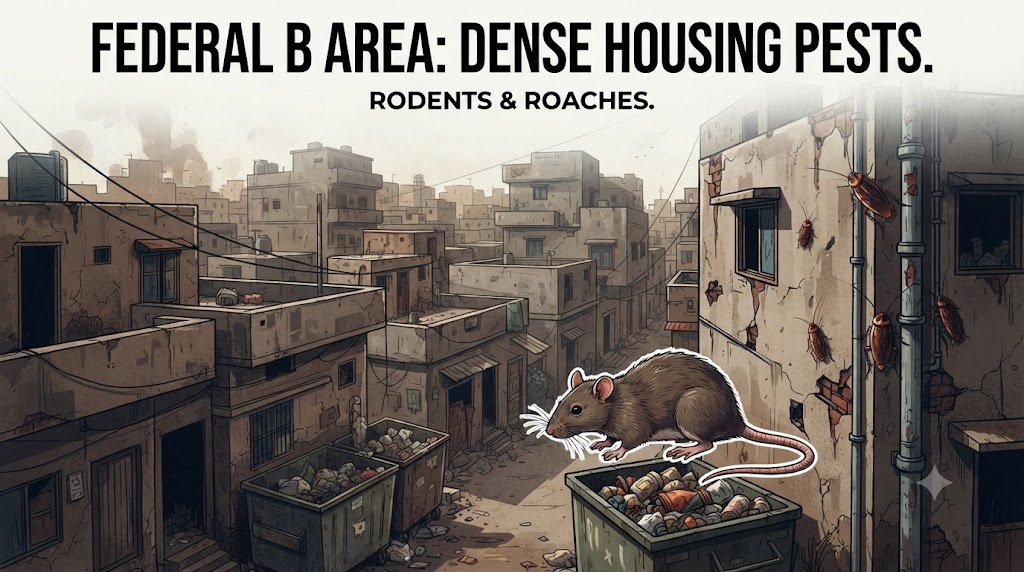
    Federal B Area is built tight — narrow streets, houses sharing boundary walls with almost no gap between them, ground-floor shops and small businesses mixed in among residential blocks, and a street-level density that’s different from both the apartment towers of Bahadurabad and the wider bungalow plots of PECHS. That specific kind of density is what makes rodents and cockroaches such a persistent issue here, and it’s also why treating a single house in isolation often doesn’t hold — a pest control service in Karachi built for a standalone bungalow won’t account for shared walls and shared drains the way this kind of housing needs.

    Why Dense Row Housing Behaves Differently

    In a neighborhood like Federal B Area, houses are effectively connected structures even though they’re legally separate properties — shared boundary walls, narrow gullies between blocks, and open or partially covered street drains running along most lanes. Rodents and cockroaches use exactly these connections to move between properties, which means a rodent or roach population isn’t really contained to one house; it’s distributed across a stretch of the street.

    Where Each Pest Is Coming From — And Where Treatment Should Focus

    PestPrimary source in this housingWhere treatment should focus
    RodentsShared wall voids, ground-floor shop stock, roof spacesSealing boundary entry points plus bait placement
    CockroachesShared street drains, pipe gaps, floor-level cracksGel bait at drain and pipe entry points, ground floor first
    BothInconsistent garbage collection at lane endsSealed waste storage plus lane-level collection follow-up

    Rodents in Federal B Area’s Narrow Lanes

    Where They’re Actually Coming From

    The combination of ground-floor shops (which store food stock), open or poorly covered street drains, and narrow gaps between adjoining houses gives rodents a continuous corridor to move through without needing to enter open ground or gardens at all — unlike a bungalow property with a garden, where rodents nest outdoors and forage inward. In dense housing, rodents are frequently living within the wall voids and roof spaces of the row of houses itself. Our guide to rat-proofing a Karachi home covers the specific gaps worth checking in this kind of shared-wall construction.

    The Shop-Adjacent Problem

    Ground-floor shops and small godowns storing dry goods, feed, or food stock are one of the most consistent rodent draws in mixed residential-commercial lanes. If you live adjacent to or above this kind of shop, rodent activity in your own home is often originating from that stock rather than anything in your own kitchen — which is worth knowing before assuming the problem is something you’re doing wrong.

    What Actually Works Here

    Because rodents are moving through a connected network of wall voids and shared lane infrastructure rather than a single isolated space, effective rodent control in this kind of housing focuses heavily on identifying and sealing entry points at the property boundary — gaps under gates, unsealed vents, cracks where walls meet — in addition to bait placement, since bait alone without sealing tends to just draw in more rodents from the same lane.

    Cockroaches in Dense Housing

    Drains Are the Primary Source

    Federal B Area’s older street drainage, much of it running close to the surface and shared across multiple properties on a lane, is a near-ideal environment for cockroaches — warm, damp, and constantly supplied with organic material. Roaches move from these drains into ground-floor kitchens and bathrooms through floor drains, pipe gaps, and low-level cracks, which is why ground-floor units in this kind of housing see roach activity more consistently than upper floors. Our guide to cockroach species in Karachi covers which types are typically drain-dwelling versus kitchen-dwelling, since the two respond to slightly different treatment.

    Why Individual Kitchen Cleaning Isn’t Enough

    As with apartment buildings, a spotlessly clean kitchen in dense row housing doesn’t stop roaches whose actual source is the shared drainage system outside. Cockroach control that only targets the visible kitchen without addressing entry points from drains and pipe penetrations tends to see activity return within a few weeks as the population outside re-establishes indoors. Our kitchen pest prevention guide is still worth following alongside treatment — it reduces what draws roaches in even after the drain-side source is addressed.

    Gel Baiting vs. Spraying in This Setting

    Gel bait placed at entry points — around floor drains, behind stoves, along baseboards near shared walls — lets roaches carry the bait back toward the population living in the drain or wall void, affecting more of the source population than a spray that only kills what it directly touches. In dense housing where you can’t treat a neighbor’s property or a shared street drain directly, this indirect effect matters more than it would in a standalone house.

    Garbage Collection and Street-Level Sanitation

    Dense housing lanes with inconsistent garbage collection or open waste accumulation at lane ends give both rodents and roaches a steady, unmanaged food source close to homes. This isn’t something a single household can fully solve, but keeping your own waste sealed and collected promptly — see our notes on storing food and waste correctly — and raising consistent collection with neighbors or your local union council representative removes one of the bigger draws feeding pest populations along the entire lane.

    Frequently Asked Questions

    Why does my house keep getting rodents even though I keep it clean?

    In dense row housing, rodents often live in shared wall voids, roof spaces, or nearby ground-floor shop stock rather than being drawn purely by conditions inside your own home. Cleanliness helps but doesn’t fully address a source outside your property.

    Are ground-floor units really more affected than upper floors?

    Generally yes for cockroaches specifically, since drain-based access points are at ground level (see the table above). Rodents can affect any floor if wall voids or roof spaces connect between units, but ground floors near drains or shop stock tend to see more consistent activity.

    Will sealing entry points alone solve a rodent problem?

    Sealing entry points is important but works best combined with bait treatment to reduce the existing population — sealing alone stops new rodents from entering but doesn’t remove ones already established inside wall voids or roof spaces.

    Can I ask my neighbors to treat their property at the same time as mine?

    Yes, and in dense housing this often gives noticeably better results than isolated treatment, since a rodent or roach population moving through shared walls and drains tends to reinfest untreated neighboring properties otherwise.

    Is it worth complaining to the local authorities about drain conditions?

    Raising consistent drain maintenance and garbage collection with your local union council or municipal representative can meaningfully reduce the pest pressure on an entire lane over time, even though it won’t resolve an active infestation in your own home immediately.

    Getting Help

    If rodents or roaches keep returning to your Federal B Area property despite your own efforts, the source is very likely outside your four walls. Get in touch to arrange an inspection that looks at entry points and shared infrastructure, not just the room where you’re seeing activity.

  • Malir Pest Control: Farmhouse and Residential Pest Challenges on Karachi’s Outskirts

    Malir Pest Control: Farmhouse and Residential Pest Challenges on Karachi’s Outskirts

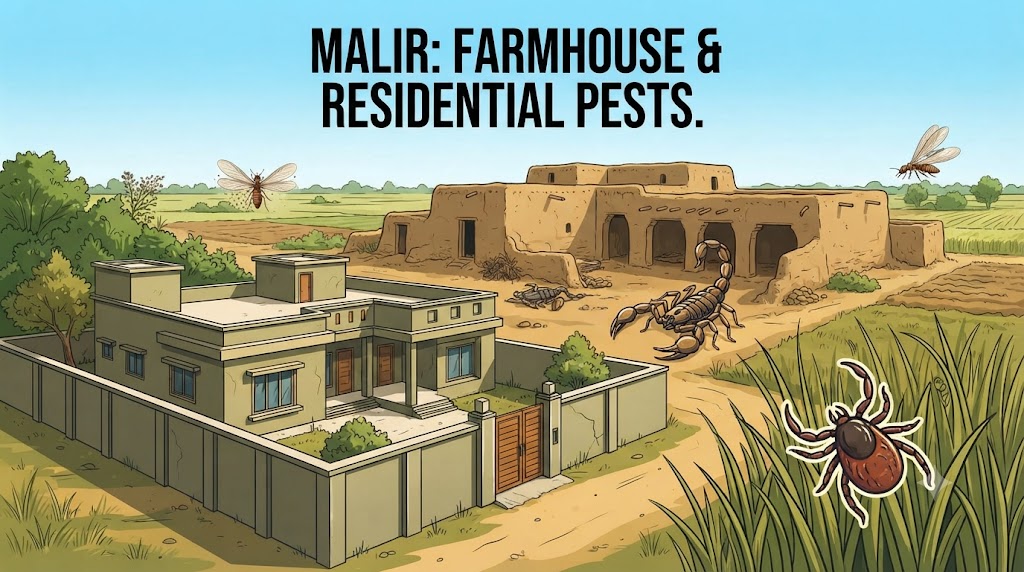
    A farmhouse or open residential plot in Malir needs pest control built around animals, standing water, and open boundaries — not the sealed-apartment approach that works for a flat in Gulshan or Clifton. Fleas and ticks tied to pets or livestock, mosquitoes breeding in irrigation water, and ants and rodents moving in from surrounding open land are the concerns that actually matter here, not the drain-based cockroach and apartment-building bed bug issues that dominate closer to the city center.

    Why Malir Properties Need a Different Approach

    Most residential pest control in Karachi assumes a property with sealed boundary walls, municipal water and drainage, and limited outdoor space. Malir’s farmhouses and larger residential plots often have none of these in the same form — open or loosely fenced boundaries, borewell or tanker-supplied water rather than a consistent WASA connection, livestock or pets on the property, and significant open land bordering agricultural fields or vacant plots. A pest control company in Karachi treating a Malir farmhouse is working with a very different set of entry points and pest pressures than the same team would face in DHA or Clifton.

    Where Each Farmhouse Pest Comes From

    PestTypical source on a Malir propertyWhere treatment should focus
    Fleas & ticksPets, livestock, stray animalsOutdoor shelter/resting areas plus any indoor spaces pets access
    MosquitoesStanding or irrigation water, low-lying rain poolingDraining or covering water sources before chemical treatment
    AntsAdjoining open or agricultural landBoundary and perimeter, not indoor trails alone
    RodentsStored animal feedFeed storage sealing plus perimeter baiting

    Fleas and Ticks: The Defining Pest Issue for Farmhouses

    Where They Actually Come From

    Fleas and ticks are overwhelmingly associated with animals — pets, livestock, or even stray animals that wander onto open farmhouse land — and they establish themselves wherever animals rest, including yards, animal shelters, and sometimes carpeted or upholstered indoor areas if pets have access to the house. A Malir property with dogs, cats, or livestock on-site has a fundamentally different flea and tick exposure than a sealed city apartment. Our guide to flea infestations in Karachi and tick identification and health risks covers how to tell the two apart and what each looks like at different life stages.

    Health Considerations Worth Knowing

    Ticks in particular are a recognized vector for several diseases transmissible to both animals and, less commonly, humans, which is why tick presence on a property with livestock or pets is worth treating proactively rather than only after a visible bite problem develops. This is well-established general knowledge about ticks as a pest category, not a claim about any specific local outbreak.

    Treating a Farmhouse-Scale Property

    Flea and tick control on a larger open property typically needs to address both the animals’ resting and shelter areas outdoors and any indoor areas pets access, since treating only the house while leaving outdoor shelter areas untreated usually means fleas or ticks re-establish from the untreated outdoor source within a short period.

    Mosquitoes and Standing Water on Larger Plots

    Open land, irrigation channels, uncovered water storage, and any low-lying areas that collect rainwater during monsoon season give mosquitoes far more breeding sites on a farmhouse plot than they’d find in a sealed city property. Mosquitoes are a well-established vector for dengue in Pakistan, and properties with any form of standing water — irrigation-related or otherwise — carry a higher baseline mosquito pressure than properties without it; our mosquito and dengue risk guide has more on what drives that risk city-wide. Identifying and either draining or covering standing water sources on the property is the single most effective step before any chemical treatment is considered, and this pressure typically peaks during Karachi’s monsoon months (roughly July to September) — our Karachi monsoon pest guide covers what else tends to spike alongside it.

    Ants Moving in From Surrounding Land

    Because Malir properties frequently border open plots, agricultural land, or undeveloped ground, ant colonies nesting in that surrounding land have an easy, uninterrupted route onto the property itself — unlike a city plot bordered by paved roads and other developed properties on all sides. Ant control on a farmhouse-scale property is generally more about managing the boundary — treating along fence lines and the perimeter where ants are entering — than about isolated indoor trails, since the source is almost always outside the property line.

    Water Tanks and Borewell-Supplied Properties

    Farmhouses relying on borewell water or tanker delivery rather than a consistent WASA connection tend to have larger storage tanks holding water for longer periods, which increases the chance of organic buildup and contamination if the tank isn’t cleaned on a regular schedule — and that buildup is itself an attractant for mosquitoes and other pests around the tank area. Water tank cleaning is arguably more important on a farmhouse property with its own storage than on a city property with frequent municipal supply turnover; our notes on how often a tank should be cleaned and what cleaning costs by tank size are both worth a look before booking, since a large borewell-fed tank is priced differently than a standard rooftop one.

    Rodents Around Feed Storage

    Properties with livestock or stored animal feed are a strong rodent draw, similar to the shop-adjacent rodent issue seen in denser parts of the city, but at a larger scale given the volume of feed typically stored on a farmhouse property. Rodent control around feed storage areas, combined with sealing gaps in storage structures, addresses this at the source rather than only treating the main house — our guide to rat-proofing a Karachi property has the specific gaps and access points worth checking first.

    Frequently Asked Questions

    Do farmhouse properties need a completely different treatment plan than a city house?

    Generally yes — the pest pressures (fleas/ticks from animals, mosquitoes from standing water, ants and rodents entering from open surrounding land) are different from what a sealed city property typically faces, so an inspection tailored to an open, larger property gives a more accurate treatment plan.

    Can I treat fleas and ticks myself if I have pets or livestock?

    Over-the-counter treatments can reduce visible activity temporarily, but without addressing outdoor shelter and resting areas alongside any indoor exposure, fleas and ticks typically re-establish from the untreated outdoor source.

    How much does standing water actually matter for mosquito control?

    It matters significantly — removing or covering standing water sources reduces mosquito breeding sites directly, and is generally more effective as a first step than relying only on chemical treatment without addressing the water sources themselves.

    Is ant treatment different for a farmhouse compared to a normal house?

    Yes — because ants on a farmhouse-scale property are usually entering from adjoining open land rather than nesting purely within the property, treatment tends to focus more on the boundary and perimeter than on indoor trails alone.

    How often should a farmhouse’s water tank be cleaned if it’s not on WASA supply?

    There’s no single fixed interval that applies to every property, but tanks holding water for longer stretches without frequent turnover generally need more regular cleaning than tanks connected to a consistent municipal supply, given the greater chance of organic buildup over time.

    Getting Help

    If you manage a farmhouse or larger residential property in Malir and want a treatment plan built around how the property actually functions — not a generic city-apartment approach — contact us to arrange an inspection, or see our charges page for a general idea of what treatment on a larger property typically involves.

  • Karsaz and Shahra-e-Faisal Commercial Pest Control: Protecting Offices and Warehouses

    Karsaz and Shahra-e-Faisal Commercial Pest Control: Protecting Offices and Warehouses

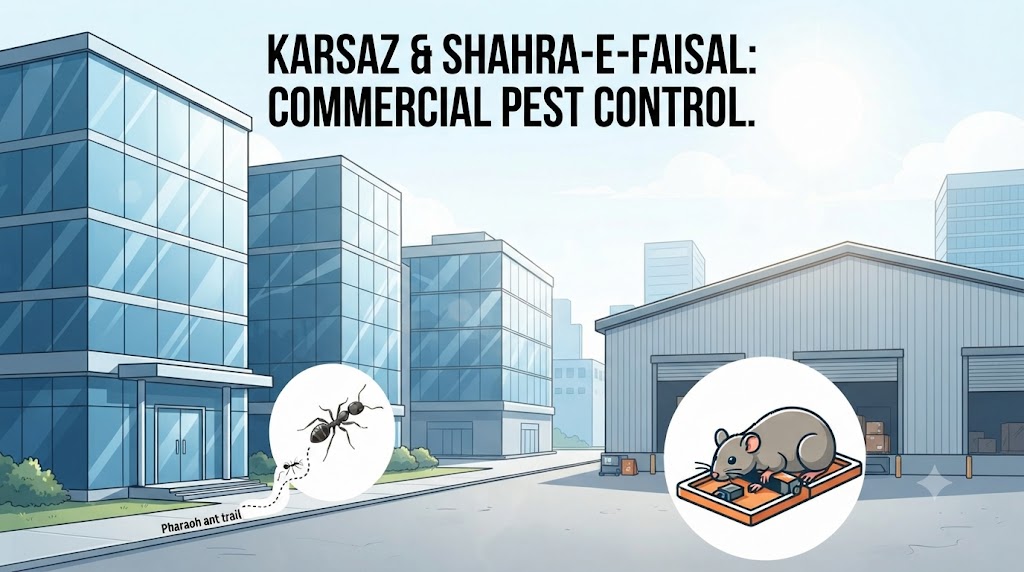
    Offices, showrooms, and warehouses along Karsaz and Shahra-e-Faisal need a different pest control approach than a house in a residential lane: treatment scheduled around business hours, phased across large floor plates instead of done in one visit, and documented well enough to satisfy an audit or a health inspection. This corridor is Karachi’s busiest commercial strip — airport-facing offices, corporate towers, logistics warehouses, banks, showrooms, and a steady run of restaurants — and each type of business carries a different pest risk and a different tolerance for disruption.

    A pest control service in Karachi that works for a bungalow in DHA doesn’t automatically work for a 40,000 sq ft warehouse near Shahra-e-Faisal. The pests are often the same species, but the scale, the access constraints, and the business risk are not.

    Why Karsaz and Shahra-e-Faisal Are a Different Kind of Job

    This corridor is a mix of multi-storey office blocks, bank branches, showrooms, hotels, and warehousing that feeds the rest of the city. Buildings here run double shifts, host visiting clients, and often can’t shut down for a treatment the way a home can simply lock a bedroom for a few hours.

    The other difference is exposure. A warehouse near Shahra-e-Faisal is receiving trucks, pallets, and packaging from all over the city and sometimes upcountry, and every delivery is a potential entry point for rodents, ants, and stored-product pests — something a typical household never has to think about. An office tower, by contrast, has almost no goods movement but a constant flow of tenants, visitors, and shared service areas like lifts, basements, and cafeterias where one floor’s problem can spread to the next.

    Common Pests in Karachi’s Commercial Buildings

    A few pests show up again and again in offices, showrooms, and warehouses along this stretch:

    • Cockroaches — cockroach control is usually needed around pantries, cafeterias, and basement stores where food waste and moisture collect overnight.
    • Rats and mice — rodent control tends to concentrate around loading bays, stockrooms, and false ceilings where cabling runs give them cover.
    • Termites — termite control risk climbs wherever there’s wooden paneling, false-ceiling framework, or stored timber pallets sitting against a damp wall.
    • Ants — ant control is usually needed where trails run in through cafeteria counters and vending areas once sugar or grease residue builds up.

    Warehouse-Specific Risks Worth Taking Seriously

    Warehouses carry a different kind of exposure than offices. Stored-product pests can move in with raw material or packaging and spread through pallet stacks before anyone notices. Cardboard boxes stacked directly on the floor, especially near loading dock walls, are a classic rodent and cockroach entry point, and condensation from air conditioning units or poorly sealed roof lines creates the damp pockets that termites and cockroaches both look for. In a warehouse holding paper stock, textiles, or packaged food, that damage isn’t cosmetic — it’s inventory loss. Our warehouse and godown fumigation guide covers how a facility that size should be zoned and treated.

    Office and Showroom-Specific Risks

    Offices and showrooms don’t have a warehouse’s stock exposure, but they have their own weak points: shared pantries and basement cafeterias that run all day, server rooms and false ceilings that stay warm and undisturbed, and reception or display areas where a single sighting in front of a client does more damage than the pest itself. Multi-tenant towers add a layer most single-owner buildings don’t face — one tenant’s kitchen or storeroom can seed an infestation that spreads through shared risers and ceiling voids to floors that have nothing to do with the source. Building management companies along this corridor are increasingly asking for standing pest control contracts rather than one-off callouts for exactly this reason; our note on corporate office pest control contracts lays out what that arrangement usually covers, and showroom or retail spaces facing similar client-facing pressure can see how audits typically run in our shopping mall and retail pest control audits guide.

    Compliance and the Business Reputation Angle

    Restaurants and food outlets along Shahra-e-Faisal face real inspection pressure — the Sindh Food Authority has run repeated hygiene crackdowns across Karachi in recent years, and pest presence or a lack of fumigation records is one of the things inspectors flag. A documented pest control schedule isn’t just good practice; it’s often asked for directly when a client, franchisor, or health inspector visits. Our restaurant fumigation certificate guide covers what documentation an SFA visit typically expects.

    Offices and showrooms have a softer version of the same problem: client-facing spaces where a visible pest sighting damages trust in a way that’s hard to undo. Building management companies increasingly ask vendors for proof of licensing before signing an annual contract — worth checking our pest control license page, and worth reading our PPMA registered vs unregistered companies comparison before signing with any vendor, since an unlicensed contractor’s paperwork won’t hold up in an audit.

    How Often Commercial Spaces on This Corridor Need Treatment

    Business typeTypical treatment pattern
    Offices & showroomsAnnual contract with quarterly check visits
    Restaurants & food outletsQuarterly to monthly, plus records kept for inspections
    Warehouses & godownsQuarterly, with extra checks after large or irregular stock deliveries
    Hotels & banquet/event spacesMonthly, timed around occupancy and event calendars

    These are general patterns, not fixed rules — the right frequency depends on the building’s age, how much goods movement it sees, and what came up at the last inspection. A standing contract versus a one-time treatment is usually the first decision worth making once a business moves past its first callout.

    Scheduling Treatment Without Disrupting Operations

    Commercial clients almost always ask the same question first: can this be done without shutting us down? For most office and showroom treatments, the answer is yes — after-hours or early-morning slots let the treatment set in before staff arrive, and low-odour formulations are available for spaces that can’t tolerate a strong smell during business hours.

    Warehouses usually need a phased approach — one zone treated while operations continue in another, rather than a single all-at-once shutdown. A pre-treatment walkthrough is worth insisting on so the technician can map loading bays, electrical risers, and storage racks before anything is scheduled. Karachi’s monsoon months (roughly July to September) also tend to push up cockroach and termite activity in this corridor, so buildings due for their quarterly check around then shouldn’t push it back.

    A Basic Prevention Checklist for Office and Warehouse Managers

    • Keep pallets and boxes off the floor and away from exterior walls — a few inches of clearance breaks the easiest rodent and termite access routes.
    • Seal gaps around loading dock doors and cable entry points; these are the two most common entry points in commercial buildings.
    • Schedule pantry and cafeteria deep-cleans on a fixed weekly basis, not on an as-needed basis.
    • Log every pest sighting with date and location — this is what turns a reactive callout into a pattern management program.
    • Renew treatment contracts annually rather than waiting for a visible infestation to trigger action.

    Frequently Asked Questions

    Can pest control be done in an office without disrupting work hours?

    Yes — most office and showroom treatments are scheduled after-hours or early morning specifically so the space is ready before staff return.

    Do warehouses need a different treatment approach than offices?

    Yes. Warehouses have larger areas, loading dock exposure, and stored goods that need protecting, so treatment is usually phased across zones rather than done in one pass, while offices are treated in a single after-hours visit.

    How often should a commercial building in this area be treated?

    It depends on the type of business — see the treatment pattern table above. Buildings with heavier goods movement or food handling generally need more frequent visits than a standard office.

    Does a restaurant need proof of pest control for health inspections?

    Yes, food outlets are commonly asked for a documented treatment schedule during inspections, so keeping records from every visit is worth doing regardless of whether it’s requested that day.

    What’s the biggest pest risk specific to warehouses versus homes?

    Stored-product pests and rodents entering with incoming stock — a risk homes generally don’t face since goods aren’t moving in and out on pallets daily.

    What should I ask a pest control company before signing a commercial contract?

    Ask for proof of registration and licensing before anything else — an unregistered contractor’s paperwork won’t satisfy a building management or health audit. Beyond that, ask how zoning works for larger spaces, what’s covered under the annual rate versus billed as extra, and how sightings between visits are handled.

    Get a Commercial Assessment Before It Becomes a Bigger Problem

    If your office, showroom, or warehouse along Karsaz or Shahra-e-Faisal hasn’t had a proper pest assessment recently, it’s worth getting one done before a client visit or inspection forces the issue. Pricing depends on the property’s size, layout, and how severe the activity already is — our charges page has the breakdown. Get in touch to schedule a walkthrough and a treatment plan that fits your operating hours.

  • Surjani Town Pest Guide: New Development Pest Risks and Prevention

    Surjani Town Pest Guide: New Development Pest Risks and Prevention

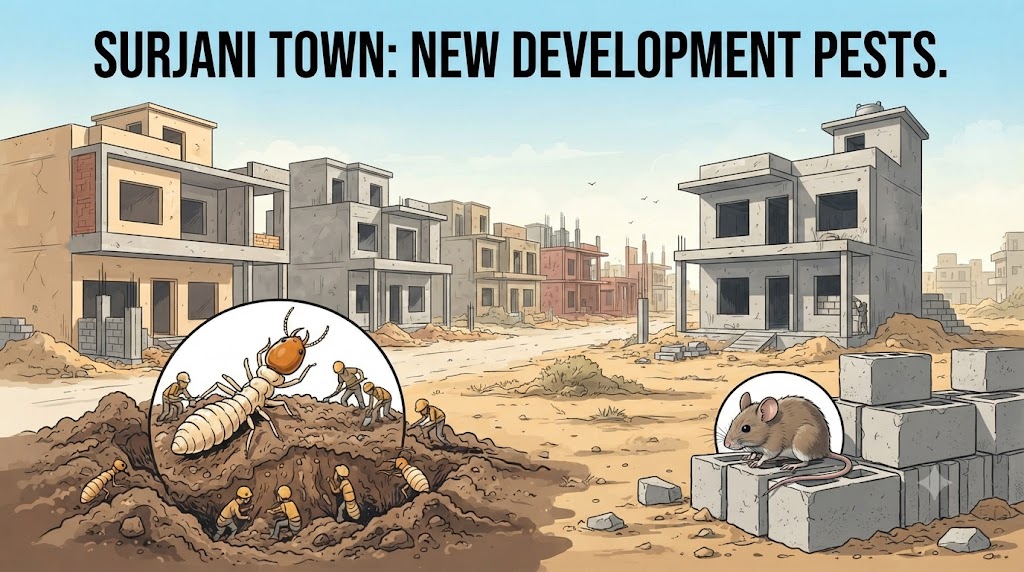
    Surjani Town is one of Karachi’s fastest-growing residential areas, and that growth brings a specific set of pest problems that older, fully-built neighbourhoods don’t deal with in the same way. Vacant plots, half-finished construction, and new water and drainage lines still settling in all create conditions pests take advantage of before a household is even fully moved in.

    If you’ve just bought or built in Surjani Town, the pest issues you’ll run into in year one look different from what a family in an older part of the city deals with — and prevention here starts before you unpack the last box. The same new-construction pattern shows up elsewhere on Karachi’s growing edges; our guide to pest risks in Bahria Town and Scheme 33 new construction covers it in another fast-developing part of the city.

    A Township Still Filling In

    Large parts of Surjani Town are still under active construction, which means new buildings often sit next to open plots, half-built structures, and construction debris. That mix is exactly what pests look for — undisturbed ground, standing water from construction work, and building material piled up long enough to become a nesting site.

    New Construction Comes With Its Own Termite Risk

    New buildings feel like they should be pest-free, but termites are actually a real risk at this stage. Fresh timber used for doors, window frames, and false ceilings hasn’t been treated the way older wood eventually gets, and any wood-to-soil contact during construction — formwork, scaffolding planks left in the ground — can introduce a colony before the house is even finished. Our guide to identifying termite damage in Karachi homes is worth reading so you know what to check for even at this early stage.

    Basements and ground-floor storage rooms in new construction are especially vulnerable if damp-proofing wasn’t done properly. It’s worth having a termite inspection done before final finishing work, not after you notice damage — this is exactly the kind of check covered in our guide to pre-handover pest inspections.

    Open Plots and Vacant Land: The Bigger Township-Level Problem

    Unlike a fully built-up neighbourhood, Surjani Town still has a meaningful number of vacant plots between developed homes. These plots collect rainwater during monsoon, become dumping spots for construction and household waste, and give rodents open ground to move between properties undetected.

    • Standing water on open plots is one of the main local mosquito breeding sources during monsoon season — our overview of mosquito and dengue risk in Karachi covers why this matters beyond the nuisance factor.
    • Rubble and debris piles on vacant land are a common rodent harborage point — rodent control for a house next to one of these plots often needs to include exterior bait stations, not just indoor treatment.
    • Overgrown vegetation on undeveloped plots gives ants and ticks a route into adjoining gardens.

    Water Storage and Tank Hygiene in a Growing Area

    Water supply in newer parts of Karachi’s periphery is often less consistent than in older, established neighbourhoods, which means more households rely on storage tanks and periodic tanker deliveries. A tank that isn’t cleaned regularly becomes a breeding site for mosquitoes and a source of contamination that has nothing to do with the water quality coming in — it’s what’s growing inside the tank itself.

    If your household is filling a tank every few days rather than relying on continuous supply, it’s worth getting water tank cleaning done on a fixed schedule rather than waiting until the water looks or smells off. Our guide to signs your water tank needs cleaning covers what to watch for in the meantime.

    The Household Pests You’ll Notice First

    Once a family actually moves in and starts using the kitchen, a few pests tend to show up within the first few months:

    PestWhy it shows up earlyWhat helps
    AntsArrive with furniture or building material, establish quickly in a kitchen still being organisedSeal new plumbing and conduit gaps early
    CockroachesMove in from neighbouring under-construction plots once kitchen waste starts building upTreat before waste generation attracts more
    MosquitoesTank storage plus standing water on nearby open plotsFixed tank cleaning schedule, clear standing water
    TermitesFresh untreated timber, wood-to-soil contact during constructionInspection before final woodwork and flooring

    Building a Prevention Plan as You Move In

    The advantage of a new home is that prevention is cheaper and easier before you’ve filled it with furniture and finished every room. A pre-move-in pest inspection covering timber work, the boundary wall, and any adjoining vacant land gives you a baseline before problems start rather than after — our guide to moving into a new Karachi home or office covers the broader prevention checklist for this stage.

    • Get a termite inspection done before final woodwork and flooring is completed.
    • Seal gaps around new plumbing and electrical conduit entry points — these are common ant and cockroach access routes in freshly built homes.
    • Set a tank cleaning schedule from day one rather than waiting for visible signs of contamination.
    • If your plot borders vacant land, ask for exterior perimeter treatment as part of your first pest control visit.

    Frequently Asked Questions

    Can a brand-new house already have a termite problem?

    Yes — fresh timber used in doors and frames, and any wood left in contact with soil during construction, can bring termites in before the house is even finished.

    Why does Surjani Town have more mosquito issues than some older areas?

    A combination of open, undeveloped plots collecting rainwater and heavier reliance on stored tank water both contribute to more mosquito breeding sites than a fully built-up neighbourhood typically has.

    Should I get pest control done before or after moving in?

    Before, if possible — treating an empty house is more thorough and cheaper than treating around furniture, and it catches construction-stage termite risk before flooring is finished.

    How often should tanks be cleaned in an area with irregular water supply?

    Households relying on tanker deliveries or intermittent supply generally need tank cleaning more frequently than those on continuous municipal supply, since water sits longer between refills.

    Does a vacant plot next door mean I’ll definitely get pests?

    Not definitely, but it raises the risk meaningfully, and it’s a reasonable factor to mention to your technician so exterior treatment is included.

    Start With an Inspection, Not a Reaction

    If you’re building, finishing, or just moved into a home in Surjani Town, getting ahead of these risks is far easier than dealing with an established infestation later. Contact us to schedule a pre-move-in inspection and a plan that accounts for what’s happening on the plots around you.

  • Liaquatabad Pest Control: Managing Infestations in High-Density Housing

    Liaquatabad Pest Control: Managing Infestations in High-Density Housing

    Liaquatabad is one of Karachi’s most densely built residential areas — narrow lanes, shared walls, and multi-storey apartment buildings where units sit directly on top of and beside each other. That density changes how pests behave. A problem in one flat rarely stays in one flat, and pest control here has to account for the whole building, not just a single household.

    If you live in an apartment in Liaquatabad and have dealt with a pest issue that keeps coming back no matter how often you treat your own unit, the building next door — or the flat next to yours — is very likely part of the reason. It’s a pattern we see in dense apartment areas across the city; our guide to apartment pest control in Gulshan-e-Iqbal and Gulistan-e-Johar covers the same building-wide spread mechanics.

    Why Density Changes the Pest Equation

    In a standalone house, pests generally have to find their own way in from outside. In a dense apartment block, they have a much easier route: shared walls, common stairwells, connected plumbing risers, and gaps around shared electrical conduits. Treating one unit while the flat next door stays untreated often just pushes the problem sideways temporarily.

    Single-Flat vs Building-Wide Treatment

    PestWhy single-flat treatment failsWhat building-wide treatment covers
    Bed bugsAdjoining unit still active, re-seeds your flat through walls or furnitureTwo or three adjoining units treated together
    CockroachesColony persists in shared drainage or waste chuteBuilding’s common drainage points plus individual kitchens
    RodentsRats relocate a few feet within false ceilings and risersImmediately adjoining units sealed and baited together
    TermitesDamage often traced to shared damp ground-floor structureBuilding-level periodic inspection, not one flat at a time

    Bed Bugs and Shared Walls: A Building-Wide Problem

    Bed bugs are the clearest example of this. They don’t need much of a gap to move between adjoining units through wall cavities, shared furniture moved between floors, or even a visiting relative’s luggage — our guide to bed bug identification and behaviour covers how to catch this early. Bed bug treatment done in isolation, in just one flat, is one of the most common reasons a bed bug problem returns within a few months — the source unit next door was never addressed. We’ve seen the same pattern in other dense apartment areas, including Bahadurabad apartment buildings.

    If you’re dealing with recurring bed bugs in a Liaquatabad apartment, it’s worth raising with neighbours or the building’s residents’ committee whether other units are also affected, even quietly. A coordinated treatment across two or three adjoining units is far more effective than repeated single-unit visits.

    Cockroaches and Shared Drainage Systems

    Older apartment buildings in this part of Karachi often share drainage lines and waste chutes between floors, and cockroaches use these as highways — our guide to cockroach species in Karachi covers which types are most likely to be involved. A kitchen on the third floor can have a roach problem traced back to a poorly sealed drain connection two floors down. This is also why cockroach control in these buildings tends to need attention at the building’s common drainage points, not just inside individual kitchens.

    Rodents Moving Between Units

    Rats and mice in dense housing move along the same shared infrastructure — false ceilings that run continuously across several flats, and gaps around plumbing risers. Our guide to rat-proofing your home covers the entry points worth sealing first. Rodent control in a building like this usually works best when at least the immediately adjoining units agree to be treated together, since rodents will simply relocate a few feet if only one flat is sealed and baited.

    Aging Structures and Termite Vulnerability

    Many buildings in Liaquatabad are decades old, and older timber — door frames, window frames, built-in cupboards — is more vulnerable simply because of age and years of moisture exposure from monsoon seasons. Our guide to identifying termite damage in Karachi homes covers the early signs worth checking. Termite inspection is worth doing at the building level periodically, especially in ground-floor units where dampness collects most.

    Getting a Building Committee on Board

    The single biggest factor in solving a recurring pest problem in dense housing isn’t the treatment itself — it’s coordination. If you’re trying to make the case to a building committee, our list of questions to ask before hiring a fumigation company is a useful starting point for what to compare between quotes. A few practical steps that work well in buildings like this:

    • Raise the issue at a residents’ committee or building management meeting rather than only dealing with it unit by unit.
    • Ask neighbouring units, especially directly adjoining or above/below, whether they’ve noticed similar issues.
    • Push for a building-wide annual inspection rather than relying only on individual complaints.
    • Keep common areas — stairwells, shared storage, drainage access points — as part of any treatment plan, not just private units.

    Frequently Asked Questions

    Why does my bed bug problem keep coming back after treatment?

    In apartment buildings, this is very often because an adjoining unit still has an active infestation that keeps re-seeding your flat through shared walls or furniture.

    Can cockroaches really travel between different floors of a building?

    Yes, especially through shared drainage lines, waste chutes, and poorly sealed plumbing risers that run through multiple floors.

    Is it worth involving my neighbours in pest control?

    In dense housing, yes — a coordinated treatment across adjoining units is significantly more effective than repeated single-unit visits.

    How do I convince a building committee to arrange collective pest control?

    Framing it as a shared cost that prevents repeated individual call-outs, and pointing to any documented recurring complaints, usually makes the case for a building-wide contract.

    Are older buildings in Liaquatabad more prone to termites?

    Generally yes, simply due to the age of the timber and years of monsoon moisture exposure, though this varies building to building depending on maintenance history.

    Talk to Us Before Treating Just One Flat

    If you’re dealing with a recurring pest problem in a Liaquatabad apartment, it’s worth discussing the building layout with us before booking, so treatment accounts for shared walls and drainage rather than just your unit. Reach out here to talk through what coordinated treatment would involve.

  • Garden and Old City Areas: Termite and Rodent Risks in Karachi’s Historic Buildings

    Garden and Old City Areas: Termite and Rodent Risks in Karachi’s Historic Buildings

    The Garden area and Karachi’s surrounding old city neighbourhoods hold some of the city’s oldest residential and commercial buildings — many with original timber beams, wooden staircases, and drainage systems that predate most of the plumbing standards used in newer construction. That age is part of what gives these buildings their character, but it’s also exactly what makes them vulnerable to termites and rodents in ways newer buildings simply aren’t.

    If you own or manage a property in Garden or one of the older surrounding neighbourhoods, pest control here isn’t just about eliminating an infestation — it’s about doing it in a way that doesn’t damage a structure that can’t easily be replaced.

    Why Karachi’s Old City Fabric Is Different

    Buildings in this part of the city were often built decades before modern damp-proofing and pest-resistant construction practices became standard. Original wooden beams, door frames, and staircases have had far longer exposure to Karachi’s humidity and monsoon seasons than anything in a newer development, and many have been through multiple rounds of minor water damage that was never fully addressed. Old city and heritage-adjacent neighbourhoods across Karachi share this pattern — our broader look at pest control challenges in old Karachi buildings covers it beyond Garden specifically.

    Old Buildings vs Modern Construction: Why the Risk Differs

    Risk factorOlder Garden / old city propertiesNewer construction elsewhere
    Timber exposureOriginal structural and decorative wood, decades of humidity exposureMinimal structural timber; treated or engineered materials common
    Drainage systemOld, often cracked or unsealed pipe networksSealed, modern piping standards
    Termite treatment approachMust protect original woodwork; not all methods are suitableStandard treatment methods generally apply
    Recommended inspection frequencyAnnual, given the cost of undetected damageCan typically follow a longer routine schedule

    Termites in Century-Old Timber

    Subterranean termites are the primary threat to old timber in this area, and by the time damage is visible — sagging beams, hollow-sounding wood, or crumbling near the base of a staircase — the colony has usually been established for a long time. Our guide to identifying termite damage in Karachi homes covers the early warning signs worth checking before damage gets to that stage. Termite control in a heritage or century-old structure needs a different approach than a newer building: assessing which timber elements are structural versus decorative, and choosing treatment methods that don’t require removing or heavily disturbing original woodwork.

    Regular inspection matters more here than almost anywhere else in the city, simply because the cost of discovering termite damage late — in a beam that can’t be easily replicated — is much higher than in standard modern construction. Our overview of termite season in Karachi is worth reading alongside this if you want to time inspections around the periods when termite activity picks up, and our breakdown of termite treatment cost in Karachi covers what factors affect pricing for a job like this. The same structural sensitivity applies in other older or heritage-adjacent parts of the city — see our note on why DHA and Clifton homes get termite infestations for how the risk shows up differently in newer construction nearby.

    Rodents and Karachi’s Aging Drainage Network

    Old city drainage systems, in many cases, are decades old and were not built with the sealed, modern piping standards used today. Cracked or open sections of old drains give rodents a direct route into basements and ground-floor storage areas, and rodent activity in this part of the city is very often traced back to the drainage network itself rather than anything a specific property is doing wrong. Our guide to rat-proofing your home covers the entry points worth sealing first, wherever a property sits.

    This means rodent control in old city properties often needs to look beyond the building’s own boundary — sealing entry points where old drains meet the foundation, not just placing bait indoors.

    Treating Historic Structures Without Causing Damage

    A few practical considerations that matter specifically for older and heritage-adjacent buildings:

    • Termite treatment methods should be chosen based on whether timber is structural or decorative — some treatments require drilling, which isn’t appropriate for original decorative woodwork.
    • Chemical treatments near old plaster or lime-based finishes need care, since some modern products can react badly with older building materials.
    • Access points for treatment should be planned with a structural view in mind, not just the shortest route to the infestation.

    Balancing Heritage Preservation With Pest Control

    Property owners in this part of Karachi are often caught between wanting to preserve a building’s original character and needing to deal with a real, ongoing structural threat. The two aren’t actually in conflict if treatment is planned properly — the goal is to eliminate the colony or infestation while disturbing as little of the original material as possible, and to follow up with prevention (moisture control, sealing) rather than repeated invasive treatment. Our post-renovation pest prevention guide covers a related version of this same principle for properties that have recently had repair or renovation work done.

    Practical Steps for Old City Property Owners

    • Get a termite inspection done annually rather than waiting for visible damage — this is the single most cost-effective step for an older property.
    • Address any moisture source (leaking pipes, poor roof drainage) before or alongside pest treatment, since damp timber will keep attracting termites regardless of chemical treatment.
    • Ask about the specific building’s drainage connections when booking rodent control, so entry points from old shared drains are included in the treatment plan.
    • Keep a record of any past treatment and structural repairs — this helps a technician assess which areas have already been addressed.

    Frequently Asked Questions

    How do I know if my old building has termite damage if I can’t see it?

    Tapping timber for a hollow sound, checking for fine mud tunnels along walls or foundations, and getting a professional inspection are the most reliable ways to catch damage before it becomes visible or structural.

    Can termite treatment damage original woodwork in a heritage building?

    It can if the wrong method is used, which is why treatment on structural versus decorative timber should be assessed separately before any work begins.

    Why do old city buildings seem to have more rodent problems than newer ones?

    It’s very often linked to aging, cracked drainage networks that give rodents a direct route into buildings, rather than anything specific to how a given property is maintained.

    Is it worth treating an old building if I’m not sure I’ll fix the underlying moisture issue?

    Treatment will still help in the short term, but termites and dampness-related pests will likely return until the moisture source itself is addressed alongside treatment.

    How often should a century-old property be inspected?

    Annual inspection is generally recommended for older structures, given how much more costly undetected termite damage becomes in original timber.

    Protect What Can’t Be Replaced

    If you own or manage an older property in Garden or a nearby old city neighbourhood, it’s worth getting a proper structural pest assessment rather than a standard treatment visit. Contact us to arrange an inspection that takes the building’s age and materials into account.