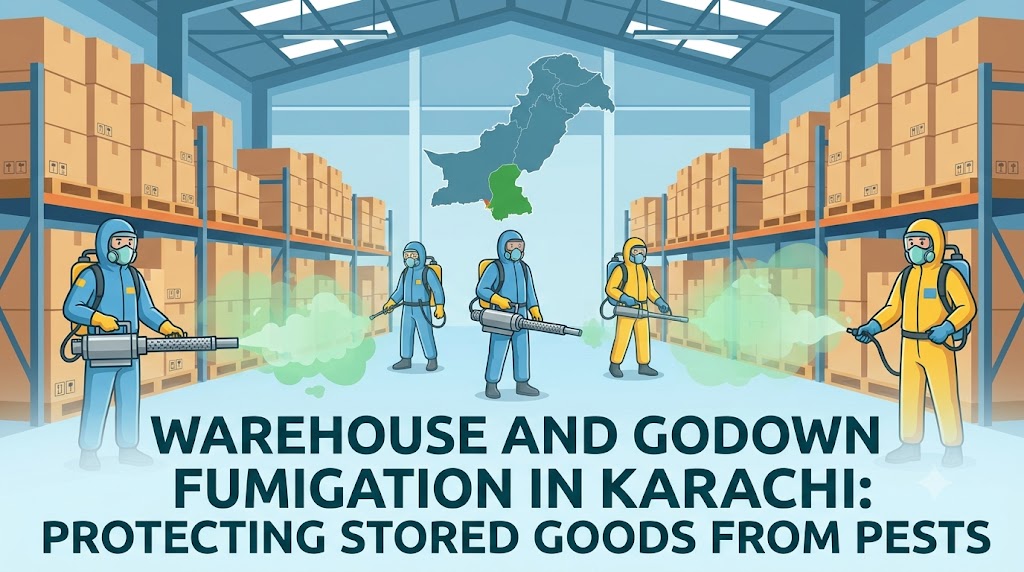
Warehouse and godown fumigation in Karachi is, for most facilities, not fumigation in the strict sense. Day-to-day protection comes from a documented programme of inspection, rodent bait stations, perimeter treatment and proofing. True gas fumigation of sealed stock is kept for confirmed stored-product infestations and for export consignments that require it.
The stakes are different from a shop or a home. A few rodent droppings in a grain lot, weevils in packaged flour or a pest complaint from a buyer can mean a rejected shipment, a cancelled contract or costly rework before goods leave the facility. A fumigation service in Karachi built for households does not map onto that, so this post covers what warehouse work involves.
Why Are Warehouses a Different Risk From Homes and Offices?
A house gets treated and the problem is largely contained to that structure. A warehouse is a moving target: new stock arrives daily, pallets get shifted, and loading bay doors stay open for hours during dispatch. Each of those is an entry point, and dense stacking limits how much of the floor anyone can see. That is why warehouse pest management leans on ongoing monitoring far more than a single treatment ever could.
The financial exposure is different in kind too. Residential pest damage is unpleasant; in a warehouse it is a balance-sheet event — a contaminated lot, a rejected container, stock written off — before counting the cost of a client finding pest evidence in a delivered consignment.
Which Pests Damage Stock in Karachi Godowns?
Rats and Mice
Rodents are the biggest concern in almost every godown. They contaminate far more than they eat through droppings and urine, and they gnaw through sacks, cartons, cabling and insulation. Serious rat and rodent control for a warehouse is built on a numbered bait station map around the perimeter and inside the building, checked on every visit, not a handful of traps set after a sighting.
Stored-Product Insects
Weevils, beetles and moths that live inside grain, flour, pulses and dried goods are often the most expensive pest to deal with, because infested stock frequently has to be discarded. For rice and grain exporters the khapra beetle matters most: it survives long periods without food, resists many insecticides, and has caused Pakistani rice shipments to be rejected by the United States, Mexico and Russia. Red flour beetle has triggered interceptions in the EU. These insects usually arrive inside incoming stock, which is why inspection at the dock matters as much as any treatment.
Cockroaches and Ants
Cockroaches thrive around loading docks, drains, staff canteens and anywhere food waste collects, so cockroach control has to cover the whole perimeter and not just the visible hotspots. Ants are a persistent problem around sugar, confectionery and packaged food, and a proper ants control plan traces the colony instead of spraying the trail.
Termites
Termites are a slower risk to wooden pallets, racking, cartons stacked on the floor and any structural timber. An annual check through a termite control service is worth it, especially in older industrial buildings.
Fumigation vs Routine Pest Control: What Does a Warehouse Need?
People use “fumigation” for any pest treatment, but the two jobs are not the same, and most warehouses need the first far more often than the second.
| Routine pest management | Gas fumigation | |
|---|---|---|
| What it is | Inspection, bait stations, perimeter treatment and proofing | A toxic gas, usually phosphine released from aluminium phosphide, held in a sealed store or under gas-proof sheets |
| Targets | Rodents, cockroaches, ants, flies | Insects living inside grain, flour, pulses and other stored commodities |
| Effect on operations | The facility keeps running | The treated stack or store is sealed and out of bounds for several days, then aired before re-entry |
| When it is used | On a fixed cycle all year | A confirmed stored-product infestation, or a shipment whose buyer or destination requires it |
| Lasting protection | Continuous while the programme runs | None: the gas kills what is present and leaves nothing behind to stop reinfestation |
A serious programme starts with a facility audit that maps entry points, loading docks, drainage and storage layout before any chemical is applied. From there, most facilities move to a monthly or bi-monthly monitoring cycle, depending on stock type and turnover, with every bait station and trap checked and logged. Exclusion work — sealing gaps, repairing dock seals, fixing drainage — does more of the practical work than gas fumigation alone.
Do You Need a License or Certificate to Fumigate a Warehouse?
There is no single government license for routine pest control in a warehouse in Pakistan. What exists are company registrations, industry memberships and, on the export side, plant quarantine requirements. Our own registrations and certifications are listed on the site, and our comparison of registered vs unregistered pest control companies explains what to look for. In practice, the paperwork a godown is asked for comes from four directions:
| Document | Who asks for it | When it applies |
|---|---|---|
| Dated pest control records | FMCG distributors, supermarket chains, export buyers and their auditors | Any supply agreement that makes pest management a condition of doing business |
| Evidence of hygienic food storage | Sindh Food Authority | Godowns storing food, since storage counts as a food business under the Sindh Food Authority Act |
| Phytosanitary certificate | Department of Plant Protection | Export consignments of plant produce; for commodities such as rice the shipment is fumigated before certification |
| ISPM 15 mark | Quarantine authorities in the importing country | Wooden pallets and crates in export shipments, which must be treated and stamped |
The export certificates are a separate, commodity-specific process and a routine treatment does not cover them. If your godown handles export-bound goods, confirm with your freight forwarder or buyer exactly which certificate they need; our guide to export container fumigation in Karachi covers that side. For domestic supply, buyers’ audits follow much the same pattern as the pest control audits for Karachi shopping malls and retail outlets.
How Do You Keep Pests Out Between Visits?
- Inspect incoming stock at the dock and hold back any lot showing live insects, webbing or gnawed packaging.
- Keep stacks on pallets with a clear gap from the walls, so the perimeter can be inspected and baited.
- Rotate stock first in, first out. Old lots at the back of a stack are where insect populations build.
- Sweep up spillage the same day, including under racking and around dock levellers.
- Keep dock doors shut between trucks, repair worn door seals and fit mesh over drains and vents.
Which Karachi Industrial Areas Carry the Most Risk?
Godowns and distribution warehouses cluster in Korangi and Landhi, where units sit wall to wall and pest pressure travels quickly between neighbours; that is the case we make in why Korangi and Landhi industrial units need fumigation contracts. Malir‘s semi-open plots bring more rodent and outdoor pest pressure from surrounding land, as our Malir pest control guide describes, and the industrial pockets of Surjani Town have their own pattern, set out in the Surjani Town pest guide.
Smaller godowns in the New Karachi and Federal B Area industrial areas are hemmed in by housing, so rodents and cockroaches move in from neighbourhood drains and garbage points. SITE, the grain and rice stores near Port Qasim and the old wholesale godowns of Jodia Bazaar each add their own conditions. A survey that accounts for the neighbourhood catches these differences early.
How Is Treatment Scheduled and Priced for a Working Facility?
A warehouse rarely has a window when it is simply empty. Loading and dispatch schedules, shift changes and stock movement all have to be worked around, so treatment is mapped against your operating calendar: early morning before the first shift, evening after dispatch closes, or a rotating zone-by-zone plan that never takes the whole facility offline at once.
Cost is scoped differently from a household job. It depends on covered floor area, the number of loading points, the perimeter length needing bait stations, the stock type (food-grade storage needs more careful chemical selection than hardware or textiles) and whether gas fumigation is part of the plan or an as-needed extra. Two warehouses of the same size can have very different risk profiles, so a facility survey is the only reliable way to price it; our charges page gives a starting point, and our post on a fumigation contract vs one-time treatment explains how the two are costed.
Frequently Asked Questions
How often should a warehouse be fumigated?
No single number fits every facility. Most active warehouses run a monthly or bi-monthly inspection and bait-station cycle, with gas fumigation reserved for confirmed stored-product infestations or shipments that require it. Fast-moving food stock sits at the frequent end of that range.
Can pest control damage or contaminate stored goods?
A properly planned programme is designed around exactly this concern. Bait stations are sealed and placed away from stock, sprays are targeted and kept off food-grade goods and packaging, and after any gas fumigation the goods and the area are left for the product’s full clearance time before anyone goes back in.
Which season is worst for stored-product pests in Karachi?
The monsoon, roughly July to September. Warm, humid air speeds up insect breeding inside grain and flour, damp sacks grow mould, and flooded drains push rodents indoors. Inspect more often in these months and see our Karachi monsoon pest guide for the wider picture.
What should we do if we find insects in a grain lot?
Isolate the lot where it stands and do not move it through the store, because that spreads the insects to clean stacks. Check the neighbouring lots, keep a sample of the insect, and have it identified before deciding whether the stock can be fumigated or has to be discarded.
What records should a warehouse keep for buyers and auditors?
Keep a site plan showing every numbered bait station, a dated report for each visit with findings and the chemicals used, a log of pest sightings by staff, and a note of the corrective actions taken. Whether on paper or digital, this file is what protects a facility manager when a buyer or auditor asks for proof of a pest management system.
Book a Warehouse Pest Survey
If your warehouse or godown does not have a documented, scheduled pest management programme, that gap is worth closing before it shows up as damaged stock or a lost contract. Contact us for a facility survey and a proposal built around your storage layout and stock type.

Rehan Khan is the founder of Accurate Fumigation and an entomologist. He holds an M.Sc. in Entomology and a B.Sc. in Environmental Science, and has worked in pest control in Karachi for three decades. He founded the company in 2005 and writes about the pest and water problems the city deals with each season. Accurate Fumigation is ISO 9001:2015 certified and a member of the National Pest Management Association.
Questions about a service, or need a certificate for an inspection? Call the office on 0330-2533480. Read Rehan’s full profile.