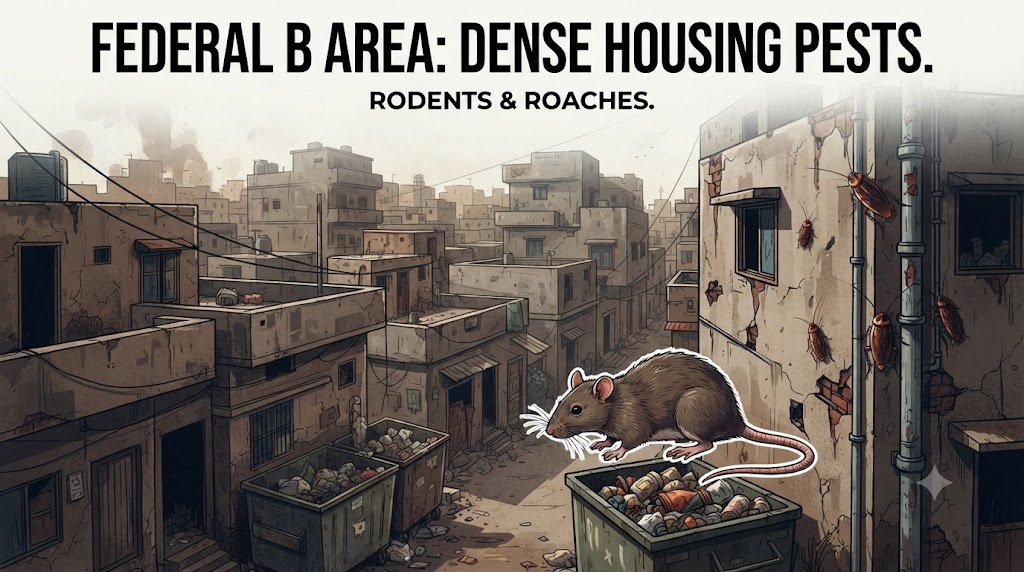
Federal B Area is built tight — narrow streets, houses sharing boundary walls with almost no gap between them, ground-floor shops and small businesses mixed in among residential blocks, and a street-level density that’s different from both the apartment towers of Bahadurabad and the wider bungalow plots of PECHS. That specific kind of density is what makes rodents and cockroaches such a persistent issue here, and it’s also why treating a single house in isolation often doesn’t hold — a pest control service in Karachi built for a standalone bungalow won’t account for shared walls and shared drains the way this kind of housing needs.
Why Dense Row Housing Behaves Differently
In a neighborhood like Federal B Area, houses are effectively connected structures even though they’re legally separate properties — shared boundary walls, narrow gullies between blocks, and open or partially covered street drains running along most lanes. Rodents and cockroaches use exactly these connections to move between properties, which means a rodent or roach population isn’t really contained to one house; it’s distributed across a stretch of the street.
Where Each Pest Is Coming From — And Where Treatment Should Focus
| Pest | Primary source in this housing | Where treatment should focus |
|---|---|---|
| Rodents | Shared wall voids, ground-floor shop stock, roof spaces | Sealing boundary entry points plus bait placement |
| Cockroaches | Shared street drains, pipe gaps, floor-level cracks | Gel bait at drain and pipe entry points, ground floor first |
| Both | Inconsistent garbage collection at lane ends | Sealed waste storage plus lane-level collection follow-up |
Rodents in Federal B Area’s Narrow Lanes
Where They’re Actually Coming From
The combination of ground-floor shops (which store food stock), open or poorly covered street drains, and narrow gaps between adjoining houses gives rodents a continuous corridor to move through without needing to enter open ground or gardens at all — unlike a bungalow property with a garden, where rodents nest outdoors and forage inward. In dense housing, rodents are frequently living within the wall voids and roof spaces of the row of houses itself. Our guide to rat-proofing a Karachi home covers the specific gaps worth checking in this kind of shared-wall construction.
The Shop-Adjacent Problem
Ground-floor shops and small godowns storing dry goods, feed, or food stock are one of the most consistent rodent draws in mixed residential-commercial lanes. If you live adjacent to or above this kind of shop, rodent activity in your own home is often originating from that stock rather than anything in your own kitchen — which is worth knowing before assuming the problem is something you’re doing wrong.
What Actually Works Here
Because rodents are moving through a connected network of wall voids and shared lane infrastructure rather than a single isolated space, effective rodent control in this kind of housing focuses heavily on identifying and sealing entry points at the property boundary — gaps under gates, unsealed vents, cracks where walls meet — in addition to bait placement, since bait alone without sealing tends to just draw in more rodents from the same lane.
Cockroaches in Dense Housing
Drains Are the Primary Source
Federal B Area’s older street drainage, much of it running close to the surface and shared across multiple properties on a lane, is a near-ideal environment for cockroaches — warm, damp, and constantly supplied with organic material. Roaches move from these drains into ground-floor kitchens and bathrooms through floor drains, pipe gaps, and low-level cracks, which is why ground-floor units in this kind of housing see roach activity more consistently than upper floors. Our guide to cockroach species in Karachi covers which types are typically drain-dwelling versus kitchen-dwelling, since the two respond to slightly different treatment.
Why Individual Kitchen Cleaning Isn’t Enough
As with apartment buildings, a spotlessly clean kitchen in dense row housing doesn’t stop roaches whose actual source is the shared drainage system outside. Cockroach control that only targets the visible kitchen without addressing entry points from drains and pipe penetrations tends to see activity return within a few weeks as the population outside re-establishes indoors. Our kitchen pest prevention guide is still worth following alongside treatment — it reduces what draws roaches in even after the drain-side source is addressed.
Gel Baiting vs. Spraying in This Setting
Gel bait placed at entry points — around floor drains, behind stoves, along baseboards near shared walls — lets roaches carry the bait back toward the population living in the drain or wall void, affecting more of the source population than a spray that only kills what it directly touches. In dense housing where you can’t treat a neighbor’s property or a shared street drain directly, this indirect effect matters more than it would in a standalone house.
Garbage Collection and Street-Level Sanitation
Dense housing lanes with inconsistent garbage collection or open waste accumulation at lane ends give both rodents and roaches a steady, unmanaged food source close to homes. This isn’t something a single household can fully solve, but keeping your own waste sealed and collected promptly — see our notes on storing food and waste correctly — and raising consistent collection with neighbors or your local union council representative removes one of the bigger draws feeding pest populations along the entire lane.
Frequently Asked Questions
Why does my house keep getting rodents even though I keep it clean?
In dense row housing, rodents often live in shared wall voids, roof spaces, or nearby ground-floor shop stock rather than being drawn purely by conditions inside your own home. Cleanliness helps but doesn’t fully address a source outside your property.
Are ground-floor units really more affected than upper floors?
Generally yes for cockroaches specifically, since drain-based access points are at ground level (see the table above). Rodents can affect any floor if wall voids or roof spaces connect between units, but ground floors near drains or shop stock tend to see more consistent activity.
Will sealing entry points alone solve a rodent problem?
Sealing entry points is important but works best combined with bait treatment to reduce the existing population — sealing alone stops new rodents from entering but doesn’t remove ones already established inside wall voids or roof spaces.
Can I ask my neighbors to treat their property at the same time as mine?
Yes, and in dense housing this often gives noticeably better results than isolated treatment, since a rodent or roach population moving through shared walls and drains tends to reinfest untreated neighboring properties otherwise.
Is it worth complaining to the local authorities about drain conditions?
Raising consistent drain maintenance and garbage collection with your local union council or municipal representative can meaningfully reduce the pest pressure on an entire lane over time, even though it won’t resolve an active infestation in your own home immediately.
Getting Help
If rodents or roaches keep returning to your Federal B Area property despite your own efforts, the source is very likely outside your four walls. Get in touch to arrange an inspection that looks at entry points and shared infrastructure, not just the room where you’re seeing activity.

Rehan Khan is the founder of Accurate Fumigation and an entomologist. He holds an M.Sc. in Entomology and a B.Sc. in Environmental Science, and has worked in pest control in Karachi for three decades. He founded the company in 2005 and writes about the pest and water problems the city deals with each season. Accurate Fumigation is ISO 9001:2015 certified and a member of the National Pest Management Association.
Questions about a service, or need a certificate for an inspection? Call the office on 0330-2533480. Read Rehan’s full profile.