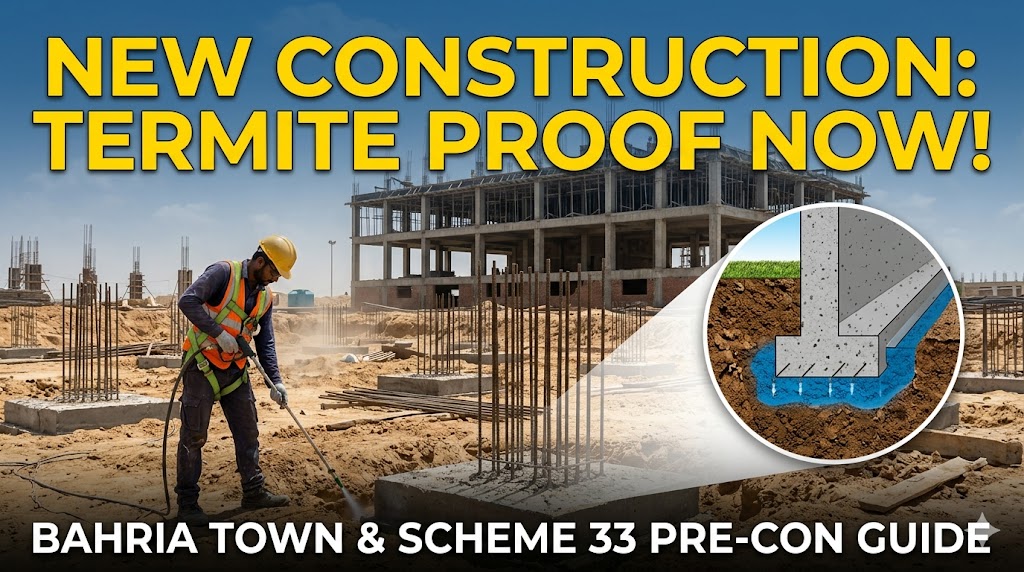
Pre-construction termite proofing is a soil treatment applied during building, before the floor slab is poured. A licensed operator treats the excavation, the fill beneath the slab and the soil around the plinth with a liquid termiticide. This creates a continuous chemical barrier between the ground and the structure. It is the most effective and lowest-cost termite protection a building will ever get, and it can only be done at specific stages of construction.
In Bahria Town Karachi and Scheme 33, where thousands of homes are going up on newly cleared land, it is also the step most often skipped. Buyers focus on materials, contractors and finishing, and termite proofing rarely comes up until after handover, when the best window has already closed.
Why Do New Builds in Bahria Town and Scheme 33 Need Termite Proofing?
Both zones are being built on land that was open scrub, farmland or old goth settlements until recently. Clearing that land leaves roots, stumps and buried plant debris in the soil, which feed subterranean termite colonies already living in the ground. When foundations go in, those colonies simply forage into the new structure.
Construction itself adds to the risk in three ways:
- Buried timber: wooden shuttering offcuts, pegs and formwork scraps often end up in plinth fill and act as ready food right under the slab.
- Constant moisture: weeks of daily curing water on slabs and walls, followed by irrigated lawns and landscaping, keep the soil moist.
- Vulnerable interiors: MDF, particle board and laminated panels are standard in new kitchens and wardrobes. Termites eat them readily, and damp makes them swell and fail quickly.
Moisture-driven termite pressure is a citywide problem, as our guide to why DHA and Clifton homes get termite infestations shows. New developments add fresh soil disturbance on top of it.
At Which Construction Stages Must Treatment Happen?
Each stage has a one-time window. Once it passes, the soil it covers can never be reached directly again.
| Stage | When | What Gets Treated |
|---|---|---|
| 1. Foundation excavation | Before any fill or concrete is placed | Bottom and side walls of the trenches and pits (the most critical stage) |
| 2. Plinth fill | After compaction, before the damp-proof membrane or slab | The full top surface of the fill beneath the floor |
| 3. External perimeter | Before backfilling around plinth walls | Soil along the outside of the plinth |
| 4. Service penetrations | Before pipes and conduits are sealed into the slab | Soil around every plumbing and electrical entry point |
Clear all wooden formwork scraps and debris from the fill before Stage 2. Treating soil that still has timber buried in it undermines the barrier. Ask your contractor to build these stages into the schedule, because the pest control team needs a short notice period before each pour.
Pre-Construction vs Post-Construction Treatment
If the slab is already poured, the only option left is post-construction soil injection. It works, but it is a compromise:
| Factor | Pre-Construction | Post-Construction |
|---|---|---|
| Coverage under the slab | Complete and continuous | Only along drilled lines; harder under the middle of large slabs |
| Disruption | None; done during building | Drilling through tiles and concrete, then patching the holes |
| Cost | Lower for the same area | Higher, with the added cost of tile and finish repairs |
| Best timing | Stages 1–4 above | Before internal finishing, if the pre-construction window was missed |
Skipping protection entirely is the most expensive route. Damage to built-in woodwork, door frames and skirting costs far more to repair than the treatment would have. Repairs also do nothing to remove the colony. For a new home, that affects both its structure and its resale value.
Which Chemicals Are Used, and How Long Do They Last?
Licensed operators use registered soil termiticides based on actives such as bifenthrin, imidacloprid or fipronil. These are applied at the label concentration and volume per square metre of treated soil.
A correctly applied barrier protects the building for several years. How long exactly depends on the product, the soil and drainage conditions, and whether later digging disturbs the treated layer. Our guide to how long a fumigation treatment lasts compares treatment lifespans. Any extension, underground plumbing or boundary work after handover breaks the barrier, so follow the steps in our guide to post-renovation pest prevention.
This is not DIY work. Retail sprays cannot form a soil barrier. Under-dosing leaves gaps, and over-application risks contaminating soil and groundwater, so the job needs professional equipment and a licensed operator.
How Do You Verify Termite Proofing Was Done Correctly?
Once the building is finished, the treatment is invisible. Whether you are building on your own plot or buying a completed house, ask for:
- A written report listing the product, concentration, volume per square metre and the areas treated at each stage
- Dated photographs of each stage
- A certificate and warranty issued by the pest control company, not the general contractor
Check the operator’s credentials against our pest control license page. Our guide to pest control warranties and guarantees explains what the warranty should cover.
If there are no records, assume the house is unprotected. Book a pre-handover pest inspection before you take possession, so any existing activity is found while the builder is still responsible.
Frequently Asked Questions
My house is already above slab level. Is it too late?
Too late for full pre-construction treatment, but not for protection. External perimeter treatment can still be done if backfilling is not complete. Post-construction injection should follow before tiling and finishing, when drilling is cheapest and least disruptive.
Do flats in high-rise apartment towers need termite proofing?
The foundation treatment is the developer’s job, but it protects every unit. Termites can travel up through service ducts and shafts to reach upper-floor woodwork. Buyers should ask the developer for the building’s treatment records.
How will I know if termites get in later?
Watch for mud tubes at wall bases, hollow-sounding skirting or door frames, and winged swarmers after the monsoon rains. Our guides to identifying termite damage in Karachi homes and termite season in Karachi cover what to look for and when.
How much does pre-construction termite proofing cost?
Cost depends on the covered area and the number of stages treated. For the same area, it is cheaper than post-construction treatment. See our breakdown of termite treatment cost in Karachi, or our charges page.
Book Before Your Foundation Is Poured
If you are building in Scheme 33 or any part of Bahria Town Karachi, arrange termite proofing before your first pour. Accurate Fumigation provides stage-by-stage termite proofing in Karachi, scheduled around your contractor’s timeline, with written documentation at every stage. Contact us to arrange a site visit.

Rehan Khan is the founder of Accurate Fumigation and an entomologist. He holds an M.Sc. in Entomology and a B.Sc. in Environmental Science, and has worked in pest control in Karachi for three decades. He founded the company in 2005 and writes about the pest and water problems the city deals with each season. Accurate Fumigation is ISO 9001:2015 certified and a member of the National Pest Management Association.
Questions about a service, or need a certificate for an inspection? Call the office on 0330-2533480. Read Rehan’s full profile.