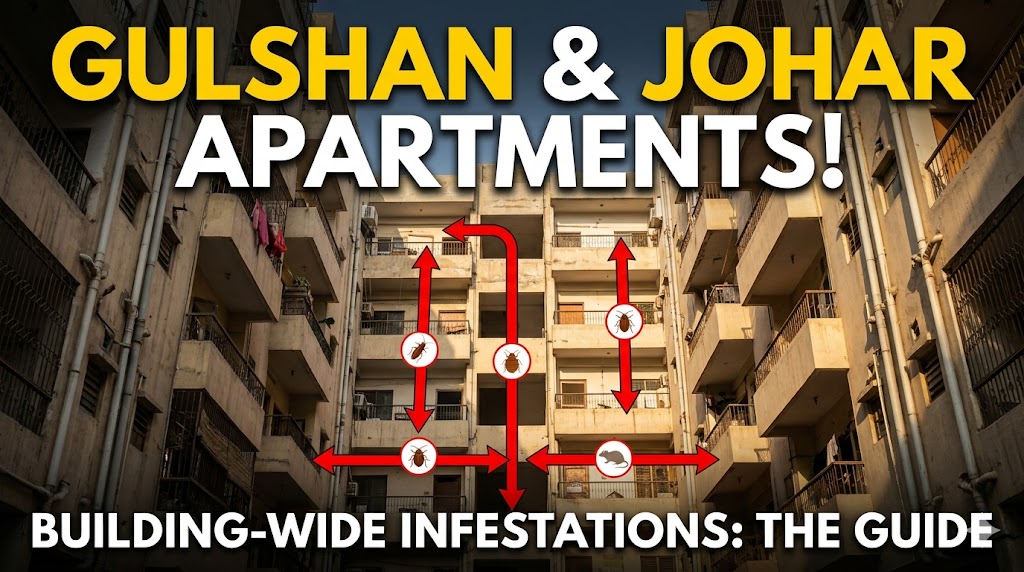
Pest problems in Gulshan-e-Iqbal and Gulistan-e-Johar apartment buildings rarely stay in one flat. Cockroaches, bed bugs, and rats move between units through shared plumbing stacks, wall cavities, and gaps around pipe penetrations — which is why treating a single flat often fails within weeks, even when the treatment itself was done correctly. The lasting fix is building-wide pest control, coordinated across all units and common areas at the same time, not repeat call-outs to one flat.
If you live in a mid-rise apartment in Gulshan-e-Iqbal or Gulistan-e-Johar, here’s why pests spread building-wide, which ones to watch for, and what residents and building management can actually do about it.
Why Apartment Buildings in Gulshan-e-Iqbal and Gulistan-e-Johar Are Particularly Vulnerable
Both neighbourhoods are dense with mid-rise apartment blocks — typically four to twelve floors — many of them decades old, with plumbing and utility sealing that predates modern pest-proofing standards. A large share of these buildings share vertical plumbing stacks between kitchen and bathroom units, have incomplete sealing around pipe penetrations in walls and slabs, and have ground-floor garages, stores, or generator rooms that get far less maintenance attention than the residential floors above them.
Shared infrastructure is the main transmission route. A single cockroach or rodent population living in a ground-floor utility room can spread through a building’s plumbing stack within months, with individuals turning up in different flats at different times. To residents, this looks like several separate infestations — when it’s actually one population working its way up the building. Building density also makes coordination hard: when even two or three flats on a floor opt out of a scheduled treatment, that gap is enough to let pests persist and re-infest the units that were treated.
Common Apartment Pests in Gulshan and Johar — At a Glance
| Pest | Main way it spreads between flats | Recommended treatment |
|---|---|---|
| German cockroaches | Plumbing gaps, drain risers, hollow wall sections | Gel baiting inside harbourage sites |
| Bed bugs | Wall sockets, gaps around plumbing, tenant belongings | Heat or high-concentration treatment, all affected units together |
| Rats and mice | Wall cavities, pipe sleeves, drainage and vent gaps | Building-wide baiting plus sealing entry points |
| Ants | Wall and floor voids, ground-floor utility rooms | Gel baiting, not surface spraying |
Cockroaches: The Most Common Building-Wide Pest
German cockroaches are the dominant pest problem in Gulshan-e-Iqbal and Gulistan-e-Johar apartment buildings — see our guide to cockroach species in Karachi for how to tell them apart from other species. Unlike American cockroaches, which enter from outdoor drains, German cockroaches live and breed entirely indoors: inside kitchen appliances, behind wall tiles, and in electrical panel voids. Activity typically spikes each year — our piece on why cockroaches take over Karachi apartments in summer covers why the warmer months make this worse.
Professional cockroach control using gel baiting is the most effective approach, because the gel goes inside harbourage sites rather than on open surfaces where it’s less likely to be eaten. When cockroach treatments in one flat are repeatedly unsuccessful, the reason is almost always re-entry from adjacent units, not a failed treatment. Effective cockroach control in apartment buildings requires treating all units on at least one floor simultaneously, along with the building’s common areas — see our cockroach control service for how we scope a building-wide programme, and our breakdown of cockroach control cost in Karachi for how pricing usually works.
Bed Bugs: The Tenant Turnover Problem
Apartment buildings with regular tenant turnover — common for rented flats in both areas — are at higher risk for recurring bed bug infestations. Bed bugs travel in luggage and second-hand furniture, so when a flat is vacated and a new tenant moves in, they often bring bed bugs unknowingly, or inherit them from the previous occupant. Our guide to bed bug identification and behaviour covers what to look for early.
Bed bugs also spread between adjoining flats through wall sockets, gaps around plumbing, and under door frames. A serious infestation in one unit typically shows secondary activity in the flats on either side, and above or below, within weeks. Both heat treatment and high-concentration insecticide treatment can break the cycle when applied to all affected units at once — our comparison of bed bug treatment: heat vs chemical explains which suits which situation. This pattern isn’t unique to these two areas either; we’ve seen the same spread mechanics in Bahadurabad apartment buildings. Book a building-level assessment through our bed bug fumigation service.
Rodents in Ground-Floor Units and Common Areas
Ground-floor apartments and units next to parking areas or basements face regular rodent pressure. Rats enter through drainage, gaps around service pipes, and broken ventilation grilles, then move vertically through wall cavities and between floors using pipe sleeves — our guide to rat-proofing your home covers the entry points worth sealing first.
Bin areas and garbage chutes are primary attractants and harbourage sites. Buildings where waste management is inconsistent — bags left unsealed, chutes not cleaned regularly — will have persistent rodent problems no matter how thoroughly individual flats are treated. Our rodent control service covers both flat-level baiting and building perimeter work.
Ants: A Seasonal but Spreading Problem
Ant infestations peak during summer and just after monsoon. Ant control in apartments needs baiting rather than spraying — spray kills forager ants on contact but doesn’t reach the colony, which may be in a wall void, floor cavity, or soil accessed through a ground-floor utility room. Gel bait lets foragers carry the toxicant back to the colony, which is far more effective. Black garden ants and fire ants are the most common species in these areas; fire ant encounters are rare but painful and can trigger allergic reactions, which is worth flagging in buildings with children. Our ant control service covers building-wide baiting programmes.
Signs Your Pest Problem Is Building-Wide, Not Flat-Specific
- Multiple neighbours on the same floor or plumbing stack report the same pest around the same time
- Pests reappear within weeks of a flat-level treatment
- Pest sightings turn up in stairwells, lifts, parking levels, or rooftop water tank rooms
- Cockroach or rodent activity is seen in the building’s electrical or generator room
- Activity is concentrated around shared plumbing walls between adjacent units
DIY Prevention Steps for Apartment Residents
- Seal gaps around all pipes entering the kitchen and bathroom with waterproof sealant
- Use drain covers and clean floor trap grilles regularly
- Avoid storing cardboard boxes for extended periods — they harbour cockroaches and bed bugs
- Inspect second-hand furniture and luggage arriving from travel before bringing it inside
- Store food in sealed containers, not open bags or uncovered dishes
- Report pest sightings to building management — individual action without building coordination rarely works
If your building has overhead or underground water tanks, keep them on a regular cleaning schedule too. Unmaintained tanks attract pests and can become breeding sites for mosquitoes and other insects — see our water tank cleaning service for how this pairs with a building’s pest programme.
The Solution: Building Management Has to Lead
For apartment buildings in Gulshan-e-Iqbal and Gulistan-e-Johar, the most cost-effective and lasting solution is a building-wide pest management programme coordinated by the owner or management committee — treating all units, common areas, drainage infrastructure, and the building periphery at the same time, then maintaining it on a set schedule.
Accurate Fumigation works with building management in Gulshan-e-Iqbal and Gulistan-e-Johar to design building-wide pest control programmes that address the actual source of infestations, rather than managing symptoms flat by flat.
Frequently Asked Questions
Why do cockroaches keep coming back after I treat my own flat?
Almost always because they’re re-entering from a neighbouring flat through shared plumbing, drain risers, or wall cavities — not because the treatment in your unit failed. A flat-level treatment can only ever be a temporary fix if the source population elsewhere in the building is still active.
Can bed bugs really spread from a neighbour’s flat into mine?
Yes. Bed bugs move through wall sockets, gaps around shared plumbing, and under door frames, and a heavy infestation in one flat commonly shows up in the units beside, above, or below it within a few weeks.
Who should organise building-wide pest control — the owner or the residents?
Building management or the owners’ committee is best placed to arrange it, since it needs access to common areas, drainage infrastructure, and every flat at the same time. Individual residents can flag the problem and push for it, but coordination works best when it’s led centrally.
Is building-wide fumigation safe for children and pets?
Reputable treatments are designed to be safe once applied correctly and given time to dry or settle, but the right precautions depend on the product and method used. See our guide on whether pest control is safe for children and pets for what to ask before a building-wide treatment.
What does building-wide apartment pest control cost?
Cost depends on the number of units, the pest involved, and how severe the infestation already is, since a badly affected building needs more visits than a preventive programme. See our charges page for how we structure pricing, or contact us for a building-specific quote.
How can I tell if my building has a rodent problem, not just my flat?
Look for droppings or gnaw marks in stairwells, parking levels, bin areas, or the electrical and generator rooms — not just inside units. Rodents move through shared wall cavities and pipe sleeves, so activity in common areas is usually a sign the problem extends beyond one flat.
Whether you’re a building owner setting up a maintenance contract or a resident who’s tried flat-level treatments without success, contact us to discuss the right building-wide approach.

Rehan Khan is the founder of Accurate Fumigation and an entomologist. He holds an M.Sc. in Entomology and a B.Sc. in Environmental Science, and has worked in pest control in Karachi for three decades. He founded the company in 2005 and writes about the pest and water problems the city deals with each season. Accurate Fumigation is ISO 9001:2015 certified and a member of the National Pest Management Association.
Questions about a service, or need a certificate for an inspection? Call the office on 0330-2533480. Read Rehan’s full profile.