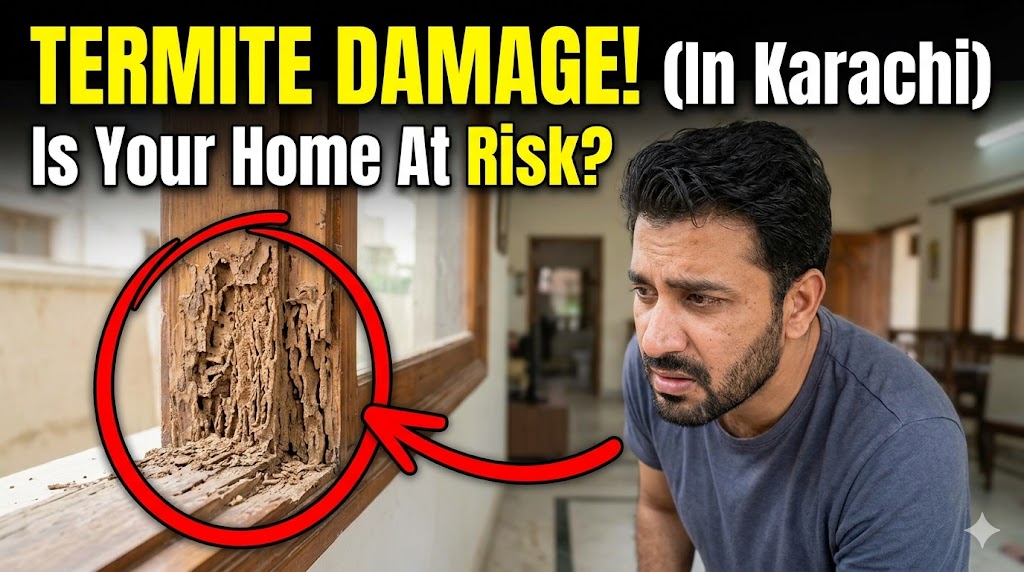
The clearest signs of termite damage in a Karachi home are mud tubes running up a wall or foundation, wood that sounds hollow when you tap it, and paint that blisters or bubbles with no leak anywhere nearby. Termites work underground, inside wall cavities, and behind plaster, so by the time you notice a sagging ceiling or a crumbling door frame, the colony has usually been active for months already. This guide covers exactly what to look for, where to check first in a typical Karachi home, and how to tell whether a sign means “keep an eye on it” or “call someone today.”
What Are the Warning Signs of Termite Damage?
Unlike cockroaches or rats, termites rarely announce themselves — they eat wood and cellulose from the inside out. Here are the visual signs that termites may already be active in your home:
- Mud tubes on walls or foundations: Pencil-thin tunnels of soil and saliva, roughly 6–10mm wide, are the most reliable sign of subterranean termites. Check exterior walls, behind furniture pushed against walls, along skirting boards, and near plumbing entry points.
- Hollow-sounding wood: Knock on door frames, window surrounds, skirting boards, or wooden furniture. A papery, hollow sound instead of a solid thud means termites have likely eaten through the interior.
- Blistered or bubbling paint: Paint that bubbles on wooden surfaces with no water leak nearby often means termites are feeding just beneath the surface, leaving a thin shell intact.
- Frass (droppings): Drywood termites push tiny pellets that look like sawdust or sand out of small holes in wood, often piling up near infested furniture or frames.
- Discarded wings near windows and lights: Termite swarmers shed their wings after finding a new nesting site. Small piles of translucent wings near sills or light fixtures, especially after the first monsoon rains, are a warning sign.
- Sagging ceilings or floors: Severe infestations weaken structural wood, leaving floors that feel soft underfoot or ceilings that bow slightly.
- Doors and windows that suddenly stick: Termite damage lets moisture into wooden frames, causing warping that can feel like humidity-related stiffness but isn’t.
Why Are Karachi Homes So Vulnerable to Termites?
Karachi’s geography and building stock combine to create near-perfect termite conditions. Much of the city sits on sandy, moisture-retentive soil, and ground-floor units, bungalows, and older housing stock with wooden beams, timber door frames, and plywood paneling give termites abundant food. Many buildings were constructed decades ago with no termite-proofing treatment in the soil or foundation at all.
Monsoon season, roughly July through September, is the most dangerous window. Heavy rain drives subterranean termites upward and outward from their underground colonies and into walls, foundations, and any timber they can reach — our Karachi monsoon pest guide covers what else becomes active in this window. Termite activity doesn’t stop once the rain does, either; our guide to termite season in Karachi breaks down when colonies are actually most active year-round.
Post-Eid construction activity — renovating or adding rooms after Eid-ul-Adha — also disturbs soil and exposes raw, untreated wood, giving termites easy entry into newly built structures. If you’ve renovated recently without pre-construction soil treatment, see our post-renovation pest prevention guide.
Where to Check First in a Karachi Home
Older neighbourhoods with aging timber and ground-floor units — think Nazimabad, Liaquatabad, or North Nazimabad — carry particular risk. Wherever you live, prioritize these spots during a visual inspection:
- Foundation walls and the point where walls meet the floor, especially in ground-floor units and bungalows
- Kitchen and bathroom walls where pipes enter — plumbing moisture creates ideal conditions
- Wooden door and window frames, particularly older timber
- The underside of wooden staircase treads and risers
- Behind almirahs, bookshelves, and furniture placed directly against walls
- Roof beams and attic or loft areas in bungalows with wooden roof structures
- Godown or storage room floors where cardboard and paper products are stored
How to Confirm an Active Infestation Before You Call
If you spot a mud tube, break a short section open. Moist tubes with pale, soft-bodied termites inside mean the infestation is active. A dry, empty tube means the colony has rerouted elsewhere — not that the risk is gone.
If you find hollow wood, press a screwdriver gently into the surface. If it sinks in with little resistance, the wood is extensively damaged and needs professional assessment right away.
DIY Prevention You Can Start Today
Professional treatment is the only reliable way to eliminate an established colony, but these steps reduce your risk and slow down any activity already underway:
- Fix water leaks immediately — dripping pipes, roof leaks, and blocked drainage all create the moisture termites need
- Ventilate storage rooms, under-staircase spaces, and bathrooms to keep humidity down
- Don’t store firewood, timber offcuts, cardboard, or old newspapers against walls or directly on the floor inside the house
- Seal cracks in your foundation, skirting boards, and around pipe entry points
- Keep soil and mulch at least 15–20cm clear of exterior wall bases
- Inspect second-hand wooden furniture thoroughly before bringing it inside
- After monsoon, ventilate aggressively and let walls and floors dry fully before pushing furniture back against them
Why DIY Termite Treatment Doesn’t Work
Surface sprays, kerosene, and over-the-counter termiticides from hardware stores kill visible termites but never reach the colony, which can sit several feet underground or deep inside a wall cavity. A Karachi subterranean colony can hold hundreds of thousands of workers — kill the surface-level ones and the rest simply reroute their mud tubes and keep feeding elsewhere while you lose time. Our DIY vs. professional fumigation comparison breaks this down pest by pest.
| Aspect | DIY Spray / Kerosene | Professional Treatment |
|---|---|---|
| Reaches the colony | No — kills surface termites only | Yes — soil + wood treatment targets the source |
| Method | Hand spraying visible tubes or wood | Drilling and injecting termiticide into soil and timber |
| Typical result | Colony reroutes and keeps feeding elsewhere | Colony dies off as termites carry treatment back to it |
| Best for | Nothing beyond a stop-gap on a single spotted termite | Any confirmed mud tube, hollow wood, or active swarm |
Our termite control service in Karachi uses approved termiticides and systematic soil and wood treatment to eliminate colonies at the source, not just the surface.
What to Expect From Professional Termite Treatment
A proper termite treatment starts with an inspection to identify affected areas and colony entry points, followed by drilling and injecting termiticide into soil at the foundation and into affected wood. In severe cases, structural wood may need replacing after treatment. It isn’t a one-day job with a hand sprayer — it needs proper equipment, chemicals registered for termite use, and a plan based on your building’s layout and how far the infestation has spread. Pricing depends on property size and infestation severity, so see our termite treatment cost guide for how that’s worked out, or our charges page for upfront pricing.
You can review our pest control license and learn more about us before booking. We serve homeowners and businesses across Karachi, including DHA, Clifton, Gulshan-e-Iqbal, and beyond.
Frequently Asked Questions
What is usually the first visible sign of termites?
Mud tubes are typically the first thing homeowners notice — thin brown tunnels running up an exterior wall or foundation. By the time paint is blistering or wood sounds hollow, the infestation is already more advanced.
How do I know if wood damage is termites and not just moisture?
Moisture damage tends to swell or soften wood evenly and often comes with a musty smell. Termite damage sounds hollow when tapped and, once opened, shows tunnelling along the wood grain rather than uniform softness.
Are termites worse in Karachi during monsoon?
Yes. Monsoon rain, roughly July to September, pushes subterranean termites up out of the soil and into walls and foundations, and the lingering humidity afterward keeps conditions favourable for new colonies to establish.
Can I get rid of termites myself with spray or kerosene?
Not reliably. These kill the termites you can see but don’t reach the colony underground or inside the wall, so the infestation continues elsewhere while the visible symptoms briefly disappear.
Is a dry, empty mud tube still a problem?
It means that particular tube is no longer in use, but the colony itself is likely still active nearby. Treat it as a sign to inspect the surrounding area rather than an all-clear.
How much does termite treatment cost in Karachi?
Cost depends on property size, how far the infestation has spread, and whether wood replacement is needed. Our termite treatment cost guide walks through what drives the price up or down.
Book a Termite Inspection Today
Termite damage compounds quickly — the longer you wait, the more structural repair cost stacks on top of treatment cost. If you’ve spotted any of the signs above, or your home is older construction that’s never been treated, don’t delay. Contact Accurate Fumigation to schedule a professional inspection.

Rehan Khan is the founder of Accurate Fumigation and an entomologist. He holds an M.Sc. in Entomology and a B.Sc. in Environmental Science, and has worked in pest control in Karachi for three decades. He founded the company in 2005 and writes about the pest and water problems the city deals with each season. Accurate Fumigation is ISO 9001:2015 certified and a member of the National Pest Management Association.
Questions about a service, or need a certificate for an inspection? Call the office on 0330-2533480. Read Rehan’s full profile.