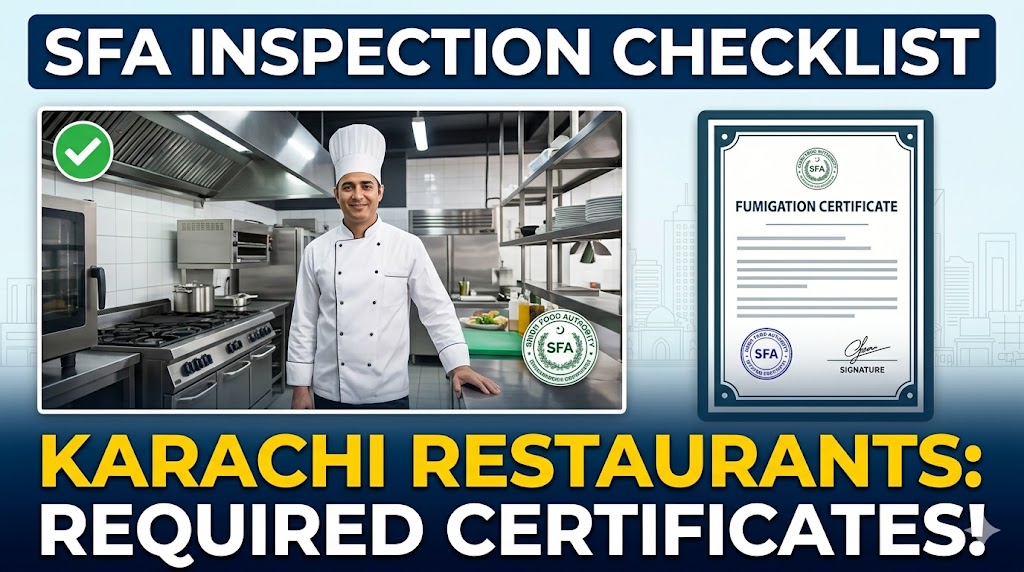
Yes — a Karachi restaurant should hold a current fumigation certificate and treatment records before an SFA inspection, not after. The Sindh Food Authority inspects food premises for hygiene under the Sindh Food Authority Act, 2016, and visible pest evidence combined with patchy pest control paperwork is one of the quickest ways for a kitchen to collect an improvement notice.
Most Karachi restaurant owners only think about fumigation once cockroaches show up or an inspector is at the door. This guide covers what inspectors look at, which documents to keep on site, how often a food premises should be treated, and what happens when a kitchen fails.
What SFA Inspectors Look for When Checking Pest Control
SFA inspections cover the whole premises, and pest control sits within hygiene and sanitation. We haven’t seen a fixed fumigation interval written into SFA’s rules that we can point you to, so we won’t quote one. What matters in practice is what the inspector can see in your kitchen and what you can show to prove it is actively managed.
| Area | What inspectors look for | Common trouble spots |
|---|---|---|
| Kitchen and food preparation | Live or dead cockroaches, droppings, smear marks, egg casings | Floor drains, under cooking ranges, inside electrical panels |
| Storage and dry goods | Rodent droppings, gnaw marks on packaging, entry points | Wall penetrations, gaps around pipes, cartons stored on the floor |
| Waste disposal area | Fly breeding, uncovered bins, pooled drainage water | Shared bin areas, back lanes, blocked drains |
One certificate from two years ago shows a single job, not a running programme. Keep dated, recent records that show treatment is ongoing, and brief your kitchen and front-of-house staff on what the programme is and who to call. For the daily housekeeping that keeps a kitchen inspection-ready between visits, see our guide to kitchen pest prevention.
Running a hotel kitchen, hospital canteen or banquet hall? Audit expectations differ for larger operations — see how Karachi hotels and hospitals pass pest control audits and pest control for wedding halls and banquets.
Which Pest Control Documents Should a Restaurant Keep On Site?
Keep a physical pest control folder in the premises — not just in WhatsApp or email — so you can hand it over in under a minute:
- Current fumigation certificate (original or certified copy)
- Chemical safety data sheets for every product used
- Treatment log showing dates, areas treated, chemicals used and technician name
- Service agreement or written schedule proving ongoing pest management
- Proof of the pest control company’s licence or registration
Organised records tell an inspector the kitchen is managed rather than scrambling to produce paperwork mid-visit. If you need to confirm a provider’s credentials, see our pest control license page.
Why Karachi Restaurants Face Higher Pest Pressure
Karachi’s heat and humidity keep cockroaches, rodents and flies active nearly all year. From April to September, cockroaches move into kitchens through drainage lines, wall gaps and utility ducting. The monsoon, roughly July to September, adds moisture under counters, inside floor drains and behind cooking equipment, where populations build fast. For treatment aimed at food premises, see our cockroach control service in Karachi.
Older commercial buildings around Saddar, Burns Road and Bahadurabad were built without pest exclusion in mind: cracked tiles, exposed pipework and drainage shared with neighbouring units. Our guide to pest control challenges in old Karachi buildings explains why these are hard to keep clear. Newer plazas on Shahra-e-Faisal are not immune — a restaurant sharing a basement or utility corridor with other tenants can see cockroaches within weeks.
Storage rooms are the other weak point: rodents enter through wall penetrations and pipe gaps, which is where our rodent control service usually starts.
How Often Should a Karachi Restaurant Fumigate?
We can’t cite an SFA-mandated interval, so this is the schedule we recommend for food premises in Karachi:
| Premises | Recommended service |
|---|---|
| Standard restaurant or café | General pest control every month or two, plus a full fumigation at least every six months |
| High-volume kitchen running double shifts | Monthly service contract |
| Kitchen near an open drain, nullah or shared utility area | More frequent visits, regardless of season |
| Peak pest periods (April–September for cockroaches; monsoon for rodents and flies) | Increase the visit frequency |
Restaurants in DHA Karachi and Clifton tend to have better construction, but the same paperwork expectations apply. If you’re weighing a recurring plan against a single visit, read fumigation contract vs one-time treatment; for rhythms across homes and businesses, see how often to get fumigation done in Karachi.
How to Choose a Pest Control Company That Provides Proper Documentation
Not every fumigation service issues paperwork you can comfortably hand to an inspector. Before signing, confirm that the company:
- Can show its licence or registration — see how registered and unregistered pest control companies in Karachi differ
- Issues a certificate on company letterhead with chemical details, treated areas, date and technician signature
- Uses products suitable for food premises and supplies safety data sheets for them
- Provides a written service schedule, not an informal arrangement
You can review our credentials on our about page and verify licensing on our pest control license page.
What Happens If a Restaurant Fails an SFA Inspection?
SFA does not normally seal a kitchen on the first visit. Its operations director has described the sequence as an improvement notice first, then a warning and penalty if problems are not fixed, with sealing as the last step, lasting until requirements are met. It does seal, though: Sindh’s food minister reported 370 outlets sealed between July 2025 and January 2026, out of 47,875 inspections and improvement notices issued across the province.
A sealed kitchen costs trading days, emergency treatment, follow-up visits and the reputational damage if it spreads on social media. A recurring service contract costs far less. What you pay depends on premises size and infestation severity — see our pest control charges, and cockroach control cost in Karachi for what drives the price.
Frequently Asked Questions
Does SFA require a fumigation certificate for restaurants in Karachi?
We haven’t seen a fixed certificate interval in SFA’s rules that we can quote. What inspectors do assess is pest evidence and whether your kitchen is managed, and a dated certificate with treatment records is the clearest proof you can show. Treat it as essential.
How recent should my fumigation certificate be?
It should fall within your current service cycle — if you’re on a monthly or bi-monthly plan, your latest visit should be on file. A single old certificate with nothing since looks like a one-off job, not an ongoing programme.
Will fumigation force my restaurant to close?
Treatments are usually scheduled outside trading hours. The technician will tell you what must be covered or cleared and how long to ventilate before reopening, which depends on the method used.
Is pest treatment safe in a kitchen with food on site?
It is when done properly: food, utensils and food-contact surfaces are covered, removed or cleaned according to the technician’s instructions, and the products used are suitable for food premises. Ask for the safety data sheets and keep them in your folder.
What if an inspector finds a cockroach even though I have a contract?
A single sighting backed by current records and quick corrective action is far easier to defend than no programme at all. Call your provider for a follow-up visit straight away and log it in your treatment records.
Book Your Restaurant Fumigation and Get Inspection-Ready Documentation
If your pest control paperwork isn’t in order, fix it now rather than after an inspection. Contact us through our booking page to schedule a treatment and receive a dated fumigation certificate with chemical details, treated areas and technician signature. We also offer ongoing service agreements for restaurants, cafés and food businesses across Karachi.

Rehan Khan is the founder of Accurate Fumigation and an entomologist. He holds an M.Sc. in Entomology and a B.Sc. in Environmental Science, and has worked in pest control in Karachi for three decades. He founded the company in 2005 and writes about the pest and water problems the city deals with each season. Accurate Fumigation is ISO 9001:2015 certified and a member of the National Pest Management Association.
Questions about a service, or need a certificate for an inspection? Call the office on 0330-2533480. Read Rehan’s full profile.