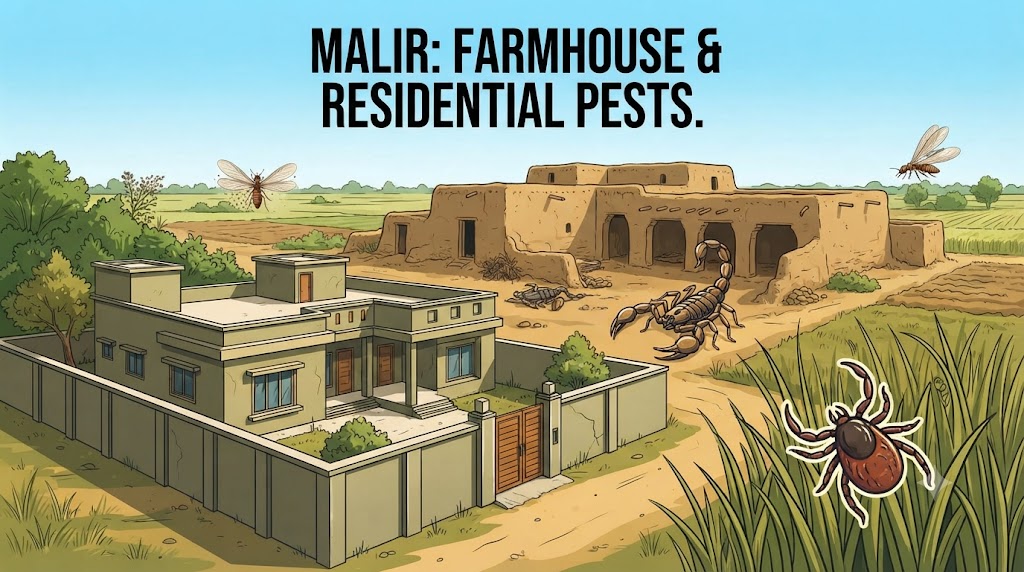
A farmhouse or open residential plot in Malir needs pest control built around animals, standing water, and open boundaries — not the sealed-apartment approach that works for a flat in Gulshan or Clifton. Fleas and ticks tied to pets or livestock, mosquitoes breeding in irrigation water, and ants and rodents moving in from surrounding open land are the concerns that actually matter here, not the drain-based cockroach and apartment-building bed bug issues that dominate closer to the city center.
Why Malir Properties Need a Different Approach
Most residential pest control in Karachi assumes a property with sealed boundary walls, municipal water and drainage, and limited outdoor space. Malir’s farmhouses and larger residential plots often have none of these in the same form — open or loosely fenced boundaries, borewell or tanker-supplied water rather than a consistent WASA connection, livestock or pets on the property, and significant open land bordering agricultural fields or vacant plots. A pest control company in Karachi treating a Malir farmhouse is working with a very different set of entry points and pest pressures than the same team would face in DHA or Clifton.
Where Each Farmhouse Pest Comes From
| Pest | Typical source on a Malir property | Where treatment should focus |
|---|---|---|
| Fleas & ticks | Pets, livestock, stray animals | Outdoor shelter/resting areas plus any indoor spaces pets access |
| Mosquitoes | Standing or irrigation water, low-lying rain pooling | Draining or covering water sources before chemical treatment |
| Ants | Adjoining open or agricultural land | Boundary and perimeter, not indoor trails alone |
| Rodents | Stored animal feed | Feed storage sealing plus perimeter baiting |
Fleas and Ticks: The Defining Pest Issue for Farmhouses
Where They Actually Come From
Fleas and ticks are overwhelmingly associated with animals — pets, livestock, or even stray animals that wander onto open farmhouse land — and they establish themselves wherever animals rest, including yards, animal shelters, and sometimes carpeted or upholstered indoor areas if pets have access to the house. A Malir property with dogs, cats, or livestock on-site has a fundamentally different flea and tick exposure than a sealed city apartment. Our guide to flea infestations in Karachi and tick identification and health risks covers how to tell the two apart and what each looks like at different life stages.
Health Considerations Worth Knowing
Ticks in particular are a recognized vector for several diseases transmissible to both animals and, less commonly, humans, which is why tick presence on a property with livestock or pets is worth treating proactively rather than only after a visible bite problem develops. This is well-established general knowledge about ticks as a pest category, not a claim about any specific local outbreak.
Treating a Farmhouse-Scale Property
Flea and tick control on a larger open property typically needs to address both the animals’ resting and shelter areas outdoors and any indoor areas pets access, since treating only the house while leaving outdoor shelter areas untreated usually means fleas or ticks re-establish from the untreated outdoor source within a short period.
Mosquitoes and Standing Water on Larger Plots
Open land, irrigation channels, uncovered water storage, and any low-lying areas that collect rainwater during monsoon season give mosquitoes far more breeding sites on a farmhouse plot than they’d find in a sealed city property. Mosquitoes are a well-established vector for dengue in Pakistan, and properties with any form of standing water — irrigation-related or otherwise — carry a higher baseline mosquito pressure than properties without it; our mosquito and dengue risk guide has more on what drives that risk city-wide. Identifying and either draining or covering standing water sources on the property is the single most effective step before any chemical treatment is considered, and this pressure typically peaks during Karachi’s monsoon months (roughly July to September) — our Karachi monsoon pest guide covers what else tends to spike alongside it.
Ants Moving in From Surrounding Land
Because Malir properties frequently border open plots, agricultural land, or undeveloped ground, ant colonies nesting in that surrounding land have an easy, uninterrupted route onto the property itself — unlike a city plot bordered by paved roads and other developed properties on all sides. Ant control on a farmhouse-scale property is generally more about managing the boundary — treating along fence lines and the perimeter where ants are entering — than about isolated indoor trails, since the source is almost always outside the property line.
Water Tanks and Borewell-Supplied Properties
Farmhouses relying on borewell water or tanker delivery rather than a consistent WASA connection tend to have larger storage tanks holding water for longer periods, which increases the chance of organic buildup and contamination if the tank isn’t cleaned on a regular schedule — and that buildup is itself an attractant for mosquitoes and other pests around the tank area. Water tank cleaning is arguably more important on a farmhouse property with its own storage than on a city property with frequent municipal supply turnover; our notes on how often a tank should be cleaned and what cleaning costs by tank size are both worth a look before booking, since a large borewell-fed tank is priced differently than a standard rooftop one.
Rodents Around Feed Storage
Properties with livestock or stored animal feed are a strong rodent draw, similar to the shop-adjacent rodent issue seen in denser parts of the city, but at a larger scale given the volume of feed typically stored on a farmhouse property. Rodent control around feed storage areas, combined with sealing gaps in storage structures, addresses this at the source rather than only treating the main house — our guide to rat-proofing a Karachi property has the specific gaps and access points worth checking first.
Frequently Asked Questions
Do farmhouse properties need a completely different treatment plan than a city house?
Generally yes — the pest pressures (fleas/ticks from animals, mosquitoes from standing water, ants and rodents entering from open surrounding land) are different from what a sealed city property typically faces, so an inspection tailored to an open, larger property gives a more accurate treatment plan.
Can I treat fleas and ticks myself if I have pets or livestock?
Over-the-counter treatments can reduce visible activity temporarily, but without addressing outdoor shelter and resting areas alongside any indoor exposure, fleas and ticks typically re-establish from the untreated outdoor source.
How much does standing water actually matter for mosquito control?
It matters significantly — removing or covering standing water sources reduces mosquito breeding sites directly, and is generally more effective as a first step than relying only on chemical treatment without addressing the water sources themselves.
Is ant treatment different for a farmhouse compared to a normal house?
Yes — because ants on a farmhouse-scale property are usually entering from adjoining open land rather than nesting purely within the property, treatment tends to focus more on the boundary and perimeter than on indoor trails alone.
How often should a farmhouse’s water tank be cleaned if it’s not on WASA supply?
There’s no single fixed interval that applies to every property, but tanks holding water for longer stretches without frequent turnover generally need more regular cleaning than tanks connected to a consistent municipal supply, given the greater chance of organic buildup over time.
Getting Help
If you manage a farmhouse or larger residential property in Malir and want a treatment plan built around how the property actually functions — not a generic city-apartment approach — contact us to arrange an inspection, or see our charges page for a general idea of what treatment on a larger property typically involves.

Rehan Khan is the founder of Accurate Fumigation and an entomologist. He holds an M.Sc. in Entomology and a B.Sc. in Environmental Science, and has worked in pest control in Karachi for three decades. He founded the company in 2005 and writes about the pest and water problems the city deals with each season. Accurate Fumigation is ISO 9001:2015 certified and a member of the National Pest Management Association.
Questions about a service, or need a certificate for an inspection? Call the office on 0330-2533480. Read Rehan’s full profile.