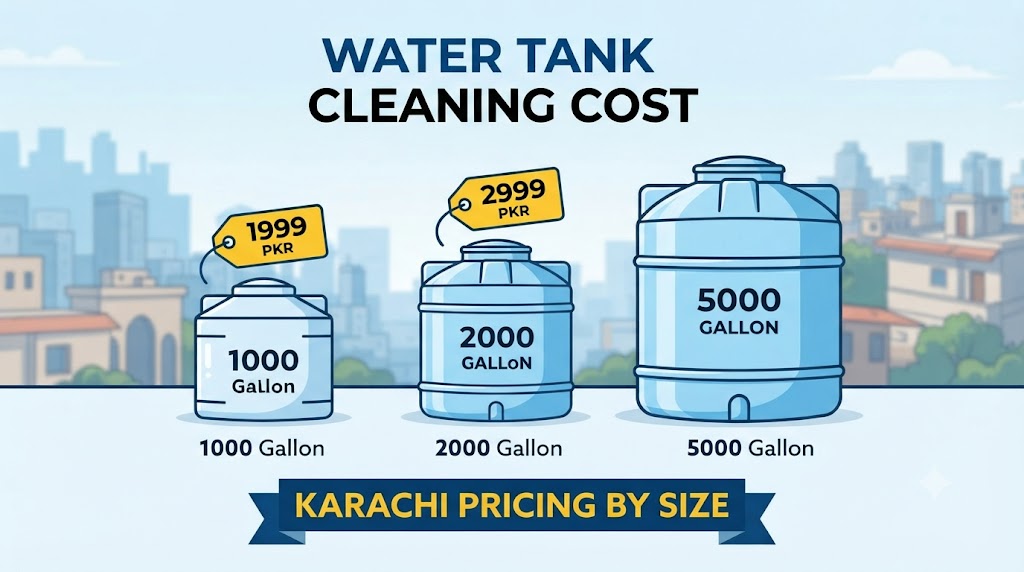
“How much will it cost?” is usually the first question after “is my tank actually dirty?” — and it’s a fair one, since prices for water tank cleaning in Karachi can look inconsistent from one company to the next if you’re just comparing numbers without knowing what’s behind them. This post breaks down what actually drives cost by tank size, so you know what a quote should reasonably cover before you accept it.
We won’t quote exact fixed figures here — pricing depends on your specific tank’s condition, material, and accessibility, and you can see our current rates on the charges page or get a quote after a quick site visit. What we can do is explain the pattern.
Why Size Isn’t the Only Factor
It’s tempting to assume cost scales purely with gallons — a 5,000 gallon tank should cost roughly five times a 1,000 gallon one. In practice it doesn’t work that cleanly, because several other variables move independently of size:
- Underground vs overhead — access difficulty affects labour time regardless of tank capacity, which we cover in detail in our comparison of underground and overhead cleaning
- Tank material — concrete tanks with rough or aged internal surfaces take longer to scrub thoroughly than smooth plastic tanks
- Condition at time of cleaning — a tank that’s gone well past its recommended interval, with heavy sediment or algae buildup, takes longer to bring back to a clean baseline than one on a consistent schedule
- Number of tanks on the property — many Karachi homes have more than one storage point, and servicing multiple tanks in a single visit is priced differently than isolated single-tank jobs
1,000 Gallon Tanks
This is a common size for smaller homes and apartments. Cleaning typically takes a shorter working window than larger tanks simply because there’s less surface area to scrub and less water volume to drain and refill. It’s usually the lower end of the pricing range for a given tank type (overhead or underground), assuming reasonably normal condition and access.
2,000 Gallon Tanks
A step up in both surface area and drain/refill time. This size is common for mid-sized houses and smaller apartment blocks. Pricing sits in the middle of the range, and this is often the size where the difference between overhead and underground access starts to matter more noticeably in the quote, since there’s more sediment volume to remove in a sump of this capacity.
5,000 Gallon Tanks
Common for larger homes, small apartment buildings, and some commercial properties. At this size, the labour time for draining, scrubbing, sediment removal, and refilling all scale up meaningfully, and underground tanks of this capacity in particular can take considerably longer to clean thoroughly than a comparable overhead tank because of the sludge volume involved. This is typically the higher end of standard residential pricing before you move into genuinely commercial or industrial tank territory.
What a Fair Quote Should Include
Regardless of size, a proper quote should account for:
- Drainage of the existing water
- Full interior scrubbing — walls and floor, not just a surface rinse
- Sediment and sludge removal, appropriate to the tank type
- Disinfection with a safe solution and proper contact time
- Rinse and refill
If a quote seems unusually low compared to others you’ve received, it’s worth asking specifically whether it includes disinfection and full sediment removal, or just a drain-and-rinse — a shortcut that leaves biofilm on the walls and doesn’t meaningfully extend the interval before you need cleaning again.
Getting Multiple Tanks Cleaned Together
If your property has both an underground and overhead tank — the standard setup for most Karachi homes — it’s worth asking about combined pricing for cleaning both in the same visit rather than booking them separately. Since water flows from the sump into the overhead tank, cleaning both together also makes more practical sense than cleaning one and immediately recontaminating it from the other.
Red Flags in a Cheap Quote
A noticeably low quote isn’t automatically a bad deal, but it’s worth checking what’s been left out before accepting one:
- No mention of disinfection — a drain-and-rinse without a disinfecting solution and proper contact time isn’t a full clean
- No sediment removal step described, particularly for underground tanks where sludge volume is usually the main job
- Vague answers about equipment, especially for underground jobs where confined-space handling genuinely matters for safety
- No inspection component — a proper cleaning visit is also the natural point to flag cracks, seal issues, or other problems, and a rushed job may skip this entirely
- Pressure to book immediately without a chance to ask questions about what’s included
None of these automatically mean a quote is dishonest, but they’re worth clarifying before you commit, regardless of tank size.
Why Getting a Site Visit Matters More Than a Phone Quote
Because condition affects price as much as size does, a number given over the phone without seeing the tank is necessarily a rough estimate. A short in-person visit lets a technician check sediment depth, tank material, access difficulty, and general condition, and gives you a number you can actually rely on — which is also the point where you’d confirm anything relevant to your building’s pest control license compliance if you’re a commercial property.
FAQs
Is a 5,000 gallon tank exactly five times the cost of a 1,000 gallon tank?
No — cost scales with size but not in a strict linear way, since fixed costs like the disinfection step and initial setup don’t multiply the same way sediment removal or scrubbing time does.
Does an old tank cost more to clean than a newer one of the same size?
Often yes, particularly if it’s overdue for cleaning — heavier sediment, more established biofilm, and in some cases minor structural issues that need addressing all add time.
Should I get more than one quote before booking?
It’s a reasonable approach, but make sure you’re comparing quotes that include the same scope of work — draining, full scrubbing, sediment removal, and disinfection — rather than comparing a full service against a quick rinse.
Do commercial properties pay a different rate than residential?
Commercial and industrial tanks are often larger and may have compliance requirements around documentation or frequency, which can factor into pricing beyond just tank size.
Is it cheaper to clean the tank myself?
DIY cleaning avoids a service fee but typically misses biofilm removal, proper disinfection contact time, and — for underground tanks especially — carries real safety risks around confined-space entry that professional equipment is designed to manage.
Get an Accurate Quote for Your Tank
Numbers vary enough by condition and access that the most useful next step is a quick assessment rather than guessing from a size alone. Check our charges page for current rates, or contact us to arrange a site visit and get a firm quote for your specific tank.

Rehan Khan is the founder of Accurate Fumigation and an entomologist. He holds an M.Sc. in Entomology and a B.Sc. in Environmental Science, and has worked in pest control in Karachi for three decades. He founded the company in 2005 and writes about the pest and water problems the city deals with each season. Accurate Fumigation is ISO 9001:2015 certified and a member of the National Pest Management Association.
Questions about a service, or need a certificate for an inspection? Call the office on 0330-2533480. Read Rehan’s full profile.