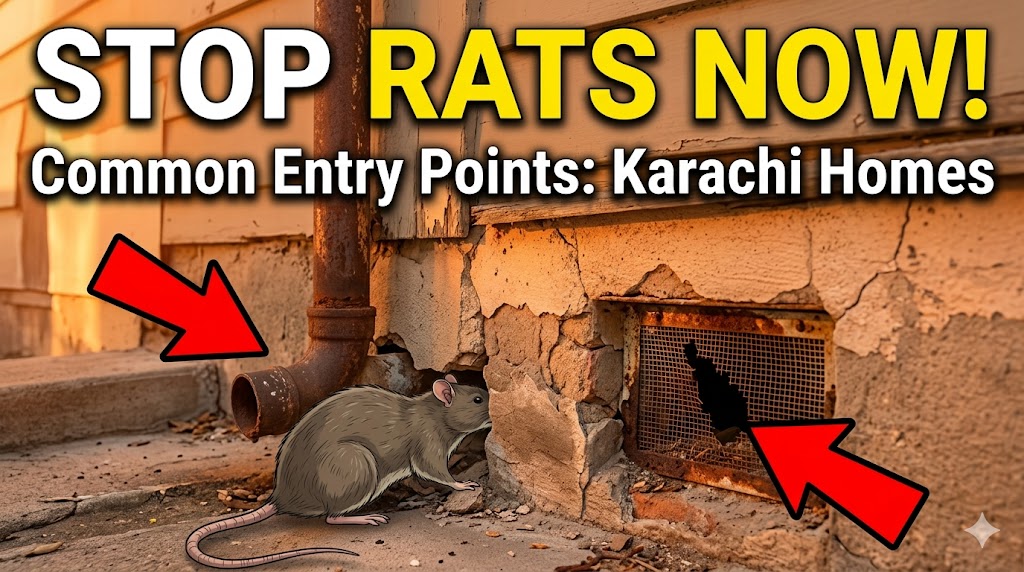
Rats get into Karachi homes through gaps around pipes, uncovered floor drains, worn door bottoms, rooftop routes such as trees and cables, and cracked walls. An opening of about 2cm is all an adult rat needs. Rats do not enter because a home is dirty; they enter because it offers food, water, and shelter, and older Karachi housing offers plenty of ways in.
This guide covers the six entry points pest controllers find most often in older Karachi homes, how to seal each one properly, and when sealing alone is not enough.
Which Rats Get Into Karachi Homes?
Two species cause most rat problems in Karachi homes. They use different routes, so the right fix depends on which one you have.
| Feature | Norway rat (Rattus norvegicus) | Roof rat (Rattus rattus) |
|---|---|---|
| Build and habits | Large, heavy-bodied burrower | Slimmer, agile climber |
| Usual way in | Ground-level gaps, foundation cracks, floor drains | Trees, pipes, cables, rooftop gaps |
| Where you notice it | Ground floor, godowns, burrows in the compound | Ceiling voids, roof, upper floors, near water tanks |
| Droppings | About 1.5–2cm, blunt-ended | About 1cm or less, pointed and slightly curved |
| Smallest gap it can use | About 2cm | Slightly smaller, around 1.5cm |
Why Is Older Karachi Construction So Vulnerable to Rats?
Older Karachi homes were rarely built with pest exclusion in mind, and decades of wear open up the gaps rats need. Foundations settle and crack, render falls away from exterior walls, wooden doors and frames shrink or rot, and the plaster around kitchen and bathroom pipes crumbles. Many also have features rats love: raised ground floors with accessible voids beneath, flat roofs reachable from neighboring buildings, shared boundary walls with gaps, and exposed pipework running up outer walls.
Ground-floor apartments and shops in Nazimabad, Liaquatabad, and Saddar are hit hardest. For the oldest parts of the city, see our guides to pest control challenges in old Karachi buildings and the rodent risks in Garden and the Old City.
The monsoon (roughly July to September) makes everything worse. Heavy rain floods drains and burrows and forces rats to relocate, so indoor sightings spike during and just after the rains, especially in ground-floor units and godowns. Our Karachi monsoon pest guide covers what else to expect. Seal gaps before the rains arrive, not after.
Where Do Rats Get Into Karachi Homes? 6 Common Entry Points
1. Gaps Around Pipes and Utility Entry Points
This is the most common entry point in Karachi homes. Water supply, drainage, and gas pipes and electrical conduits all pass through walls and floors, and in older buildings the mortar or plaster around them has often cracked away, leaving gaps of 2–5cm.
Check under the kitchen sink, behind the stove, and in bathrooms and utility rooms. Pack coarse steel wool or copper mesh tightly into each gap, then cover it with cement or mortar to hold it in place. The cover matters: steel wool alone rusts away in damp spots like under sinks, while rats will not chew through metal wool or hard cement.
2. Damaged or Poorly Fitted Drain Covers
Floor drains, wash-area drains, and sink drains link your home to Karachi’s sewer and stormwater network. Rats are strong swimmers and use these routes readily, especially where a cover is missing, cracked, or loose. After monsoon flooding, sewer rats displaced from underground systems often surface through floor drains in ground-floor apartments.
Use drain covers with mesh holes no larger than 6mm, and replace broken or missing covers immediately.
3. Gaps Under Doors
Old wooden doors that have shrunk or warped often leave a gap at the bottom wide enough for a rat. In older bungalows the side entrance, back door, and storeroom door are the ones most often neglected.
Fit door sweeps along the bottom of every external door. For doors opening onto gardens or ground-level areas, choose metal: it resists gnawing and outlasts rubber in Karachi’s heat. Our DIY guide to pest-proofing doors and windows covers fitting in more detail.
4. Roof Rats Climbing Trees, Pipes, and Cables
In tree-lined neighborhoods such as DHA, Clifton, and PECHS, roof rats climb branches that overhang the building and drop onto the roof. From there they enter around rooftop water tanks, air conditioner penetrations, ventilation openings, and the gap between the roof slab and parapet wall. Trim back any branch that touches or overhangs the roofline.
Vertical drain pipes on exterior walls are rat highways too: rats grip the pipe against the adjacent wall and climb it. Cone-shaped metal rat guards fitted around the pipe stop them.
If rats have been reaching your water tank, treat it as a hygiene problem as well as a pest problem. Our water tank cleaning service restores water safety alongside rat-proofing.
5. Cracks in Foundation Walls
Settlement cracks in older Karachi buildings often go unrepaired for years, and a crack of 1–2cm in a foundation or low exterior wall is enough for rats to work through. Norway rats burrow under foundations and enter through cracks at or below ground level.
Inspect the outside of the ground floor, especially where the wall meets the floor and along the outer perimeter, and seal every crack with mortar. For extensive cracking, consult a structural engineer: pest exclusion and building maintenance go hand in hand.
6. Gaps at Roof and Ceiling Junctions
In flat-roofed Karachi homes, the junction between the roof slab and interior walls is often imperfect. Roof rats use these gaps to reach the ceiling cavity, then use it as a runway between rooms. Gaps where interior partition walls meet the ceiling allow the same movement.
Close them with mortar or a similar hard filler, not foam sealant, which rats gnaw through easily.
How Can You Tell Rats Are Already Inside?
- Droppings along wall edges and in cupboards (sizes are in the table above).
- Gnaw marks on food packaging, wooden door frames, cable insulation, or plastic pipes.
- Grease smears along walls and skirting boards, left by rats running the same route night after night.
- Scratching or rustling in walls or ceilings when the house is quiet at night.
- Burrow entrances in gardens, compounds, or along the base of exterior walls.
- Urine stains or a persistent musky smell in cupboards and store rooms.
How Do You Stop Rats Being Attracted to Your Home?
Sealing keeps rats out; removing food and water gives them less reason to try. Store all food, including pet food and birdseed, in sealed metal or hard plastic containers rather than in bags on open shelves. Keep garbage bins tightly covered and emptied regularly, and clear standing water from the compound, since rats need water daily. Our guide to storing food and waste correctly goes further.
Is Rat-Proofing Enough If Rats Are Already Inside?
No. Exclusion stops new rats but does nothing about the ones already in your home. An active infestation needs sealing combined with population control, meaning traps and baiting applied correctly and safely, particularly in homes with children and pets.
Professional rodent control uses tamper-resistant bait stations placed along rat runs, in roof spaces, and outdoors, so children, pets, and other animals are not exposed to rodenticide directly. Our article on whether pest control is safe for children and pets explains what to expect, and DIY versus professional fumigation helps you judge when home traps are no longer enough.
Our rats control service in Karachi covers both eliminating existing populations and advice on exclusion specific to your building’s weak points.
Frequently Asked Questions
Should I seal rat holes before or after getting rid of the rats?
Treat first, then seal. Closing every opening while rats are still inside can trap them in wall and ceiling cavities, where they may die and smell or gnaw a new way out. A professional can confirm nothing is left inside before the final gaps are closed.
Can rats get into an apartment on an upper floor?
Yes. Roof rats climb pipes and cable runs and can move between floors through shared service shafts, gaps around air conditioner pipe penetrations, and shared walls. Check the openings on your own floor, and ask building management to seal common ducts, because one unsealed shaft can serve the whole block.
Do peppermint oil, mothballs, or ultrasonic repellers keep rats out?
Not reliably. Strong smells and sound devices may make rats avoid a spot briefly, but they return while food, water, and open entry points remain, and mothball fumes are unhealthy to breathe indoors. Physical sealing is what lasts. Our guide to natural and home remedies for common Karachi pests looks at home remedies in more detail.
Do rats in the house spread disease?
Yes. Rats contaminate food and surfaces with droppings and urine, are linked to illnesses such as leptospirosis and salmonellosis, and carry fleas that can bite people. When clearing droppings, wear gloves and a mask, wipe them up damp rather than sweeping them dry, and wash your hands afterwards.
How much does rat proofing cost in Karachi?
Cost depends on the size of the property, how many entry points need sealing, and how severe the infestation is. Our service charges page shows current pricing, and an inspection tells you exactly what your building needs.
Get a Professional Assessment
A trained professional can spot the entry points that are easy to overlook and recommend targeted treatment to clear an existing infestation. If you have heard rats in your ceiling, found droppings in your kitchen, or noticed gnaw damage, act quickly, because rat populations grow fast.

Rehan Khan is the founder of Accurate Fumigation and an entomologist. He holds an M.Sc. in Entomology and a B.Sc. in Environmental Science, and has worked in pest control in Karachi for three decades. He founded the company in 2005 and writes about the pest and water problems the city deals with each season. Accurate Fumigation is ISO 9001:2015 certified and a member of the National Pest Management Association.
Questions about a service, or need a certificate for an inspection? Call the office on 0330-2533480. Read Rehan’s full profile.