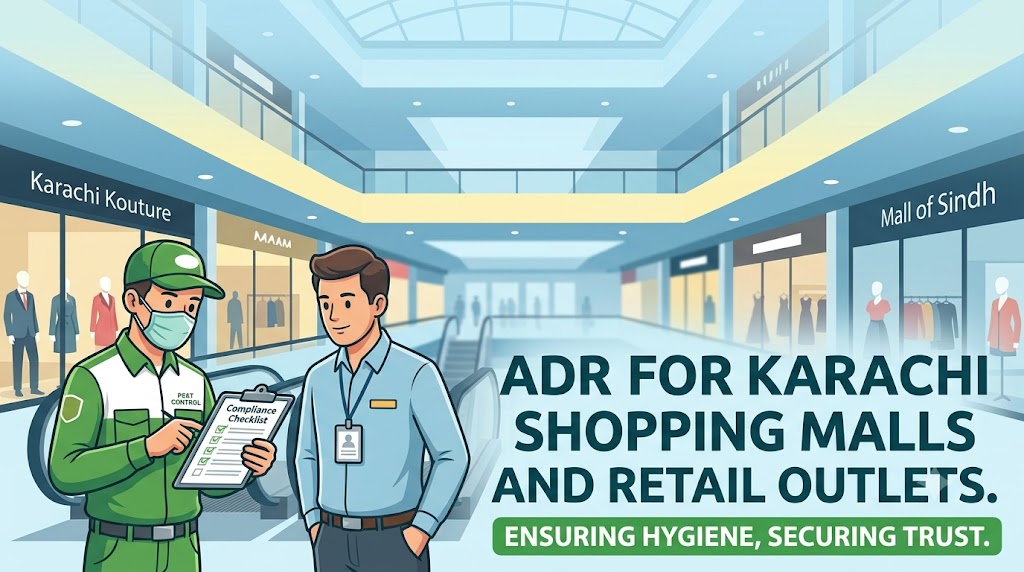
What does a pest control audit for a Karachi mall include? A proper audit is a documented walk-through of the whole building (food court, loading docks, waste storage, service corridors, plant rooms, retail floors, washrooms and water tanks), converted into a report with a risk rating for each zone. Most malls then run it as a recurring cycle, with food court and waste areas checked more often than the rest of the building.
A mall in Karachi is really several businesses stacked into one building: a food court, apparel outlets, a supermarket anchor, a cinema, sometimes a gaming zone. Each has its own pest risk, and all share the same HVAC ducts, service corridors and waste disposal points. That is why pest problems in malls spread faster and get noticed faster than in a standalone shop. A cockroach seen near the food court escalator gets photographed and posted before mall management even hears about it.
Property managers increasingly want something more structured than a monthly spray: a documented audit they can show tenants, insurers and their own management committee. This post covers what an audit for a mall or retail outlet should include, and why a pest control company in Karachi handling a mall needs a very different scope from one handling a single shop.
Why Are Malls Harder to Manage Than a Single Shop?
A standalone outlet has one entry point, one back door and one owner making decisions. A mall has dozens of tenants, each bringing stock, staff and deliveries through shared loading bays, so pest control in a mall is only as good as its worst-managed tenant. A food court stall with sloppy waste handling can seed a cockroach or rodent problem that eventually shows up three floors away in a clothing store.
Shared infrastructure compounds this. HVAC ducting, service risers, false ceilings and drains running the length of the building give pests corridors between tenants that a single-shop plan was never designed to address. Mall pest management is therefore usually a building-wide programme coordinated by property management, with tenant obligations layered on top, not a set of uncoordinated shop-level contracts. The same logic applies to corporate office pest control contracts, where multiple occupants share one building.
What Does a Mall Pest Control Audit Cover?
An audit starts with a documented walk-through of the entire facility: food court and back-of-house kitchens, loading docks and waste storage, service corridors and plant rooms, retail floors, washrooms and any storage basements. It records pest evidence, conducive conditions (standing water, gaps, poor waste storage) and existing controls such as bait stations or insect light traps.
The walk-through becomes a report with a risk rating per zone, not a single pass or fail for the building, since a food court and a jewellery store carry very different pest pressure. Run on a recurring cycle, it gives management a running record instead of a one-off snapshot. That record is what a management committee can point to when a tenant complains, what an insurer may ask for in a liability review, and what protects the building if a sighting goes viral. The same audit-ready approach is described in our guide to how Karachi hotels and hospitals pass pest control audits.
Which Zones Are Highest Risk in a Karachi Mall?
The food court and any shared or tenant kitchens are almost always the highest-risk zone. Constant food waste, grease traps and heavy foot traffic make cockroach control an ongoing line item, not an occasional one. Loading docks and waste areas come second, since they are the main route rats and rodents use to enter, particularly overnight when deliveries taper off and the dock sits quiet.
Retail floors carrying packaged food, confectionery or bakery items attract ants however clean the shop looks, since the trail often starts from a shared wall or floor gap rather than the tenant’s housekeeping. Cinemas and soft-furnishing retailers, especially mattress and furniture stores, carry a bed bug risk that is easy to overlook until a complaint arrives, since upholstered seating and display furniture are what bed bugs prefer.
Why Do Water Tanks and Restrooms Belong in the Audit?
A mall’s tanks, whether feeding washrooms, the food court or fire-fighting systems, are easy to forget because they sit on the roof or in a basement plant room. Left unchecked, sediment and stagnant sections become mosquito breeding sites and support bacterial growth that has nothing to do with what is visible on the retail floor. Water tank cleaning belongs on the same audit cycle as pest control, not a once-a-year facilities task. Our guide on how often to clean your water tank in Karachi helps you set the interval.
Who Is Responsible: Property Management or Tenants?
The most common failure in mall pest management is coordination, not treatment. A management-led schedule for common areas only works if tenants, especially food court operators, are held to housekeeping and waste-disposal standards as a lease condition. A building-wide contract that ignores tenant-level compliance treats symptoms in common areas while the source persists inside a tenant’s own kitchen.
Malls in Clifton, DHA and Gulshan-e-Iqbal, and along Shahra-e-Faisal, face slightly different pressure depending on surrounding land use and building age, which is why a generic checklist rarely fits. Our guide to commercial pest control around Karsaz and Shahra-e-Faisal covers the corridor in more detail.
How Do Karachi’s Seasons Affect Mall Pest Control?
The monsoon, which runs roughly July to September, brings the sharpest spike in complaints for large retail buildings. Humidity climbs, drainage around loading docks and basement plant rooms is tested, and any gap in the building envelope becomes an entry point for cockroaches and rodents escaping flooded streets. It is also peak mosquito season, so rooftop and basement water storage must stay sealed and clean. Our Karachi monsoon pest guide covers the wider pattern.
Cooler months bring a different pattern. Rodents move indoors more aggressively as outdoor food thins out, and a mall bordering open plots or construction sites can see a noticeable rise in activity at loading docks; see winter pest problems in Karachi. An audit calendar that anticipates these shifts catches problems before they reach the retail floor, which a flat year-round schedule does not.
What Does a Long-Term Mall Pest Control Programme Look Like?
Well-run malls usually end up with a layered structure. The frequencies below are typical starting points, adjusted for building size, age and how much food handling and foot traffic it carries.
| Layer | Scope | Typical frequency |
|---|---|---|
| Building-wide audit | All zones, with a risk rating and written report per zone | Quarterly |
| Targeted visits | Food court, kitchens, loading docks, waste areas | Monthly |
| Tenant obligations | Housekeeping, waste disposal and pest reporting, written into the lease | Ongoing |
| Complaint handling | A single contact so issues are logged and tracked, not handled informally | Ongoing |
A long-term arrangement generally works better than call-outs, as contract vs one-time treatment explains. Our client work and background reflect this kind of institutional programme, and pricing for a building this size is scoped around square footage and zone risk, not a flat per-visit rate.
Frequently Asked Questions
Who is responsible for pest control in a mall: property management or tenants?
Usually both, split by area. Property management typically owns common areas, HVAC and shared infrastructure, while tenants are responsible for their own units, often through a housekeeping and pest-reporting clause in the lease.
How often should a mall be audited for pests?
A quarterly building-wide audit is common, with the food court and kitchens checked monthly. The right frequency depends on the building’s size, age and food handling.
Do food court vendors need separate pest control from the rest of the mall?
In practice, yes. A food court kitchen prepares and stores food, so it is expected to meet the same food-business hygiene standards as a standalone restaurant, including pest control records. Our post on fumigation certificate requirements for Karachi restaurants explains what those records look like.
Can a single pest sighting really damage a mall’s reputation?
Given how quickly a photo travels on social media, yes. A visible pest problem is a reputational event, not just a maintenance issue, which is why documented, proactive audits matter more for malls than for most commercial properties.
What should a mall’s pest control contract include?
A clear scope covering common areas, the food court, loading docks and shared infrastructure; a defined audit and reporting frequency; documented treatment records; and clarity on which pests and areas the tenant is separately responsible for.
Get Started
If your mall or retail property doesn’t have a documented, zone-based pest audit programme, that gap is worth closing before a tenant or customer complaint forces the issue. Reach out to arrange a facility walk-through and a proposal scoped to your building.

Rehan Khan is the founder of Accurate Fumigation and an entomologist. He holds an M.Sc. in Entomology and a B.Sc. in Environmental Science, and has worked in pest control in Karachi for three decades. He founded the company in 2005 and writes about the pest and water problems the city deals with each season. Accurate Fumigation is ISO 9001:2015 certified and a member of the National Pest Management Association.
Questions about a service, or need a certificate for an inspection? Call the office on 0330-2533480. Read Rehan’s full profile.