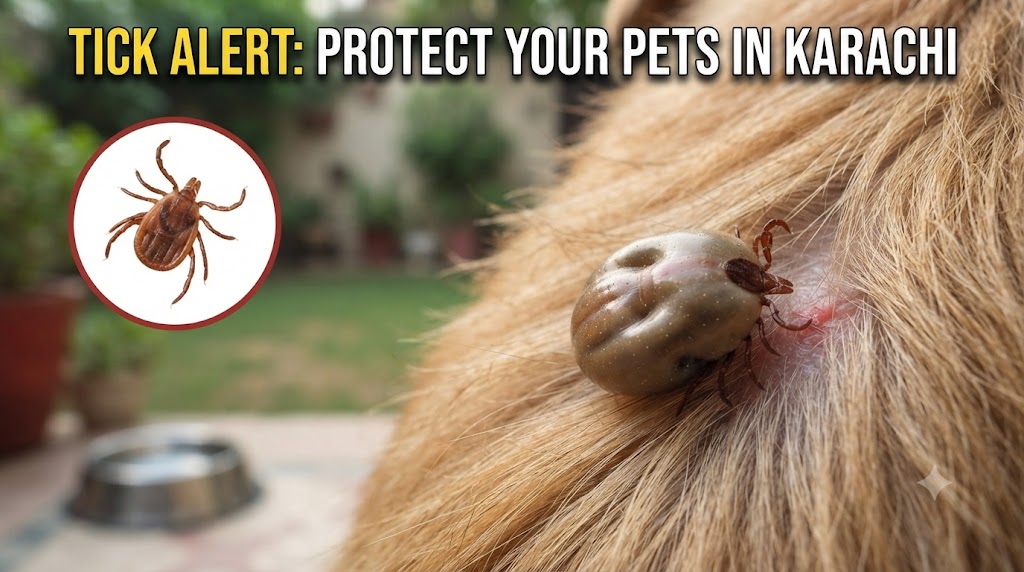
Most ticks found on dogs in Karachi are brown dog ticks. They are small reddish-brown arachnids that swell to about the size of a pea after feeding. They’re active almost year-round in the city’s warm climate, can spread serious blood infections to dogs, and — unlike most tick species — can breed inside homes, kennels and wall cracks. That last point is why treating the dog alone often doesn’t end the problem.
This guide covers how to identify ticks at every stage, the health risks for pets and people, how to remove one safely, and why they keep coming back. For an active infestation, our fleas & ticks control service in Karachi treats both the pet’s surroundings and the outdoor areas where ticks breed.
What Do Ticks Look Like?
Ticks aren’t insects. They’re arachnids, related to spiders and mites, which is part of why they don’t respond to the same treatments as fleas or mosquitoes. What you see depends on the life stage:
| Stage | Size and colour | Legs | What you’ll notice |
|---|---|---|---|
| Larva (“seed tick”) | Under 1 mm, pale to light brown | 6 | Clusters of tiny specks, often around the ears or face |
| Nymph | Roughly 1–2 mm, brown | 8 | Poppy-seed-sized dots that are easy to mistake for dirt |
| Unfed adult | About 3 mm, flat, reddish-brown | 8 | Sesame-seed-sized ticks, sometimes seen crawling up walls |
| Engorged female | Up to around 1 cm, grey or bluish | 8 | A smooth, bean-shaped bump attached to the skin — the stage most owners find first |
The Brown Dog Tick — Karachi’s Most Common Species
The species most consistently found on dogs across Pakistan is the brown dog tick, Rhipicephalus sanguineus. Most ticks need grass or woodland, but this one is unusually well adapted to buildings. Each stage feeds on a dog, drops off, and moults somewhere sheltered — a wall crack, a kennel gap, behind a picture frame — before climbing back onto a host. That’s why owners sometimes find ticks crawling up walls or near ceilings, and why the species does so well in a dense city like Karachi.
Where Do Ticks Hide?
On Your Pet
Ticks head for warm, thin-skinned spots where they’re less likely to be groomed off. Check these after every walk:
- Around and inside the ears
- Between the toes and around the paw pads
- Around the neck and under the collar
- The armpits, groin and tail base
A two-minute check with your fingers, working against the direction of the coat, is one of the most effective habits available — especially for dogs that spend time in gardens, on rooftops or in shared building compounds.
In Your Home
Off the dog, brown dog ticks shelter in wall cracks, gaps in skirting and door frames, kennel joints, under rugs and in pet bedding. In houses with outdoor space, they also collect along boundary walls, in courtyard corners and in garden debris. If you’re seeing ticks on walls rather than just on the dog, the population has already settled in the building.
What Diseases Can Ticks Spread?
Risks to Dogs
Ticks on dogs in Pakistan have been linked to several blood-borne infections, including Ehrlichia, Anaplasma and Babesia. Take your dog to a vet promptly, rather than waiting, if you notice any of these after tick exposure:
- Fever, lethargy or loss of appetite
- Pale gums, which can signal anaemia
- Nosebleeds or unusual bruising
- Dark or reddish urine
Risks to People
Brown dog ticks prefer dogs and bite people only occasionally. The bigger human risk in Karachi comes from larger Hyalomma ticks carried by cattle, goats and sheep. These ticks are a recognised vector of Crimean-Congo Haemorrhagic Fever (CCHF), a serious viral illness reported in Pakistan, and they come into the city in large numbers with sacrificial animals around Eid-ul-Adha. Wear gloves when handling animals, never crush ticks with bare fingers, and see a doctor promptly if anyone develops a fever after livestock contact or a tick bite. This guide isn’t medical advice, so symptoms should always be assessed by a doctor directly.
How to Remove a Tick Safely
- Use fine-tipped tweezers or a tick hook and grip the tick as close to the skin as possible.
- Pull straight out with steady, even pressure. Don’t twist or jerk, which can leave mouthparts in the skin.
- Dispose of it properly. Drop the tick in surgical spirit or seal it in tape. Don’t flush it or squash it by hand.
- Clean the bite and watch your pet for the symptoms listed above over the next couple of weeks.
Avoid the common home methods — kerosene, petrol, a hot matchstick or crushing the tick in place. They irritate the tick while it’s still attached and can push infectious material further into the bite.
Why Do Ticks Keep Coming Back?
A single female brown dog tick can lay several thousand eggs in one batch, hidden in cracks and bedding rather than on the dog. Because most of the life cycle happens off the animal, a problem that seems to clear up after treating the dog can come back within weeks unless the kennel, courtyard and garden are treated too. Activity also tends to build during Karachi’s hottest, most humid months, part of the wider summer pest surge in Karachi.
This is especially common in ground-floor homes and houses with gardens in areas like Scheme 33 and Gulistan-e-Jauhar, where outdoor space gives ticks far more places to settle than a sealed flat. Newer societies add another factor: open plots and construction sites next door, as our guide to pests in Bahria Town and Scheme 33 new construction explains.
How to Prevent Ticks Around Your Home
- Wash pet bedding in hot water and vacuum kennels and resting spots regularly, since eggs and early stages hide there.
- Seal cracks in kennel walls and along skirting, which removes the hiding spots brown dog ticks moult in.
- Keep grass, shrubs and garden debris trimmed back along walls and fence lines.
- Keep stray animals and rodents out of the compound, since they carry ticks in. Our guide to rat-proofing your Karachi home covers the entry points.
- Treat every pet in the household at the same time, and ask your vet for a preventive tick product suited to each animal.
When to Call a Professional
If you’re finding ticks repeatedly despite checks and cleaning, seeing them on walls, or dealing with an ongoing problem in a garden, kennel or building compound, environmental treatment is usually the missing piece. As a pest control company in Karachi, we treat the places ticks actually breed — cracks, courtyards, kennels and garden beds — and give owners clear guidance on keeping pets away until treated areas are dry.
One visit rarely breaks the whole cycle, because eggs already laid can hatch after treatment. That’s why a follow-up is usually planned — our article on how long a fumigation treatment lasts explains the timing. Cost depends on the property size and how widespread the infestation is; see our charges page for typical pricing. Building management companies handling shared outdoor areas can review our work with existing clients for reference.
Frequently Asked Questions
Can ticks infest an apartment or an indoor-only pet?
Yes. Ticks can come in on shoes, clothing or visiting animals, and in apartment blocks they spread through shared stairwells, rooftops and compounds used by neighbours’ dogs or strays. Our Gulshan-e-Iqbal and Gulistan-e-Johar apartment pest guide covers how pests move between flats in shared buildings.
How do I tell a tick from a flea?
Fleas are tiny, flattened side to side, fast-moving and able to jump, and they leave black “flea dirt” in the coat. Ticks don’t jump. Once attached, they stay in one spot and swell as they feed. If you’re seeing fast-moving specks rather than attached bumps, read our guide to flea infestations in Karachi.
How long can a tick stay attached before it’s a problem?
The risk of infection generally rises the longer a tick stays attached and feeding. That’s why removing ticks the same day you find them matters more than anything else you do at home.
Do ticks jump between pets and people?
No. Ticks can’t jump or fly. They climb onto a host from vegetation, cracks or bedding. Pets and people in the same home pick them up separately from the same infested environment, which is why treating that environment matters.
Can I use mosquito spray on ticks?
Not reliably. Mosquito treatments target flying insects and open breeding water, while tick eggs and early stages sit deep in cracks and bedding. A tick problem needs products and application aimed at those hiding places.
Is tick treatment safe for my pets?
Professional treatment is applied to surfaces and hiding spots, not to the animal. Pets should be kept away until treated areas have dried. We explain the precautions in detail in our guide to whether pest control is safe for children and pets.
Get Your Home and Garden Checked
If ticks keep showing up on your pet no matter how often you check and clean, the problem is living in your home, not just on your dog. Contact Accurate Fumigation to arrange a tick and flea treatment for your home, kennel or garden anywhere in Karachi.

Rehan Khan is the founder of Accurate Fumigation and an entomologist. He holds an M.Sc. in Entomology and a B.Sc. in Environmental Science, and has worked in pest control in Karachi for three decades. He founded the company in 2005 and writes about the pest and water problems the city deals with each season. Accurate Fumigation is ISO 9001:2015 certified and a member of the National Pest Management Association.
Questions about a service, or need a certificate for an inspection? Call the office on 0330-2533480. Read Rehan’s full profile.