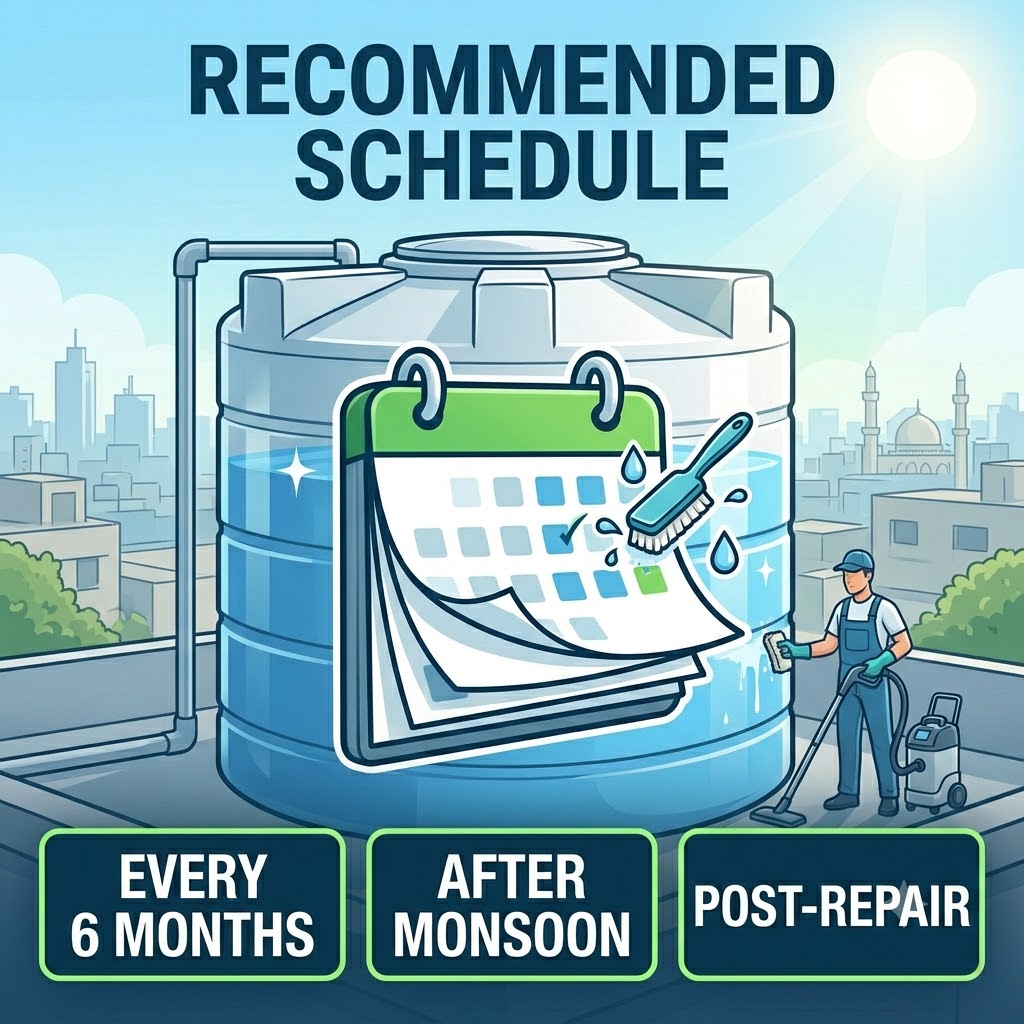
For most Karachi households, clean the water tank at least every 6 months. Go to every 3–4 months if the tank is tanker-fed, sits in direct sun, or serves a restaurant, hotel or school. Shared building tanks should also be cleaned every 6 months, on a committee schedule someone actually owns.
“How often” is one of the most common questions we get, and the answer depends on tank type, water source and how heavily the tank is used. This post gives a practical schedule for Karachi households, apartment buildings and businesses, plus the situations where you should not wait for the next date. Whether you do it yourself or book professional water tank cleaning, a schedule handles routine maintenance, while our checklist of signs your water tank needs cleaning catches problems that show up early.
How Often Should You Clean a Water Tank in Karachi?
Guidance varies, so this is the schedule we recommend for Karachi’s heat and variable water sources. Local health advice reported in the press also points to cleaning tanks before summer each year. Treat 6 months as the outer limit for most households, not the target.
| Situation | Recommended interval | Main reason |
|---|---|---|
| Standard household, piped supply, normal use | Every 6 months | Baseline for Karachi’s heat; the outer limit, not the target |
| Tanker-fed household or building | Every 3–4 months | Source water quality varies, so sediment and contamination can build up faster |
| Apartment building or housing society | Every 6 months, logged on a committee schedule | Shared tank with heavier use; one missed clean affects the whole building |
| Restaurant, hotel or school | Every 3–4 months, or as your inspection requirements specify | Water is used for food or served to the public |
| Overhead (rooftop) tank | Every 6 months; every 3–4 months in direct, unshaded sun | Sun exposure is a major driver of algae growth |
| Underground tank (sump) | Every 6 months; sooner in flood-prone areas | More exposed to seepage, cracked seals and silt than to algae |
Shared tanks are usually managed by building committees. You can learn more about our team on our about us page, and the practical steps are in our guide to water tank cleaning for apartment buildings. Businesses that need paperwork for their tank cleaning should read about KMC and WASA tank cleaning certification in Karachi.
Underground tanks get no direct sunlight, so algae is usually slower than in rooftop tanks, but they are more exposed to groundwater seepage, cracked seals and silt, especially in parts of Malir and Korangi and other low-lying areas where monsoon flooding recurs. Our comparison of underground vs overhead water tank cleaning in Karachi covers the practical differences.
What Should Push You Toward the Shorter Interval?
Beyond the situations in the table, move to the shorter end of any range if:
- The tank is old concrete with rough or cracked internal surfaces, which trap sediment and biofilm more easily than newer, smooth-lined tanks
- Usage is heavy or uneven: many people drawing from one tank, or frequent low-water periods that disturb sediment
- The monsoon has just passed: many households notice more sediment and turbidity afterwards, which justifies an off-schedule clean (see monsoon water contamination in Karachi)
Signs You Shouldn’t Wait for the Next Scheduled Clean
Do not treat the schedule as rigid. If you notice a smell, discolouration, taste change or unexplained illness in the household before the next planned date, clean sooner. Our post on the health risks of dirty water tanks in Karachi explains why that matters.
Mapping a Schedule Onto Karachi’s Calendar
Rather than picking two arbitrary dates six months apart, anchor your cleaning to points in the year that already mean something in Karachi:
- Before summer (around March–April), before peak heat accelerates algae growth in overhead tanks
- After the monsoon (late September–October), once the rains have passed and any sediment they introduced has had time to show up
- A mid-year check for higher-risk setups, such as tanker-dependent households, restaurants, or buildings with visible warning signs, rather than waiting the full gap between the two anchors above
Ramadan raises household water use for many families, but it moves roughly ten to eleven days earlier each year, so check its dates rather than fixing it to a month. We cover timing around it in water tank cleaning for Ramadan.
Setting Up a Reminder System
Households and committees rarely fail because they disagree on the interval. They forget. Three habits fix that:
- Put the anchor dates above in your phone calendar or your building’s maintenance diary, so the clean is booked in advance
- For buildings, assign the task to the committee’s existing maintenance calendar instead of leaving it to residents to request
- Keep a simple log of the last cleaning date and who did it, so nobody has to guess whether it is due
Frequently Asked Questions
Is once a year enough for a Karachi household?
It is the outer limit we would accept, and only for a household on a stable, good-quality piped supply with no visible warning signs. Given Karachi’s climate and variable water sources, 6 months is a safer default for most homes.
Do smaller tanks need cleaning more often than larger ones?
Not necessarily. Water source, sun exposure and how heavily the tank is used matter more than size. Size mainly affects cleaning time and cost; see water tank cleaning cost by tank size.
Should I clean the tank before or after monsoon season?
Both have value. A clean before the rains reduces the sediment load going into the wet season, and one afterwards deals with any turbidity or debris that got in during heavy rain.
Does a new tank need cleaning right away?
We recommend cleaning and disinfecting a new tank before first use to remove manufacturing residue and dust from storage and transport, then following the normal schedule from that point.
How do I know if my building’s shared tank is being cleaned on schedule?
Ask your building committee or management office for the maintenance log. If there is none, raise it: a shared tank without a documented cleaning schedule is a common gap in apartment buildings.
Ready to Get on a Schedule?
Whether you need a one-off clean or a recurring schedule for your home or building, get in touch and we will help you work out the right interval for your setup. See our charges page for how pricing works.

Rehan Khan is the founder of Accurate Fumigation and an entomologist. He holds an M.Sc. in Entomology and a B.Sc. in Environmental Science, and has worked in pest control in Karachi for three decades. He founded the company in 2005 and writes about the pest and water problems the city deals with each season. Accurate Fumigation is ISO 9001:2015 certified and a member of the National Pest Management Association.
Questions about a service, or need a certificate for an inspection? Call the office on 0330-2533480. Read Rehan’s full profile.