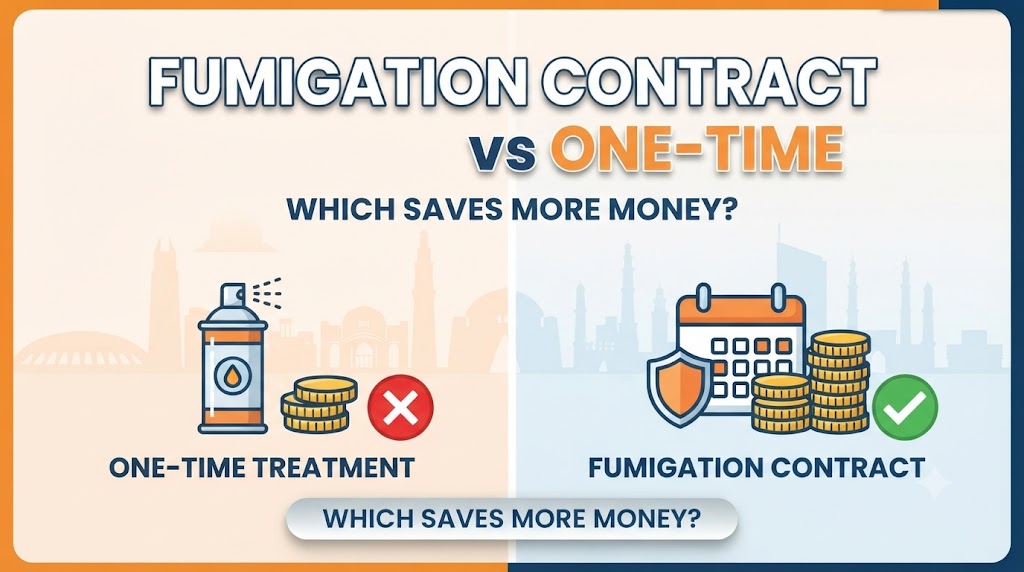
For an isolated problem, a one-time treatment is usually enough. For recurring pests, food businesses, and older buildings with a termite or rodent history, a scheduled fumigation contract often works out cheaper over a year, because repeat one-off visits add up and nothing addresses the underlying cause.
When pests show up, the instinct is to book one visit, clear what is visible, and move on. That works for a wasp nest or a single ant trail. For termites, bed bugs, cockroaches, and rodents, the real question is not what one visit costs but whether a single treatment or an ongoing fumigation service in Karachi works out better over a year. This guide covers the trade-offs of each without pretending one is always right.
Fumigation Contract vs One-Time Treatment: What’s the Difference?
| One-time treatment | Fumigation contract | |
|---|---|---|
| What it addresses | The infestation that exists now | The current problem plus ongoing prevention |
| Visits | One treatment, plus a follow-up if the provider includes one | Scheduled visits, commonly quarterly or twice a year depending on pest risk and property type |
| Between visits | You book a new call-out and assessment each time | Many contracts include priority response; check whether call-outs are free |
| Records | Usually a single receipt or certificate | A running treatment history, useful for inspections and audits |
| Cost pattern | Lower upfront, but repeats add up | Often priced lower per visit than the same number of separate bookings; confirm in a written quote |
| Weakness | Does not protect against reinfestation or fix why pests keep returning | Wasted if your property rarely has pests and visits are skipped |
Ask any provider whether a follow-up visit is included in a one-time price instead of sold separately, particularly for bed bugs, where a follow-up is standard practice.
Which Is Cheaper Over a Year?
The honest comparison is cost per year including repeat visits, not contract price vs one-time price. A one-time treatment repeated three times in a year because the underlying cause (a nearby termite colony, a drain-based roach source, an unsealed rodent entry point) was never fixed often ends up costing as much as a contract, without the priority response or the records. Our cockroach control cost and termite treatment cost guides show how prices build up for each pest.
A contract is not automatically cheaper. A well-maintained apartment with no pest history does not need scheduled visits it will probably skip. A simple test: look back over the last 12 months. If you had zero or one isolated incident, start with a one-time treatment. If you had two or more for the same pest, or you run a food business, ask for a contract quote and compare it with what those repeat visits cost. Current pricing logic for both options is on our charges page.
Which Option Fits Your Property?
| Situation | Usually the better fit | Why |
|---|---|---|
| A single, clearly caused incident, such as ants after a food spill | One-time treatment | There is no ongoing source to guard against |
| A newly built or newly moved-into property, or a one-off event such as preparing a property for sale | One-time treatment | Ongoing coverage is not relevant to the situation |
| Restaurants, hotels, and food businesses | Contract | One missed sighting can cost more in inspection trouble or lost customers than a year of visits |
| Older buildings with termite history | Contract with scheduled inspections | Termite damage can be costly to repair, and colonies are often active inside walls before anything shows |
| Ground-floor units and houses with gardens | Contract, especially for ants, termites, and rodents | Constant pressure from outdoor colonies and neighbouring areas |
| Any property that needed two or more one-time treatments for the same pest in a year | Contract | The repeats already cost contract-level money without a guarantee or priority response |
| Bed bugs in a home | Usually one-time with follow-up | Usually introduced by travel, secondhand furniture, or guests |
| Bed bugs in a hostel, guesthouse, or rented block | Contract if it recurs | Shared buildings reintroduce the problem |
| Cockroaches at home with an isolated sighting | One-time with follow-up | A single cause is usually enough to fix |
| Cockroaches in a restaurant or kitchen with constant food and moisture | Contract | The source keeps replenishing the population |
| Rodents in ground-floor properties, warehouses, and buildings near open drains or construction | Contract | New rodents re-enter from outside however well the last treatment worked |
For commercial properties, our guides to fumigation certificate requirements for Karachi restaurants, corporate office pest control contracts, and why Korangi and Landhi industrial units need fumigation contracts cover what to expect. The main pest pages are termite control, cockroach control, ants control, and rodent control.
How Often Should a Contract Schedule Visits?
Frequency depends on the pest and the property, not a fixed rule. Karachi’s warm, humid conditions and monsoon rains put pressure on pest control for much of the year, so many properties benefit from timing visits around the seasons. See how often you should get fumigation done in Karachi and how long a fumigation treatment lasts to choose an interval.
Contract Length and Flexibility
A fumigation contract does not have to be a rigid multi-year commitment. Terms vary by provider, and many run annually with visits built in. Ask upfront whether you can scale down or cancel if the property’s risk genuinely changes, for example after a full renovation that removes old wall voids and plumbing chases where infestations often start. Also ask what the written agreement says about guarantees, which our guide to pest control warranties and guarantees explains.
What Happens If You Do Nothing?
Ignoring an early termite infestation can lead to structural repair costs that far exceed a treatment or a year of scheduled inspections. For food businesses, an unresolved pest issue risks a failed inspection, reputational damage, and lost customers, costs that can dwarf the price gap between a one-time visit and a contract.
Frequently Asked Questions
Is a fumigation contract more expensive than paying per visit?
Per visit, contracts are often priced lower than separate call-outs, because scheduled visits are easier to plan. The annual total depends on how many one-time visits you would otherwise need, and for properties with recurring problems contracts tend to work out cheaper overall. Ask for both quotes in writing to compare.
Can I switch from one-time treatments to a contract later?
Yes, and it is a common path. Many clients start with a one-time treatment and move to a scheduled contract if the same pest returns within a few months.
Do contracts cover visits between scheduled dates?
Many include priority response when something is spotted between visits, but terms differ, so confirm whether call-outs are free or charged. Either way, you are not starting from scratch with a new assessment and quote each time.
Are contracts only worth it for restaurants and commercial properties?
No. They are most clearly worth it for commercial premises and buildings with a known pest history, but any home with recurring termite, ant, or rodent pressure, such as a ground-floor unit or a house with a garden, can benefit too.
Is a DIY treatment a cheaper alternative to either option?
For very light, early activity it can be. For termites, bed bugs, or an established infestation it usually costs more once repeats and damage are counted. See DIY pest control vs professional fumigation for the comparison.
How do I know which option is right for my property?
Use your own history over the last year. If you have needed repeat visits for the same pest, compare a contract quote. If this is a first, isolated issue, a one-time treatment is a reasonable start, and you can move to a contract if it recurs.
Talk to Us Before You Decide
Rather than guessing, contact our team with your property’s pest history and we will tell you honestly whether a one-time treatment or a contract makes more sense, including for properties in Gulistan-e-Jauhar and Federal B Area, where we regularly see both types of jobs. You can also read more about our background and the properties we work with on our about us and clients pages.

Rehan Khan is the founder of Accurate Fumigation and an entomologist. He holds an M.Sc. in Entomology and a B.Sc. in Environmental Science, and has worked in pest control in Karachi for three decades. He founded the company in 2005 and writes about the pest and water problems the city deals with each season. Accurate Fumigation is ISO 9001:2015 certified and a member of the National Pest Management Association.
Questions about a service, or need a certificate for an inspection? Call the office on 0330-2533480. Read Rehan’s full profile.