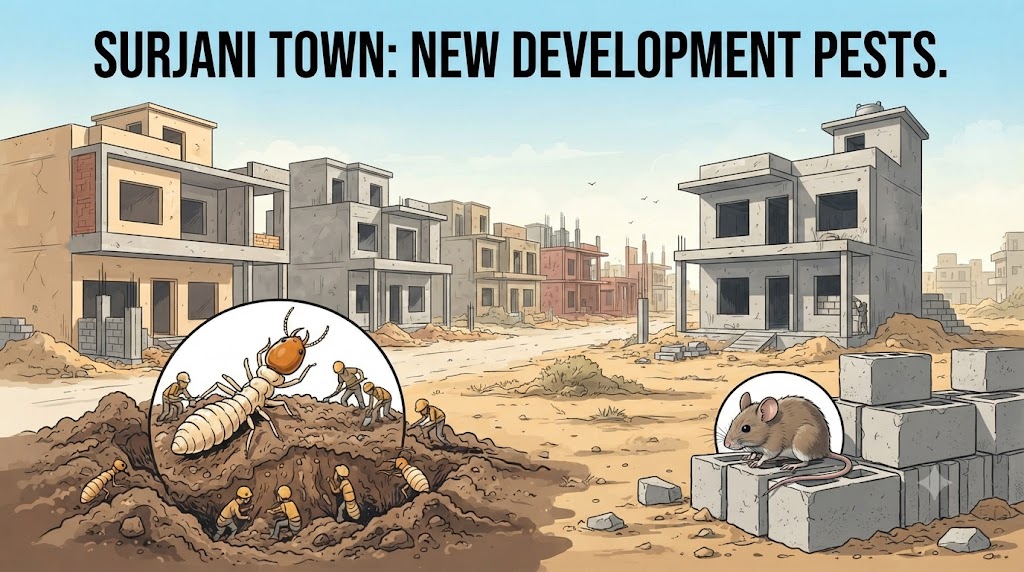
Surjani Town is one of Karachi’s fastest-growing residential areas, and that growth brings a specific set of pest problems that older, fully-built neighbourhoods don’t deal with in the same way. Vacant plots, half-finished construction, and new water and drainage lines still settling in all create conditions pests take advantage of before a household is even fully moved in.
If you’ve just bought or built in Surjani Town, the pest issues you’ll run into in year one look different from what a family in an older part of the city deals with — and prevention here starts before you unpack the last box. The same new-construction pattern shows up elsewhere on Karachi’s growing edges; our guide to pest risks in Bahria Town and Scheme 33 new construction covers it in another fast-developing part of the city.
A Township Still Filling In
Large parts of Surjani Town are still under active construction, which means new buildings often sit next to open plots, half-built structures, and construction debris. That mix is exactly what pests look for — undisturbed ground, standing water from construction work, and building material piled up long enough to become a nesting site.
New Construction Comes With Its Own Termite Risk
New buildings feel like they should be pest-free, but termites are actually a real risk at this stage. Fresh timber used for doors, window frames, and false ceilings hasn’t been treated the way older wood eventually gets, and any wood-to-soil contact during construction — formwork, scaffolding planks left in the ground — can introduce a colony before the house is even finished. Our guide to identifying termite damage in Karachi homes is worth reading so you know what to check for even at this early stage.
Basements and ground-floor storage rooms in new construction are especially vulnerable if damp-proofing wasn’t done properly. It’s worth having a termite inspection done before final finishing work, not after you notice damage — this is exactly the kind of check covered in our guide to pre-handover pest inspections.
Open Plots and Vacant Land: The Bigger Township-Level Problem
Unlike a fully built-up neighbourhood, Surjani Town still has a meaningful number of vacant plots between developed homes. These plots collect rainwater during monsoon, become dumping spots for construction and household waste, and give rodents open ground to move between properties undetected.
- Standing water on open plots is one of the main local mosquito breeding sources during monsoon season — our overview of mosquito and dengue risk in Karachi covers why this matters beyond the nuisance factor.
- Rubble and debris piles on vacant land are a common rodent harborage point — rodent control for a house next to one of these plots often needs to include exterior bait stations, not just indoor treatment.
- Overgrown vegetation on undeveloped plots gives ants and ticks a route into adjoining gardens.
Water Storage and Tank Hygiene in a Growing Area
Water supply in newer parts of Karachi’s periphery is often less consistent than in older, established neighbourhoods, which means more households rely on storage tanks and periodic tanker deliveries. A tank that isn’t cleaned regularly becomes a breeding site for mosquitoes and a source of contamination that has nothing to do with the water quality coming in — it’s what’s growing inside the tank itself.
If your household is filling a tank every few days rather than relying on continuous supply, it’s worth getting water tank cleaning done on a fixed schedule rather than waiting until the water looks or smells off. Our guide to signs your water tank needs cleaning covers what to watch for in the meantime.
The Household Pests You’ll Notice First
Once a family actually moves in and starts using the kitchen, a few pests tend to show up within the first few months:
| Pest | Why it shows up early | What helps |
|---|---|---|
| Ants | Arrive with furniture or building material, establish quickly in a kitchen still being organised | Seal new plumbing and conduit gaps early |
| Cockroaches | Move in from neighbouring under-construction plots once kitchen waste starts building up | Treat before waste generation attracts more |
| Mosquitoes | Tank storage plus standing water on nearby open plots | Fixed tank cleaning schedule, clear standing water |
| Termites | Fresh untreated timber, wood-to-soil contact during construction | Inspection before final woodwork and flooring |
Building a Prevention Plan as You Move In
The advantage of a new home is that prevention is cheaper and easier before you’ve filled it with furniture and finished every room. A pre-move-in pest inspection covering timber work, the boundary wall, and any adjoining vacant land gives you a baseline before problems start rather than after — our guide to moving into a new Karachi home or office covers the broader prevention checklist for this stage.
- Get a termite inspection done before final woodwork and flooring is completed.
- Seal gaps around new plumbing and electrical conduit entry points — these are common ant and cockroach access routes in freshly built homes.
- Set a tank cleaning schedule from day one rather than waiting for visible signs of contamination.
- If your plot borders vacant land, ask for exterior perimeter treatment as part of your first pest control visit.
Frequently Asked Questions
Can a brand-new house already have a termite problem?
Yes — fresh timber used in doors and frames, and any wood left in contact with soil during construction, can bring termites in before the house is even finished.
Why does Surjani Town have more mosquito issues than some older areas?
A combination of open, undeveloped plots collecting rainwater and heavier reliance on stored tank water both contribute to more mosquito breeding sites than a fully built-up neighbourhood typically has.
Should I get pest control done before or after moving in?
Before, if possible — treating an empty house is more thorough and cheaper than treating around furniture, and it catches construction-stage termite risk before flooring is finished.
How often should tanks be cleaned in an area with irregular water supply?
Households relying on tanker deliveries or intermittent supply generally need tank cleaning more frequently than those on continuous municipal supply, since water sits longer between refills.
Does a vacant plot next door mean I’ll definitely get pests?
Not definitely, but it raises the risk meaningfully, and it’s a reasonable factor to mention to your technician so exterior treatment is included.
Start With an Inspection, Not a Reaction
If you’re building, finishing, or just moved into a home in Surjani Town, getting ahead of these risks is far easier than dealing with an established infestation later. Contact us to schedule a pre-move-in inspection and a plan that accounts for what’s happening on the plots around you.

Rehan Khan is the founder of Accurate Fumigation and an entomologist. He holds an M.Sc. in Entomology and a B.Sc. in Environmental Science, and has worked in pest control in Karachi for three decades. He founded the company in 2005 and writes about the pest and water problems the city deals with each season. Accurate Fumigation is ISO 9001:2015 certified and a member of the National Pest Management Association.
Questions about a service, or need a certificate for an inspection? Call the office on 0330-2533480. Read Rehan’s full profile.