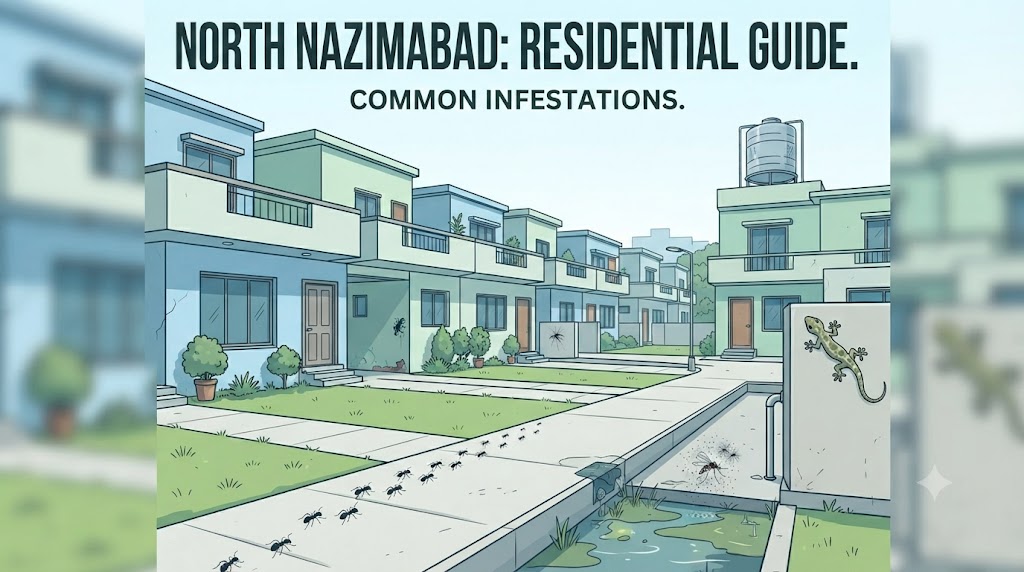
North Nazimabad is a mixed neighborhood — older bungalows on wider blocks near the main boulevards, smaller houses and apartment-style blocks in denser sections, and a housing stock that spans several decades of construction. That mix means residents here don’t usually deal with just one pest problem; they deal with a rotating set depending on the season and the specific block. A pest control service in Karachi working across North Nazimabad sees a fairly consistent seasonal pattern, and knowing it in advance makes a real difference in how quickly a problem gets under control.
Why North Nazimabad’s Pattern Is Different From a Single-Building Problem
Unlike a single apartment tower where an infestation usually has one identifiable source, North Nazimabad’s established residential blocks are a patchwork of individually built houses, shared boundary walls, aging drainage lines running under the streets, and gardens of varying upkeep. Pests here move between properties less through shared risers (like apartment buildings) and more through ground-level routes — boundary walls, drainage, and soil.
Ants: The Most Underestimated Pest in the Area
Why Ants Show Up Constantly Here
Ants are drawn to two things that established residential blocks have plenty of: mature trees and gardens providing outdoor nesting sites, and kitchens with accessible food and moisture. In North Nazimabad specifically, older concrete driveways and boundary walls with settled cracks give ants easy nesting spots close to the house, which is why residents often see trails appearing along the same routes year after year — our guide to ant trails in Karachi kitchens covers how to trace a trail back to its actual nest rather than just the entry crack.
Ants and Water Storage
One pattern worth knowing: ants — along with several other pests — are frequently drawn to areas around water tanks and their overflow points, where consistent moisture collects. If your property has ongoing ant activity near a rooftop or ground tank, it’s worth having the tank and surrounding area checked together rather than treating the ant trail in isolation. This is also a good moment to mention that water tank cleaning removes standing organic buildup that can attract pests to the same area repeatedly — our notes on signs your water tank needs cleaning are worth checking if you haven’t had it inspected recently.
Getting Ahead of an Ant Problem
Effective ant control generally relies on gel or bait treatments placed along known trails rather than surface sprays, since sprays kill visible ants but don’t reach the nest — and a colony that isn’t addressed at the nest will simply send out new foraging trails within days.
Seasonal Shifts: What Changes Through the Year
| Season | What tends to rise |
|---|---|
| Monsoon (roughly July–September) | Mosquitoes around standing water; termite swarmers after rain |
| Dry, hot months | Rodents and cockroaches moving indoors toward moisture |
Monsoon Season
Karachi’s monsoon (roughly July to September) brings a predictable rise in mosquito activity around any standing water — clogged drains, uncovered water storage, or waterlogged garden areas — and mosquitoes are a well-established vector for dengue in Pakistan, which is why standing water management matters beyond just comfort. It’s also the period when termite swarms (winged reproductive termites) are more commonly reported, since subterranean termite colonies often send out swarmers after rain when humidity is high. Our Karachi monsoon pest guide and termite season in Karachi guide both go into this pattern in more depth.
Dry, Hot Months
Drier months tend to push rodents and cockroaches toward any available moisture source indoors — kitchens, bathrooms, and areas near water tanks — since outdoor moisture becomes scarcer. This is when residents in North Nazimabad’s older bungalows most often notice rodent activity shifting from garden areas into the house itself.
Termite Activity in Older North Nazimabad Blocks
Many of the area’s older houses share the same vulnerability as PECHS bungalows: wooden frames and structural timber aging alongside settled foundations. Mud tubes along boundary walls and hollow-sounding wooden frames are worth checking periodically — our guide to identifying termite damage covers what those early signs actually look like — and if found, termite treatment targeting the underground colony, not just visible tubes, is the approach that actually resolves it rather than just delaying the next swarm.
Why Block-Wide Awareness Helps
Because North Nazimabad’s pest patterns move at ground level between adjoining properties rather than through shared building infrastructure, informal coordination with neighbors — noting when someone nearby had a termite swarm or a rodent problem — often gives useful early warning that a similar issue may be approaching your own property from the same direction.
Frequently Asked Questions
Why do I keep seeing ants near my water tank specifically?
Consistent moisture around tank overflow points and connections is attractive to ants and several other pests. Treating the ant trail without addressing the moisture source or tank cleanliness often means the ants simply return.
Is it normal to see winged termites after rain?
Yes — subterranean termite colonies commonly release winged reproductive termites (swarmers) during or shortly after periods of high humidity, including monsoon rain. Seeing swarmers is a sign an established colony is nearby, not a new, unrelated pest.
Do I need separate treatments for ants, termites, and rodents, or is it one visit?
These typically require different treatment approaches (bait-based for ants, soil/colony treatment for termites, bait stations and entry-point sealing for rodents), so a proper inspection is used to identify which pests are actually present before deciding what’s needed.
Does cleaning my water tank actually reduce pest activity nearby?
It can help, since standing organic residue and consistent moisture around a poorly maintained tank is one of the draws for ants, mosquitoes, and other pests. It’s not a complete pest control solution on its own, but it removes one contributing factor.
How can I tell if a pest problem is coming from my own property or a neighbor’s?
Ground-level entry points — boundary wall cracks, shared drainage, garden beds against a shared wall — are the most common transfer routes in this kind of neighborhood. An inspection can usually identify the direction activity is coming from based on where trails, tubes, or droppings are concentrated.
Getting Help
If you’re noticing any of these patterns in your North Nazimabad property, it’s worth getting an inspection that looks at the property as a whole rather than treating one visible symptom at a time. Contact us to schedule a visit, or check our clients page to see the kind of properties we’ve worked with across Karachi.

Rehan Khan is the founder of Accurate Fumigation and an entomologist. He holds an M.Sc. in Entomology and a B.Sc. in Environmental Science, and has worked in pest control in Karachi for three decades. He founded the company in 2005 and writes about the pest and water problems the city deals with each season. Accurate Fumigation is ISO 9001:2015 certified and a member of the National Pest Management Association.
Questions about a service, or need a certificate for an inspection? Call the office on 0330-2533480. Read Rehan’s full profile.