Category: Karachi Area Pest Guides

Neighbourhood-specific pest control information for Karachi — DHA, Clifton, Gulshan, PECHS, and more. Local conditions, common problems, and area-relevant solutions.

  • New Karachi Pest Guide: Common Household Pests and Seasonal Patterns

    New Karachi Pest Guide: Common Household Pests and Seasonal Patterns

    New Karachi is a well-established, largely residential part of the city, and the pest problems families deal with here follow a fairly predictable seasonal rhythm — driven by Karachi’s heat, its monsoon season, and the cooler winter months. Knowing that pattern makes it much easier to stay ahead of an infestation instead of reacting to one after it’s already established.

    If you live in New Karachi, the pests you’ll deal with in June look different from what shows up in August or December — and a prevention plan built around that calendar works better than treating each problem as a one-off.

    New Karachi’s Residential Character

    This is a mature, densely settled residential township with a mix of houses and apartment blocks, established gardens, and older plumbing and drainage infrastructure. That combination of age and settled greenery means most households will encounter a fairly standard set of pests over the course of a year, rather than anything unusual to the area.

    Summer Pest Patterns: Ants and Cockroaches Thrive in Heat

    As temperatures climb through Karachi’s summer, ants and cockroaches both become significantly more active — heat speeds up their reproduction cycles, and kitchens naturally generate more food waste and moisture during summer months when people are cooking and using water more. This is the period when a small ant trail or an occasional cockroach sighting is most likely to turn into a full infestation if it isn’t addressed quickly.

    Monsoon Season: Mosquitoes and Dampness-Driven Pests

    Monsoon rains bring the year’s biggest spike in mosquito activity, driven by standing water in drains, plant pots, and any uncovered storage containers around the house. This is also the season when dampness-related problems — including conditions that support termite activity in ground-floor timber — become more likely, since consistently wet soil around a foundation is exactly what subterranean termites look for.

    Water tanks are also worth attention specifically around monsoon season, since heavier rainfall increases the risk of contamination getting into open or poorly sealed tanks. A water tank cleaning scheduled just before or after monsoon is a practical, low-effort way to reduce that risk.

    Winter Slowdown, But Rodents Move Indoors

    Cooler winter months generally bring a slowdown in insect activity, but this is also when rodents become more of a household concern, since they move indoors seeking warmth and shelter. Garages, storage rooms, and areas near kitchens tend to see the most winter rodent activity in residential areas like this one.

    Pets and Fleas or Ticks in Family Homes

    Households with dogs or cats, which are common in New Karachi’s family-oriented streets, need to watch for fleas and ticks year-round, though activity does pick up in the warmer months. These pests spread quickly from a pet to soft furnishings and carpeted areas, so a pet-related flea issue is rarely just a pet problem by the time it’s noticed.

    A Season-by-Season Prevention Calendar

    • Spring (before peak heat): schedule a general inspection and address any ant or cockroach entry points before summer activity ramps up.
    • Summer: keep kitchen waste managed daily and watch for early ant trails, which are easier to treat before a colony fully establishes.
    • Pre-monsoon: clear standing water sources, check tank seals, and consider a termite check on ground-floor timber.
    • Post-monsoon: get the water tank cleaned and check for any new dampness around foundations or window frames.
    • Winter: seal garage and storage room entry points before rodents start looking for a way indoors.

    Frequently Asked Questions

    Why do ants and cockroaches get worse specifically in summer?

    Higher temperatures speed up their breeding cycles, and households also tend to generate more food waste and moisture in the kitchen during hotter months, which draws both pests in.

    Does monsoon season really increase termite risk?

    Yes — consistently damp soil around a building’s foundation during monsoon is one of the main conditions subterranean termites need to establish or expand a colony.

    Why do I see more rodents in winter than summer?

    Rodents move indoors seeking warmth and shelter as outdoor temperatures drop, which is why garages and storage rooms see more activity in cooler months.

    Should I clean my water tank before or after monsoon?

    Both are worth doing if possible — before monsoon to start the season with a clean tank, and after to check for any contamination that got in during heavy rain.

    Can fleas from a pet spread to the rest of the house?

    Yes, fleas move quickly from pets onto carpets and soft furnishings, so a flea problem noticed on a pet has often already spread to the surrounding home.

    Plan Ahead of the Season, Not After

    If you’d like a prevention plan built around New Karachi’s seasonal pattern rather than a one-time reactive treatment, get in touch and we’ll put together a schedule that fits your household and the time of year.

  • Gulshan-e-Iqbal and Gulistan-e-Johar Apartment Pest Guide: Common Building-Wide Infestations

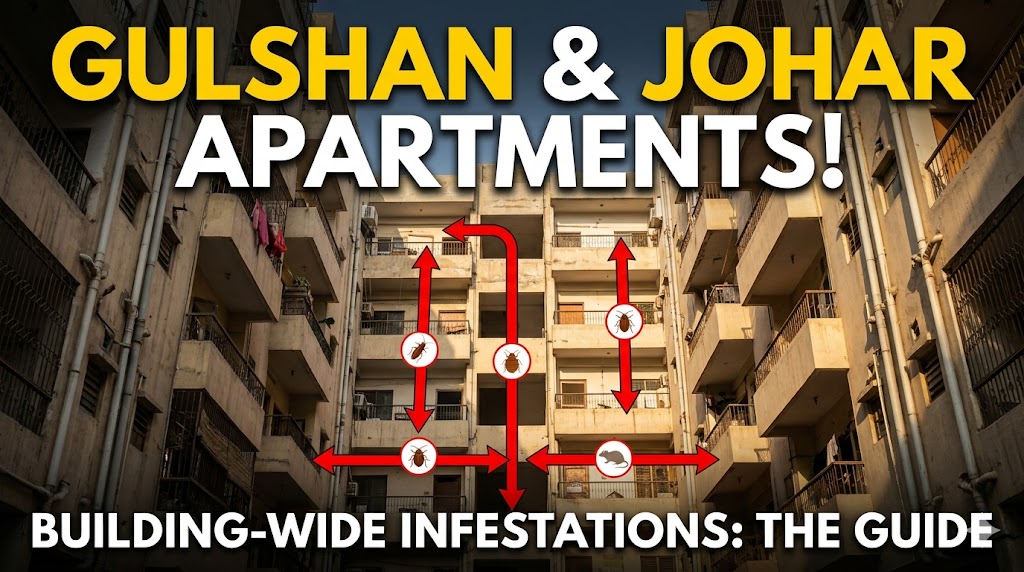
    Gulshan-e-Iqbal and Gulistan-e-Johar Apartment Pest Guide: Common Building-Wide Infestations

    If you live in an apartment in Gulshan-e-Iqbal or Gulistan-e-Johar, you have probably noticed that pest problems rarely stay contained to one flat. A neighbour complains about cockroaches — and a month later you see them too. Someone on the floor above calls a fumigator — and the pests migrate downward into your unit. This is not coincidence. It is the predictable result of how apartment buildings work.
    High-density residential buildings in these two areas present a specific set of pest challenges that flat-by-flat treatments cannot fully resolve. This guide explains the most common pests, why they spread building-wide, and what residents and building management can do about it.
    Why Apartment Buildings in Gulshan and Johar Are Particularly Vulnerable
    Both Gulshan-e-Iqbal and Gulistan-e-Johar have large stocks of mid-rise apartment buildings — typically 4 to 12 floors — built from the 1980s through to the early 2000s. Many of these buildings share common plumbing stacks, have incomplete sealing around pipe penetrations in walls and slabs, and have ground floors or basements used as garages or stores that are rarely maintained as thoroughly as residential units.
    Shared infrastructure is the primary pest transmission route. A single cockroach colony in a ground-floor utility room can populate an entire building’s kitchen plumbing stack within months, with individuals emerging in different flats at different times. This creates the illusion of multiple separate infestations when the source is actually a single population.
    The density of units also means that building-wide fumigation coordination is logistically difficult. When even two or three flats on a floor decline to participate in a treatment program, the gap allows pests to persist and re-infest treated units.
    Cockroaches: The Most Common Building-Wide Pest
    German cockroaches are the dominant pest problem in Gulshan and Johar apartment buildings. They spread through plumbing gaps between flats, through shared drain risers, and through hollow sections of kitchen and bathroom walls. Unlike American cockroaches, which enter from outdoor drains, German cockroaches live and breed entirely indoors — inside kitchen appliances, behind wall tiles, and in electrical panel voids. Professional cockroach control using gel baiting is the most effective approach because gel is placed inside harbouring sites rather than on open surfaces.
    When cockroach treatments in one flat are repeatedly unsuccessful, the reason is almost always re-entry from adjacent units. The problem is not the treatment method — it is the scope. Effective cockroach control in apartment buildings requires treating all units on at least one floor simultaneously, along with the building’s common areas.
    Bed Bugs: The Tenant Turnover Problem
    Apartment buildings with regular tenant turnover — a common feature of rented flats in these areas — are at high risk for recurring bed bug infestations. Bed bugs travel in luggage and second-hand furniture. When a flat is vacated and a new tenant moves in, they often bring bed bugs unknowingly — or find them already present from the previous occupant.
    Bed bugs also spread between adjoining flats through wall sockets, gaps around plumbing, and under door frames. A serious infestation in one unit will typically show secondary activity in the flats on either side and above or below within weeks. Heat treatment or high-concentration insecticide treatment, applied to all affected units simultaneously, is necessary to break the cycle.
    Rodents in Ground-Floor Units and Building Common Areas
    Ground-floor apartments and units adjacent to parking areas or basements in Gulshan and Johar buildings face regular rodent pressure. Rats enter through drainage, gaps around service pipes, and broken ventilation grilles. Once inside a building, they move vertically through wall cavities and between floor levels using pipe sleeves.
    Bin areas and garbage chutes in apartment buildings are primary attractants and harbouring sites. Buildings where waste management is inconsistent — bags left unsealed, chutes not regularly cleaned — will have persistent rodent problems regardless of how thoroughly individual flats are treated.
    Ants: A Seasonal but Spreading Problem
    Ant infestations in apartment buildings peak during summer and just after monsoon. Ant control in apartments requires baiting rather than spraying — spray kills forager ants on contact but does not reach the colony, which may be located in a wall void, floor cavity, or even soil accessed through ground-floor utility rooms. Gel bait allows foragers to carry toxicant back to the colony for a much more effective result.
    Black garden ants and fire ants are the most common species in these areas. Fire ant encounters, while rare, are painful and can trigger allergic reactions — particularly a concern in buildings with children.
    Signs of Building-Wide Infestation
    Residents can identify whether their pest problem is flat-specific or building-wide by watching for:
    • Multiple neighbours on the same floor or stack reporting the same pest around the same time
    • Pests reappearing within weeks of a flat-level treatment
    • Pest sightings in building common areas: stairwells, lifts, parking levels, rooftop water tank rooms
    • Cockroach or rodent activity in the building’s electrical room or generator room
    • Pest activity concentrated around shared plumbing walls between adjacent units
    DIY Prevention Steps for Apartment Residents
    • Seal gaps around all pipes entering the kitchen and bathroom with waterproof sealant
    • Use drain covers and clean floor trap grilles regularly
    • Do not store cardboard boxes for extended periods — they harbour cockroaches and bed bugs
    • Inspect second-hand furniture and luggage arriving from travel before bringing inside
    • Store food in sealed containers, not open bags or uncovered dishes
    • Report pest sightings to building management — individual action without building coordination rarely works
    If your building has overhead or underground water tanks, ensure they are cleaned regularly. Unmaintained water tanks attract pests and can become breeding sites for mosquitoes and other insects. Water tank cleaning is a hygiene service that complements pest control in apartment settings.
    The Solution: Building Management Must Lead
    For apartment buildings in Gulshan and Johar, the most cost-effective and lasting solution is a building-wide pest management program coordinated by the building owner or management committee. This involves treating all units, common areas, drainage infrastructure, and building periphery simultaneously — and maintaining it on a scheduled basis.
    Accurate Fumigation works with building management in Gulshan-e-Iqbal and Gulistan-e-Johar to design building-wide pest control programs that address the actual source of infestations rather than managing symptoms flat by flat.
    Whether you are a building owner looking to set up a maintenance contract or a resident who has tried flat-level treatments without success, contact us through our contact page to discuss the right approach. Transparent pricing for all treatment types is available on our charges page.

  • Bahria Town and Scheme 33 New Construction: Pre-Construction Termite Proofing Explained

    Bahria Town and Scheme 33 New Construction: Pre-Construction Termite Proofing Explained

    New construction in Karachi’s expanding residential zones — particularly Bahria Town Karachi and Scheme 33 — represents a significant investment. Most buyers and developers focus on material quality, contractor reliability, and finishing timelines. Pre-construction termite proofing rarely gets discussed until after the keys are handed over. By then, it is too late for the most effective form of protection.

    This article explains what pre-construction termite proofing is, why it matters specifically for new development zones, and why skipping it is a gamble that costs far more to correct later.

    What Is Pre-Construction Termite Proofing?

    Pre-construction termite proofing is a soil treatment process carried out before the concrete slab or foundation is poured. It involves applying a liquid termiticide to the soil at multiple stages of construction — beginning at the foundation excavation level — to create a chemical barrier between the ground and the building structure.

    This barrier prevents subterranean termites from migrating upward from the soil into the building. Because the treatment is applied before construction, it reaches the areas that are permanently inaccessible once the slab is poured: the soil directly beneath the foundation, around piles, and at plinth level.

    The treatment typically happens in three stages: soil treatment at the bottom of the excavation before the foundation is laid; treatment of the consolidated fill or murram beneath the slab; and perimeter treatment around the external plinth before backfilling. Some contractors also treat column bases and service pipe entry points.

    Why New Developments in Bahria Town and Scheme 33 Need This

    Both Bahria Town Karachi and Scheme 33 involve large-scale development on land that was previously undeveloped or used for agriculture and light industrial purposes. This land often has high organic content in the soil — a primary food source for subterranean termite colonies. Disturbing previously undisturbed soil during excavation also activates termite colonies that may have been dormant or distant from the surface.

    Large-scale construction projects in these zones involve extensive earthworks, irrigation of landscaped areas, and continuous soil disturbance over months or years. All of this creates moisture-rich, disturbed soil conditions — the most favourable environment for subterranean termites to establish new colonies and migrate toward construction.

    Newer developments also increasingly use engineered wood products — MDF, plywood, laminated board — in flooring, kitchens, and built-in wardrobes. These products are often more vulnerable to termite attack than solid hardwood because the adhesives used in their manufacture are not termite-resistant.

    What Happens If You Skip Pre-Construction Treatment?

    Post-construction termite proofing — applying treatment after the building is complete — is possible but significantly less effective and considerably more disruptive. It requires drilling through floor tiles and concrete at close intervals around the perimeter, injecting chemical under pressure into the substrate, and sealing the drill holes. It costs more than pre-construction treatment, is more disruptive to occupants, and cannot reach the soil directly beneath the slab centre where termite colonies most commonly migrate from.

    A building without any termite treatment can show infestation signs within two to five years, depending on soil conditions and proximity to moisture sources. Damage to built-in woodwork, skirting boards, wooden door frames, and structural beams is expensive to repair — and repair does not resolve the infestation.

    In a newly developed zone like Bahria Town or Scheme 33, where properties are sold on the basis of long-term investment value, an untreated termite infestation is both a structural and financial liability.

    The Construction Stages Where Treatment Must Happen

    Pre-construction termite proofing is time-sensitive. If the window is missed at each stage, that opportunity is permanently lost:

    • Stage 1 — Foundation excavation: Treat the soil surface and sidewalls of the excavation before any fill or concrete is placed. This is the most critical stage.
    • Stage 2 — Plinth fill: Treat the compacted fill beneath the floor slab before the damp-proof membrane or concrete is poured.
    • Stage 3 — Plinth/external perimeter: Treat the soil around the external plinth walls before backfilling and before construction progresses above plinth level.
    • Stage 4 — Pipe entry points: Apply treatment around all service pipe penetrations through the foundation slab before sealing.

    If construction is already at slab level or above, pre-construction treatment is no longer possible. The next option is post-construction soil injection, which should be done before internal finishing begins.

    Chemicals Used and How Long They Last

    Licensed termite control professionals use WHO-approved organophosphate or pyrethroid-based termiticides for soil treatment. These are applied in prescribed concentrations and volumes per square metre of treated area. When applied correctly, the chemical barrier typically remains effective for 5 to 10 years, depending on soil type, drainage, and whether any subsequent earthworks disturb the treated soil layer.

    This is why any renovation, extension, or underground plumbing work carried out after treatment must be followed by re-treatment of the affected soil area. The barrier must remain continuous to be effective.

    How to Verify Treatment Was Done Correctly

    Termite proofing is invisible once construction is complete. If you are buying a newly built property or engaging a contractor to build on your plot, ask for:

    • A written treatment report specifying the chemical used, concentration, volume applied per square metre, and the areas treated
    • The treatment certificate should be signed by a licensed pest control operator — not just the general contractor
    • Photographic documentation of the treatment stages
    • A warranty period from the pest control company, not the general contractor

    You can verify the licensing credentials of any pest control company on our pest control license page. Do not accept verbal assurances or documentation signed by the construction contractor alone.

    DIY Is Not an Option Here

    Pre-construction termite proofing cannot be done with commercially available sprays. The chemicals used are regulated, require professional-grade application equipment, and must be applied at precise concentrations to the correct volume per treated area. Under-dosing — the typical result of amateur application — produces no lasting barrier. Over-dosing in the wrong areas can contaminate soil and water.

    This is a job for a licensed pest control operator who can provide a warranty on the work. It is also one of the few pest control interventions where the cost of getting it wrong is measured in years of structural damage rather than a few weeks of inconvenience.

    Act at the Right Stage of Construction

    If you are currently building or planning to build in Scheme 33 or any part of Bahria Town Karachi, the time to arrange termite proofing is before your foundation slab is poured. Once that window closes, your options are more limited and more expensive.

    Accurate Fumigation provides pre-construction termite proofing services in Karachi, including stage-by-stage treatment aligned with your construction schedule. We provide written documentation and treatment certificates at every stage. To arrange a site visit or discuss treatment scheduling with your contractor, contact us through our contact page. For treatment costs at various property sizes, see our charges page. Build right from the ground up — termite proofing is not an optional extra, it is structural insurance.

  • Pest Control Challenges in Old Karachi Buildings: Saddar, Nazimabad, Lyari

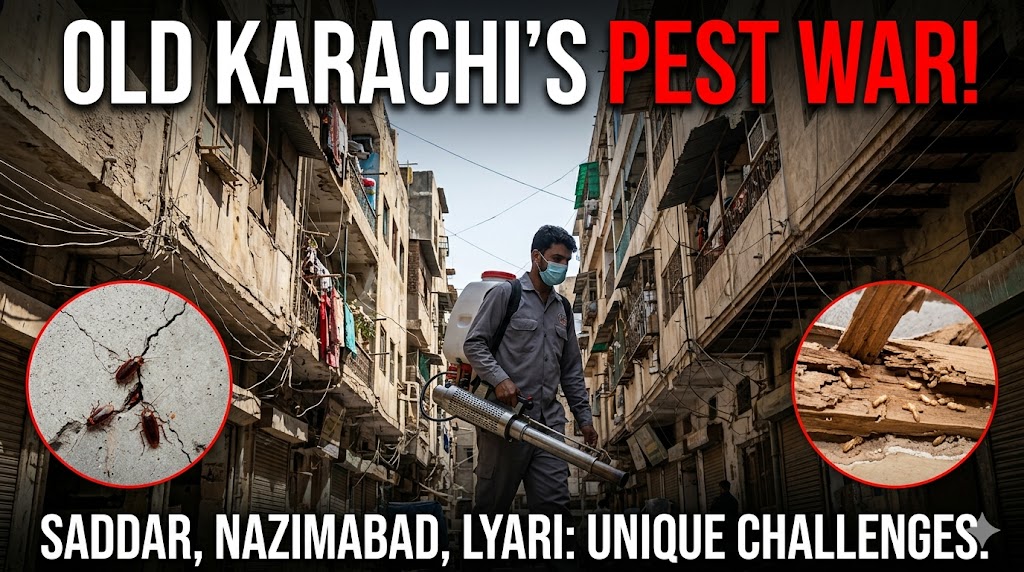
    Pest Control Challenges in Old Karachi Buildings: Saddar, Nazimabad, Lyari

    Karachi’s oldest residential and commercial zones carry the city’s architectural history in every cracked wall and narrow stairwell. But age comes with a cost that goes beyond maintenance: older buildings in Saddar, Nazimabad, Liaquatabad, and Lyari present a unique and particularly difficult set of pest control challenges that modern apartment towers simply do not face.

    This is not about cleanliness. Well-maintained old buildings still attract pests at far higher rates than newer construction. The reasons are structural, and they require a very different fumigation strategy.

    Why Old Buildings Attract More Pests

    Old construction in these areas typically features thick masonry walls with natural cracks and voids that develop over decades. Plumbing is often original, with joints that leak behind walls or under flooring — moisture that never fully dries. False ceilings and wooden mezzanines, common in older Saddar commercial buildings, create ideal harbouring spaces for cockroaches, rodents, and bed bugs.

    Many older residential buildings in Nazimabad and Liaquatabad use shared plumbing risers and drainage stacks. When one flat has an infestation, pests travel freely between units through pipe gaps, cable ducts, and broken wall cavities. Treating one apartment without coordinating with the building is almost never effective long-term.

    In Lyari and parts of old Saddar, some buildings pre-date Partition. Ground floors and basements in these structures often have earthen or poorly sealed concrete floors that allow subterranean termites and rodents to move in from the soil below.

    The Cockroach Problem in Old Buildings

    German and American cockroaches are the dominant species in old Karachi buildings, and both exploit the gaps that come with age. German cockroaches (the smaller, faster ones) breed inside electrical panels, behind refrigerators, and inside kitchen cabinet hinges — areas that old buildings have in abundance. Our cockroach control service in Karachi uses gel baiting for German cockroaches specifically because sprays do not penetrate the microhabitats they use.

    American cockroaches (the large red-brown ones) enter through drainage and sewer systems. Old buildings with deteriorating drainage pipes essentially provide direct underground access. Killing cockroaches in the living areas without sealing drainage entry points achieves nothing lasting.

    Rodents: A Structural Problem, Not Just a Hygiene One

    Rats in old Karachi buildings are not primarily a food hygiene issue — they are a structural one. The extensive void spaces inside old walls, between floor slabs, and within false ceilings give them entire hidden networks to live in undisturbed. Rat and rodent control in these buildings requires physical inspection of these void spaces and targeted placement of tamper-resistant bait stations, not surface-level traps near kitchens.

    In older commercial zones around Saddar, rodents also move between adjacent buildings and shops through connected ceiling voids and subfloor spaces. A grocery store treated in isolation will re-infest within weeks if the buildings on either side are untreated.

    Termites in Ground-Floor Units and Basements

    Ground-floor and basement units in old buildings are at very high risk for termite infestation. Termite control in these settings is complicated because the soil treatment barrier that protects the foundation was either never applied or has degraded completely over the decades. Re-treatment requires drilling through existing flooring and injecting termiticide into the substrate — a job that disrupts the space and must be done by professionals.

    In buildings where multiple tenants share a ground floor, gaining access to all affected areas simultaneously is logistically difficult. Many building owners delay until infestation has moved upward through the structure.

    Bed Bugs in Multi-Occupancy Buildings

    Old residential buildings in these areas often have high tenant turnover, which is a primary driver of bed bug infestations. Bed bugs travel in luggage, second-hand furniture, and clothing. Once they establish in one flat, they spread through shared wall cavities and door gaps to neighbouring units. A single-flat treatment rarely resolves a building-wide bed bug problem — the entire floor, at minimum, should be treated simultaneously.

    Signs of Pest Problems in Old Buildings

    Watch for these indicators specific to old Karachi construction:

    • Cockroach activity in daytime (a sign of overcrowding — the infestation is large)
    • Scratching sounds inside walls or ceilings at night (rodents in void spaces)
    • Mud tubes at the base of walls or along skirting boards in ground-floor units (termites)
    • Small blood stains or dark spots on mattress seams (bed bugs)
    • Persistent musty smell in closed rooms despite regular cleaning
    • Pest sightings despite regular tenant-level treatments that never fully resolve

    DIY Prevention in Old Buildings

    Tenants and building owners can reduce but not eliminate risk with these steps:

    • Seal all pipe entry points with foam or cement — gaps around pipes are the primary entry for both rodents and cockroaches
    • Do not allow gaps between skirting boards and walls to go unrepaired
    • Check second-hand furniture for bed bugs before bringing it into the building
    • Keep drains covered and ensure drainage pipes are watertight
    • Report leaking pipes to building management immediately — do not allow moisture to persist inside walls

    Why Building-Wide Coordination Is Essential

    The fundamental challenge with old Karachi buildings is that individual flat treatments in isolation are ineffective. Pests re-enter from adjacent units, from void spaces, and from building-wide drainage systems within weeks. Effective pest management in these buildings requires the building owner or management to coordinate treatment across all units and common areas simultaneously.

    Accurate Fumigation offers building-wide pest control contracts for residential buildings and commercial properties across Saddar, Nazimabad, and Liaquatabad. Coordinated treatment across the full building — with gap-sealing and follow-up inspections — is the only approach that delivers lasting results in old construction.

    To discuss a building-wide pest control plan or arrange an inspection, visit our contact page. For treatment costs, refer to our charges page. Old buildings deserve modern pest management — done right, once, rather than repeatedly and ineffectively.

  • Why DHA and Clifton Homes Get Termite Infestations Near the Coast

    Why DHA and Clifton Homes Get Termite Infestations Near the Coast

    If you live in DHA or Clifton and have noticed thin mud trails along your walls, hollow-sounding wooden frames, or paint that bubbles for no obvious reason, termites are the most likely culprit. Coastal proximity is not just a lifestyle perk — it is a structural risk factor that most homeowners do not account for until significant damage is already done.

    Karachi’s two most prestigious residential zones sit metres from the Arabian Sea. That coastal air carries moisture, and moisture is exactly what subterranean termites need to thrive. Understanding why your home is especially vulnerable is the first step to protecting it.

    The Coastal Factor: Salt Air, Humidity, and Wood Degradation

    Salt air corrodes metal fasteners and slowly degrades the surface integrity of timber. When wood begins to lose its outer hardness — even slightly — termites find it dramatically easier to penetrate. Homes in DHA Phase 1 through 6 and older Clifton blocks sit in a salinity corridor that effectively pre-conditions timber for termite attack.

    Karachi’s summer months (April to July) bring humidity levels that regularly exceed 80 percent in coastal areas. That ambient moisture seeps into foundations, wooden door frames, built-in cabinetry, and roof beams. Subterranean termites build their colonies underground and use mud tubes to travel upward through moist pathways — making the damp soil beneath coastal homes an ideal breeding ground.

    Monsoon season adds another layer of risk. Between July and September, water pools against boundary walls and soaks into the soil around foundations. Any home with poor drainage becomes a termite invitation. DHA plots with manicured lawns that are over-irrigated year-round face this problem even outside monsoon.

    Why Older Homes in These Areas Are at Greater Risk

    A significant portion of Clifton’s housing stock was built decades ago using construction methods that pre-date modern termite-proofing standards. Many older bungalows used untreated timber in roof structures, window frames, and flooring — wood that has had years to absorb salt-laden air and become structurally compromised.

    DHA also has a mix of old and new construction. Pre-2000 homes in Phases 1, 2, and 4 often lack soil treatment barriers beneath their slabs. Even newer construction in these phases, if not given proper pre-construction termite proofing, is vulnerable because the underlying soil conditions were never treated.

    Renovation work is a hidden risk as well. When you knock down a wall, install new piping, or excavate for an extension, you break the continuity of any existing chemical barrier in the soil. Termites exploit those gaps almost immediately.

    Signs of Termite Infestation in Coastal Karachi Homes

    Catch an infestation early by watching for:

    • Mud tubes running along the base of walls, behind pipes, or in corners of store rooms
    • Wooden door frames or skirting boards that sound hollow when tapped
    • Paint or plaster that bubbles, blisters, or cracks without obvious water leakage
    • Discarded termite wings near window sills or light fixtures after rain (a sign of swarming)
    • Fine powdery frass (termite droppings) accumulating near wooden furniture or built-ins

    In coastal homes, check the wooden members of any pergola or outdoor structure. Salt air plus ground moisture makes these the first points of attack.

    DIY Prevention Steps for DHA and Clifton Homeowners

    No DIY method replaces professional soil treatment, but these steps reduce risk:

    • Fix all plumbing leaks immediately — even a slow drip under a sink creates moisture that draws termites
    • Ensure your boundary wall drainage slopes away from the house foundation
    • Keep firewood, old timber, and cardboard stacked away from the structure and off the ground
    • Do not store wooden furniture or boxes directly on ground-floor storage room floors
    • Trim plants and hedges so they do not touch exterior walls — roots and mulch retain moisture
    • After any renovation or plumbing work, have the soil around the affected area re-treated

    Why Professional Termite Treatment Is Non-Negotiable Near the Coast

    Over-the-counter termite sprays treat surfaces, not colonies. Subterranean termites nest deep underground and send workers up through concealed tunnels. Unless the soil around and beneath the foundation is treated with a professional termiticide barrier, you are managing symptoms, not the infestation.

    Professional termite control in Karachi involves two approaches depending on your situation: soil treatment (pre- or post-construction chemical barriers) and baiting systems. For homes already built, post-construction soil treatment is injected under pressure around the perimeter and through drilled holes in the flooring — a process that requires specialist equipment and licensed chemicals not available to the public.

    If your home is in a high-humidity coastal pocket or sits on a plot with a high water table, a baiting system may be recommended alongside soil treatment. This is especially true for DHA properties near the creek areas and for older Clifton bungalows with complex foundations.

    Any treatment should be carried out by a company holding a valid pest control license, as the chemicals involved are regulated. You can verify licensing credentials at our pest control license page before hiring any service.

    Don’t Wait Until the Damage Is Visible

    Termites are known as the ‘silent destroyer’ because by the time you see physical damage, the colony has often been active for one to three years. In a coastal environment, structural timber deteriorates faster under combined salt and termite attack than in inland areas.

    Annual inspections are the minimum for DHA and Clifton homes. Properties that have already been treated should be re-inspected every 12 months to confirm the barrier remains intact, especially after any construction or plumbing work.

    Accurate Fumigation provides termite inspection and treatment across DHA and Clifton. To book an inspection or understand what a treatment plan for your property involves, visit our contact page. For a clear breakdown of what professional termite control costs, see our charges page. Protect your home before the damage is done.