Category: Pest Control Pricing & Buying Guides

Honest breakdowns of pest control costs in Karachi, what affects pricing, and how to choose the right service without overpaying. Compare options and make informed decisions.

  • 5 Questions to Ask Before Hiring Any Fumigation Company in Karachi

    5 Questions to Ask Before Hiring Any Fumigation Company in Karachi

    The fumigation market in Karachi ranges from professionally licensed operators with trained staff to roadside sprayers with a pump and a generic chemical. The difference is not always visible in marketing. It becomes visible in results — or when something goes wrong.

    Before you hand over money or allow anyone to treat your home, office, or warehouse, ask these five questions. The answers will tell you more than any brochure or WhatsApp message can.

    Question 1: Are You Registered with PPMA and Do You Hold a Valid Pest Control License?

    This is the foundational question. PPMA (Pakistan Pest Management Association) registration and a valid government-issued pest control license mean the company is legally authorized to purchase and apply regulated pesticides. Unregistered operators are not just less reliable — they are operating illegally in terms of chemical use.

    Ask for the license number and registration details. A legitimate company will provide these without hesitation. You can verify PPMA membership by contacting the association directly. Do not accept a printout that looks like a certificate with no verifiable registration number.

    You can review what a licensed operator’s credentials look like on our pest control license page.

    Question 2: Which Chemical Will You Use and What Is Its Active Ingredient?

    This question separates trained professionals from informal sprayers immediately. A trained technician will know the active ingredient by name — cypermethrin, bifenthrin, imidacloprid, fipronil, chlorpyrifos — and will be able to tell you what it targets, how it works, and what safety precautions are required.

    If the answer is “we use good spray” or the technician cannot name the active ingredient, that is a serious red flag. Unidentified chemicals in enclosed spaces — particularly in Karachi’s high-density apartment buildings and older housing stock — pose real health risks, especially for children, elderly residents, and anyone with respiratory conditions.

    Also ask: is the chemical approved for indoor residential use? Some agricultural-grade chemicals are used by informal operators because they are cheap. They are not formulated for enclosed living spaces.

    Question 3: What Does the Treatment Process Actually Involve?

    A professional fumigation or pest control treatment is not just spraying the perimeter and leaving. Ask for a step-by-step explanation of what will happen. For cockroach treatment, this should include gel bait placement in harborage areas, spray application in wall voids and plumbing access points, and post-treatment guidance. For termite treatment, it should include inspection, drilling, injection, and sealing. For bed bugs, it should include treatment of all harborage points, not just the mattress surface.

    If the explanation is vague or the technician cannot describe what they’ll do inside the affected rooms, the treatment is unlikely to be thorough.

    Our cockroach control service and termite control service pages describe the treatment methodology in detail, so you know what to expect from a professional service.

    Question 4: Is There a Written Report and a Re-Treatment Guarantee?

    A professional company documents every treatment. This includes: the property address, the pest type treated, the chemical applied and its concentration, the treatment date, and the technician’s name. This documentation protects you legally and practically — it is proof of service and a reference point if the infestation returns.

    Equally important is the re-treatment clause. Ask explicitly: if the infestation returns within the warranty period, what happens? Is a re-treatment included at no cost? Under what conditions? A company confident in its work will commit to this in writing. An informal operator who cannot provide documentation obviously cannot offer a warranty.

    In Karachi’s climate — where cockroach and mosquito pressure is seasonal and continuous — a re-treatment clause is not a luxury. It is a basic quality assurance mechanism.

    Question 5: What Precautions Should My Family Take, and for How Long?

    The answer to this question reveals whether the company is actually managing chemical safety or just completing a transaction. After treatment, residents typically need to vacate for a specified period, ventilate the space thoroughly, cover or wash food contact surfaces, and keep children and pets away from treated areas for a defined window.

    The specifics depend on the chemical used. A trained technician will give you precise, chemical-specific guidance. If the answer is “just open windows for one hour” with no further detail, that is not adequate safety communication.

    This matters most in Karachi’s apartment buildings where shared HVAC, narrow balconies, and adjacent units mean chemical drift is a genuine concern for neighbors, not just the treated unit.

    For any treatment involving stagnant water sources — tanks, drains, or wet areas that increase pest pressure — consider also asking about our water tank cleaning service, which removes a common breeding environment for mosquitoes and cockroaches.

    How to Use These Questions Before Booking

    You do not need to ask all five questions in a formal interview. Most of them come up naturally when you call to inquire. How a company responds to these questions — whether they answer with specifics or with vague reassurances — tells you what kind of service you are likely to receive.

    Serving clients across Karachi including PECHS, North Nazimabad, and Clifton, we’re prepared to answer all of these questions directly — and in writing when relevant.

    Ready to ask us these questions directly? Use our contact page to get in touch. You can also review our pricing page so there are no surprises when you request a quote.

  • Bed Bug Treatment in Karachi: Heat Treatment vs Chemical Spray — Which Lasts Longer

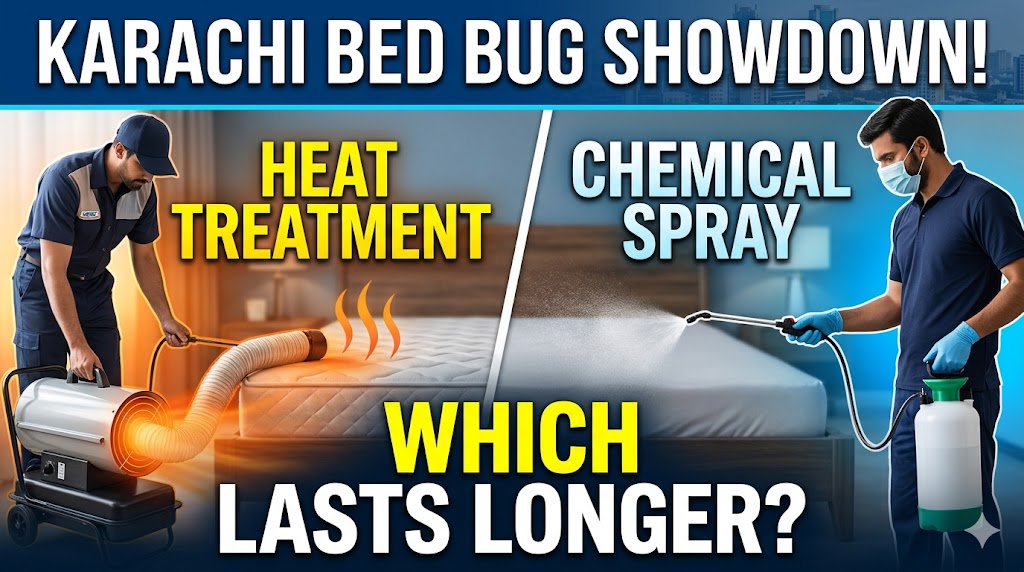
    Bed Bug Treatment in Karachi: Heat Treatment vs Chemical Spray — Which Lasts Longer

    Bed bugs are among the most difficult pest problems to eliminate in Karachi. They are small enough to hide in mattress seams, wall cracks, and electrical outlets. They reproduce quickly. And they are increasingly resistant to some commonly used pesticides. When an infestation is confirmed, the two main professional treatment options are heat treatment and chemical spray. Choosing the right one depends on the severity of the infestation, the structure of your property, and the level of disruption you can tolerate.

    This article gives you an honest comparison of both methods — what each does, what it can’t do, and which one tends to hold up longer in Karachi’s conditions.

    How Bed Bugs Behave in Karachi’s Climate

    Karachi’s heat and humidity create year-round conditions for bed bug survival and reproduction. Unlike many pests that have a defined peak season, bed bugs thrive throughout the year in Karachi — accelerating reproduction during the humid monsoon months and remaining active through the winter cold because indoor temperatures rarely drop low enough to disrupt their lifecycle.

    The most common introduction routes in Karachi are second-hand furniture and mattresses, shared transport upholstery, and hotel stays. Once inside a property, they spread rapidly between rooms and — in older apartment buildings with shared walls and utility ducts — between units.

    Chemical Spray Treatment: How It Works

    Chemical spray treatment for bed bugs in Karachi typically involves two to three rounds of insecticide application using contact killers (pyrethroids like cypermethrin) and residual products (neonicotinoids like imidacloprid or chlorpyrifos in some formulations). Gel baits are sometimes used in combination.

    The technician treats mattress seams, box spring bases, bed frames, headboards, skirting boards, wall cracks, behind electrical outlets, and any other harborage point. A professional application requires stripping the bed, moving furniture away from walls, and treating all surfaces — not just the visible mattress top.

    Chemical treatment requires residents to vacate for several hours and typically includes a follow-up application two to three weeks later to catch newly hatched nymphs that survived the first treatment in egg form, since most pesticides do not penetrate egg cases.

    Heat Treatment: How It Works

    Heat treatment (also called thermal remediation) kills bed bugs at all lifecycle stages — eggs, nymphs, and adults — by raising the temperature in the affected space to above 48-50 degrees Celsius for a sustained period. At this temperature range, bed bugs cannot survive, and crucially, their eggs are also killed — something most chemical products cannot achieve in a single application.

    Professional heat treatment requires specialized equipment: industrial heaters and fans to circulate hot air uniformly throughout the space, and temperature sensors to confirm that all areas — including inside mattresses, wall voids, and furniture joints — reach and hold the lethal temperature range for enough time.

    In Karachi, where summer ambient temperatures already reach 40+ degrees Celsius, the equipment requirement is still significant because the target temperature must be achieved uniformly inside enclosed spaces including furniture interiors.

    Comparing Effectiveness: What the Evidence Shows

    Heat treatment is widely considered to offer a higher single-treatment success rate than chemical spray alone. The reason is straightforward: heat penetrates all harborage points simultaneously, and it kills eggs — which chemical residuals typically do not. A properly executed heat treatment can achieve elimination in a single session.

    Chemical spray treatment is effective but almost always requires a follow-up application to address the egg hatching cycle. In a well-executed two-treatment protocol by trained technicians using appropriate chemistry, the results are strong. The challenge in Karachi’s market is that many informal operators use only one application at incorrect concentrations — which results in partial knockdown and infestation rebound within weeks.

    Resistance is a growing concern. Pyrethroid-resistant bed bug populations have been documented in multiple regions globally, and while Pakistan-specific resistance data is limited, the concern is valid given the heavy reliance on pyrethroids in informal pest control operations across Karachi.

    Which Lasts Longer in Practice?

    A properly executed heat treatment tends to have a higher rate of single-treatment resolution, meaning less likelihood of infestation return immediately after treatment. However, heat treatment does not provide residual protection — once the heat is off, the space is as vulnerable to re-introduction as it was before.

    A professional chemical treatment with residual products does leave active chemistry on surfaces for weeks after application, which provides some protection against newly introduced bed bugs. For properties with ongoing risk of re-introduction — high-footfall businesses, guest rooms, or apartments in buildings with confirmed bed bug problems in multiple units — this residual protection has practical value.

    In practical terms for Karachi homeowners: heat treatment offers a faster resolution with less risk of treatment failure from chemical resistance. Chemical treatment, when done correctly over two applications with appropriate chemistry, is also highly effective and more accessible since heat treatment equipment is less widely available in the market.

    Our bed bug fumigation service uses a professional chemical protocol designed specifically for the harborage patterns and resistance profile relevant to Karachi infestations.

    What a Professional Bed Bug Treatment Must Include (Regardless of Method)

    • Full inspection of the room including furniture, baseboards, wall cracks, and adjacent rooms
    • Treatment of all harborage points, not just the mattress
    • Pre-treatment preparation guidance for residents (stripping beds, clearing floor space)
    • Post-treatment ventilation and re-entry instructions specific to the chemical used
    • A follow-up visit within two to three weeks (for chemical treatment)
    • Written report of treatment and warranty terms

    If a quoted bed bug treatment does not include inspection, follow-up, and documentation, it is unlikely to achieve lasting resolution regardless of which method is used.

    Location Considerations Across Karachi

    Bed bug pressure is not confined to older properties or lower-income areas. Hotels, apartments, and even newer residential buildings in Bahadurabad, Shahra-e-Faisal, and Karsaz report infestations. The common thread is introduction from outside — not the age or quality of the property.

    The Bottom Line

    Heat treatment offers higher single-treatment efficacy and eliminates eggs that chemical products often cannot. Chemical spray treatment, done correctly over two sessions, is also highly effective and more widely available in Karachi. The method matters less than the quality of execution — an incomplete heat treatment fails just as badly as an under-dosed chemical spray.

    Choose a licensed professional, verify the treatment protocol, and ensure a follow-up visit is included in whatever you book.

    To book a professional bed bug assessment and treatment in Karachi, contact us via our contact page. For pricing details, see our charges page before you call.

  • DIY Pest Control vs Professional Fumigation in Karachi: When DIY Actually Works

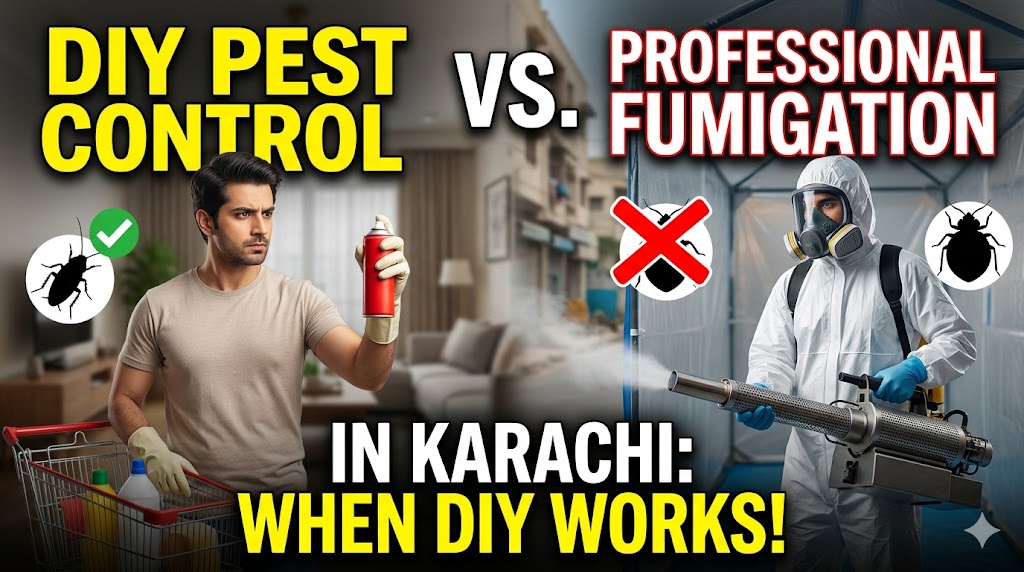
    DIY Pest Control vs Professional Fumigation in Karachi: When DIY Actually Works

    Walk into any Karachi hardware market or pharmacy and you’ll find a shelf full of pest control options: spray cans, gel baits, coil traps, ultrasonic devices, and chemical concentrates sold loose. It’s tempting to reach for these before calling a professional. Sometimes that’s the right call. Often it isn’t.

    This article gives you an honest breakdown of when DIY works, when it doesn’t, and what the difference in outcome actually looks like — based on the types of infestations common in Karachi homes, apartments, and commercial spaces.

    When DIY Pest Control Is a Reasonable First Step

    DIY is appropriate when the infestation is recent, localized, and the pest type responds to retail-grade solutions. Here are situations where it can work:

    Cockroaches (early-stage): A handful of cockroaches appearing in a newly moved-in apartment is not necessarily an infestation. Gel baits containing fipronil or hydramethylnon — available in Karachi’s pest control supply shops — can be effective if placed correctly: under the sink, behind appliances, and along plumbing runs. The key is placement precision and patience over several days.

    Ants (minor trail incursions): A small ant trail entering through a window or door gap can often be disrupted with a retail-grade ant gel or by sealing the entry point and applying a boric acid barrier. This works if the colony is not nested inside the wall cavity.

    Flies and mosquitoes (preventive): For seasonal mosquito and fly pressure — which peaks in Karachi during and after the monsoon from July through September — mesh screens, standing water elimination, and coil or electric vaporizer use is genuinely effective as prevention. These are not treatments for infestations; they are environmental controls.

    When DIY Fails — and Often Makes Things Worse

    The failure modes of DIY in Karachi are predictable. They fall into a few categories:

    Scattering without eliminating: Spraying a visible cockroach trail with a surface spray disperses the colony. Individual cockroaches scatter into wall voids and other rooms. The problem becomes harder to treat because the population is now spread across more of the property.

    Treating symptoms not the source: Bed bugs in a mattress require heat or chemical treatment that penetrates seams and joints. A retail aerosol spray will kill exposed adults on the surface but will not reach eggs or bugs in wall cracks, electrical outlets, or adjacent furniture. The infestation rebounds within two to three weeks.

    Incorrect dilution or application: Chemical concentrates sold in Karachi markets without labels or instructions are frequently misused. Overdilution makes them ineffective. Underdilution creates chemical hazards in enclosed, poorly ventilated apartments — particularly dangerous in the heat of Karachi’s April-to-June summer when windows are often closed due to dust and heat.

    For cockroach and bed bug problems that have progressed past the early stage, see our cockroach control service and bed bug fumigation service pages to understand what professional treatment involves.

    Pest Types That Should Not Be DIY’d in Karachi

    Some infestations in Karachi’s environment are structurally complex enough that DIY attempts are consistently ineffective:

    • Termites: Subterranean termites in Karachi require soil injection under the building slab. No retail product reaches this
    • Bed bugs (established): Once bed bugs have spread to multiple pieces of furniture or to wall cracks, professional treatment is the only reliable solution
    • Rodents (active colony): A rat or mouse entry point in an older property requires professional exclusion work, not just traps
    • Fleas and ticks: These require simultaneous treatment of pets, bedding, and premises — a coordination that DIY rarely achieves properly

    Our rats control service and fleas and ticks service pages explain the scope of professional treatment for these pest types.

    The Hidden Cost of Failed DIY

    The most expensive DIY mistake is delayed professional treatment. When a cockroach infestation is treated with surface sprays for six to eight weeks without success, the colony grows. The professional treatment required to address a large, scattered infestation is more intensive — and more costly — than treating the same problem early.

    In Karachi’s older apartment buildings, where infestations can travel between units through shared plumbing and wall voids, a delayed response in one unit often becomes a building-wide problem within a few months.

    DIY Prevention That Actually Works Long-Term

    Prevention is where DIY genuinely outperforms professional treatment in cost-effectiveness. These measures, done consistently, significantly reduce infestation risk:

    • Seal gaps around pipes entering the kitchen and bathroom with silicone or cement
    • Fix dripping taps and standing water in the bathroom — moisture attracts cockroaches and mosquitoes year-round
    • Store dry food in sealed containers, not open bags
    • Empty kitchen waste bins daily, especially during Karachi’s summer months when decomposition is rapid
    • Check second-hand furniture and clothing for bed bugs before bringing them inside
    • Keep the area under beds and in storage rooms free of cardboard boxes, which are a favored harborage for cockroaches

    Location Considerations Across Karachi

    Ground-floor units, basement-level spaces, and properties adjacent to open drains — common in areas like Korangi and Landhi — face higher structural pest pressure. DIY prevention works in these settings, but periodic professional treatment is often necessary to maintain control.

    If you’ve tried DIY and the problem persists, contact us via our contact page for a professional assessment. Review our service charges to understand what professional treatment costs relative to what you’ve already spent on retail products.

  • PPMA Registered vs Unregistered Pest Control Companies in Karachi: What’s the Real Difference

    PPMA Registered vs Unregistered Pest Control Companies in Karachi: What’s the Real Difference

    When a cockroach infestation hits your kitchen or a termite colony starts eating through your walls, the instinct is to call whoever you can find fastest. In Karachi, that often means a roadside sprayer, a WhatsApp contact, or someone with a hand-painted van. But choosing an unregistered operator over a PPMA-registered company is not just a gamble on quality — it can be a gamble on your family’s health.

    This article explains what PPMA registration actually means, why it matters, and how to verify a company’s credentials before letting anyone into your home or business.

    What Is PPMA and Why Does It Exist?

    PPMA stands for the Pakistan Pest Management Association. It is the industry body that sets professional standards for pest control operators across Pakistan, including licensing, chemical handling protocols, and ethical service practices. PPMA works alongside government regulatory authorities to ensure that pest control chemicals — which are classified as hazardous substances — are used safely and responsibly.

    A company listed on Accurate Fumigation’s pest control license page has passed baseline checks that unregistered operators simply bypass.

    What Registration Actually Requires

    Getting PPMA registered and maintaining legal compliance involves more than filling out a form. Registered companies must:

    • Use only approved, licensed pesticides that meet regulatory standards
    • Employ trained technicians who understand dilution ratios, application methods, and safety protocols
    • Maintain proper documentation for every treatment, including chemicals used and dosages
    • Follow label instructions legally — misuse of a registered pesticide is a violation
    • Carry liability in case of chemical damage or health incidents

    Unregistered operators have none of these obligations. They can use expired chemicals, wrong concentrations, or even industrial-grade substances meant for agricultural fields — not enclosed residential spaces.

    The Real Risks of Hiring Unregistered Operators

    The most common risk is ineffective treatment. Unregistered operators often use cheap, generic sprays at incorrect concentrations. The pests return within days, sometimes worse than before because knockdown sprays disturb colonies without eliminating the source.

    The second risk is chemical harm. Incorrect use of organophosphates or pyrethroid compounds in enclosed apartments — especially in older housing stock in areas like Saddar or Liaquatabad — can cause respiratory irritation, neurological symptoms in children, and contamination of food surfaces. Karachi’s summer heat worsens chemical evaporation in poorly ventilated spaces.

    If you’re dealing with a severe infestation and need treatment immediately, see our cockroach control service page or our termite control service page to understand what a professional treatment actually involves.

    How to Verify a Company’s Registration Status

    Do not rely on a logo on a van or a certificate printed on paper. Here is how to actually verify:

    • Ask for their PPMA membership number and cross-check it directly with PPMA
    • Ask to see their pesticide purchase receipts — registered companies buy from licensed distributors
    • Ask which active ingredient is being used and at what concentration — trained technicians will know this immediately
    • Check whether the company has a physical office address, not just a mobile number
    • Look for documented treatment reports, not just verbal assurances

    Price Differences: What You’re Actually Paying For

    Unregistered operators are cheaper — often significantly so. A registered company charges more because it absorbs the cost of proper chemicals, trained staff, equipment maintenance, and documentation. That price difference is not profit margin. It is the cost of doing the job correctly and safely.

    If you want a clear picture of what professional fumigation costs in Karachi, our charges page breaks this down transparently.

    Location Matters: Registered Coverage Across Karachi

    Registered operators typically cover broader geographic areas with consistent service standards. Whether you’re in a high-rise in DHA or a ground-floor unit in Federal B. Area, the treatment protocol should be the same.

    We serve clients across Karachi, including DHA, Federal B. Area, and Gulshan-e-Iqbal — with the same trained technicians and documented treatment process at every location.

    Bottom Line

    The difference between registered and unregistered is not about brand names or marketing. It is about accountability. When something goes wrong — and with unregistered operators, it often does — you have no recourse. No documentation, no liability, no follow-up.

    Registered companies operate under professional standards that protect both the client and the technician. In a city where pest infestations are a year-round reality, this matters.

    Ready to book a treatment from a licensed, professional team? Visit our contact page to schedule a service, or review our pricing before you call. You can also learn more about our credentials on the about us page.

  • How Much Does Termite Treatment Cost in Karachi? A Realistic Price Breakdown

    How Much Does Termite Treatment Cost in Karachi? A Realistic Price Breakdown

    Termites in Karachi are a slow disaster. They work inside walls, under flooring, and through wooden fixtures for months before the damage becomes visible. By the time you see mud tubes or hollow-sounding wood, the colony is already established. At that point, the question is no longer whether to treat — it’s how much it will cost and what you’ll actually get for that money.

    This article gives you a realistic breakdown of termite treatment pricing in Karachi, what drives cost variation, and what a genuine professional service includes versus what cheap alternatives typically skip.

    Why Termite Treatment Pricing Varies So Much in Karachi

    The price range for termite treatment in Karachi is wide — and the variation is not arbitrary. The key factors that determine cost are property size, infestation severity, treatment method, and whether it’s a residential unit or a commercial godown or warehouse.

    A ground-floor apartment in an older building in Nazimabad with subterranean termites reaching the ground slab is a fundamentally different job from a newer construction in Scheme 33 with a dry wood infestation in one set of cupboards. The chemical volumes, application depth, and labor time differ significantly.

    Common Termite Treatment Methods and Their Cost Implications

    There are two primary approaches used in Karachi for active infestations:

    Soil treatment (pre- and post-construction): This involves drilling into the floor at regular intervals and injecting termiticide directly into the soil beneath the slab. It is the most effective method for subterranean termite colonies, which is the most common type in Karachi’s older residential areas. It requires more labor, more chemical volume, and proper drilling equipment — all of which add to cost.

    Surface and injection treatment: For dry wood termites in wooden structures, furniture, or cupboards, technicians inject termiticide directly into galleries and apply it to affected surfaces. This is less invasive but may require multiple visits depending on infestation extent.

    Bait stations are used in some international markets but are less common in standard residential Karachi treatments due to cost and the need for long-term monitoring.

    What Drives the Final Price Up or Down

    • Property size: Treatment is typically quoted per square foot or per unit. Larger properties with more surface area and more potential entry points cost more
    • Infestation severity: A localized infestation in one room costs less to treat than a whole-building colony with multiple active galleries
    • Access difficulty: Crawl spaces, false ceilings, and inaccessible wall cavities add labor time
    • Chemical grade: Licensed termiticides — bifenthrin, imidacloprid, fipronil-based products — cost more than generic substitutes that unregistered operators often use
    • Warranty or follow-up included: Professional services that include a re-treatment guarantee or follow-up inspection are priced higher but often deliver better long-term value

    Red Flags in Low-Cost Quotes

    In Karachi’s pest control market, very low quotes almost always mean one or more of the following: diluted chemical concentrations, missing soil treatment steps, no drilling (just surface spray), no documentation, and no warranty. A proper soil treatment for termites is not a one-hour job. It involves mapping entry points, drilling at precise intervals, injecting under pressure, and sealing drill holes.

    For a transparent look at what professional termite treatment actually costs from a licensed company, see our charges page.

    Signs You Need Termite Treatment Before It Gets Expensive

    Early intervention costs less. Watch for these signs:

    • Mud tubes running along walls, skirting boards, or pipes
    • Hollow sound when tapping wooden frames, doors, or flooring
    • Discarded wings near windows or light fixtures (reproductive swarmers)
    • Blistering or bubbling paint that looks like water damage but isn’t near a water source
    • Frass — fine, sand-like pellets — near wooden furniture or baseboards

    If you spot any of these in Karachi’s post-monsoon months (September to November), act quickly. The humidity from the rainy season accelerates colony activity.

    DIY Termite Control: What It Can and Cannot Do

    Retail termite sprays available in Karachi markets can provide temporary surface knockdown but they do not reach soil colonies or internal gallery networks. For a localized, early-stage dry wood infestation in a single piece of furniture, a retail product may slow the spread. For anything in your walls, floors, or structural wood, professional soil injection is the only effective approach.

    Our termite control service page outlines the full treatment methodology used by our licensed technicians.

    Location-Specific Considerations in Karachi

    Older housing stock in areas like Garden, Saddar, and Liaquatabad tends to have higher termite pressure due to aging concrete slabs, deteriorating damp-proof courses, and established colony networks in the soil. Newer construction in DHA or Gulistan-e-Jauhar may face termite risk during and after construction if soil treatment was skipped.

    We provide termite treatment across Karachi, including Garden, Gulistan-e-Jauhar, and Nazimabad.

    What a Professional Quote Should Include

    A credible termite treatment quote in Karachi should specify: the treatment method, the active chemical and its concentration, the area covered, the number of drilling points (for soil treatment), whether a re-treatment clause is included, and the treatment timeline. If a quote just gives you a number with no details, ask for a written breakdown before agreeing.

    To get an accurate quote for your property, reach out via our contact page and describe your property size and the signs you’ve observed. You can also review our standard charges as a reference point before comparing quotes.