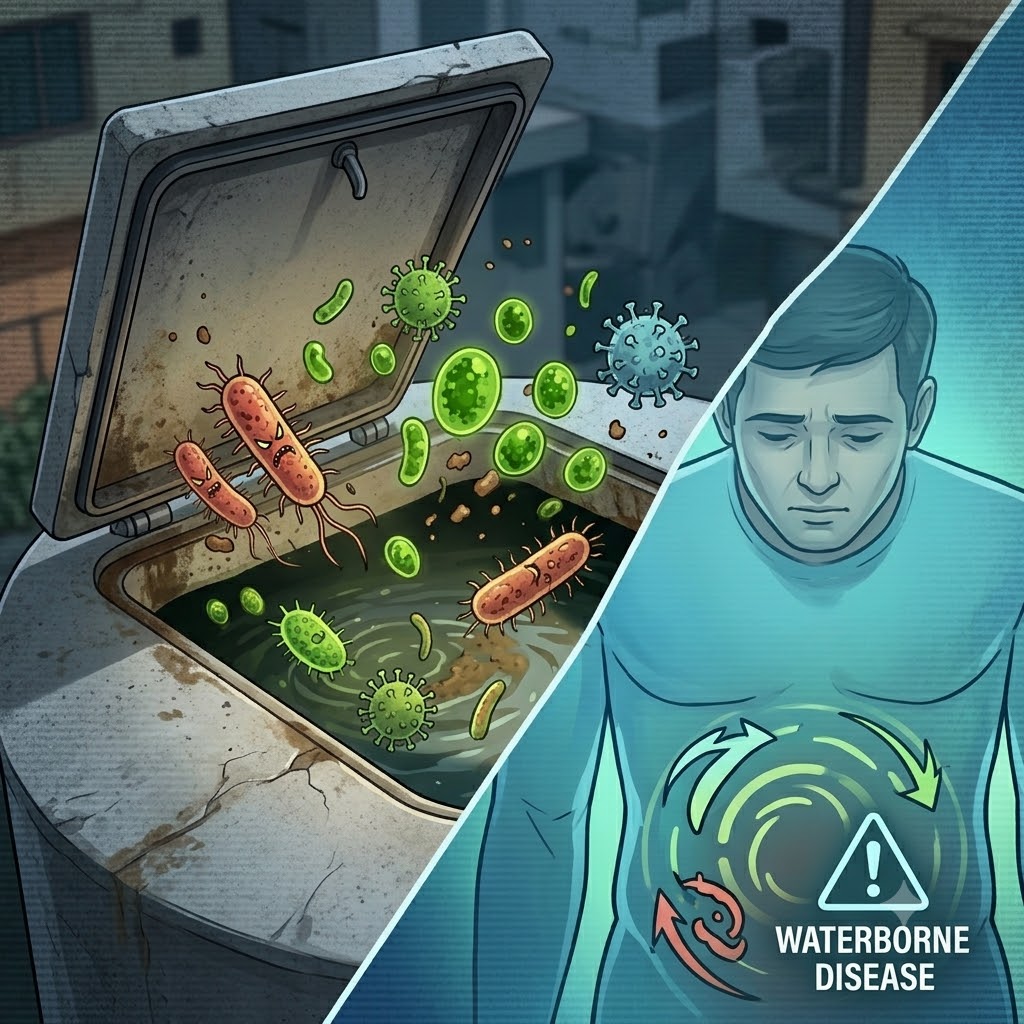
Yes, a dirty water tank can make you ill. Stored water that has grown bacteria can cause diarrhoea, vomiting and typhoid, and in Karachi unchlorinated water is also tied to the rare but almost always fatal brain infection caused by Naegleria fowleri. Clear-looking water does not rule any of this out.
Water in Karachi rarely travels a clean path from source to tap. It moves through an ageing KWSC (Karachi Water and Sewerage Corporation) network, sometimes through private tankers, into rooftop or underground storage, and finally into your kitchen. A tank is the stage where problems build over time: still water sitting for days, often warmed by sun, with organic debris and darkness in underground tanks. This post covers what grows inside a neglected tank and the health risks that follow, so you can see why regular water tank cleaning matters beyond clearer-looking water.
What Actually Grows Inside a Dirty Tank
Bacteria
Stagnant, contaminated water can harbour bacteria such as E. coli, Salmonella and Vibrio species, the organisms behind bacterial diarrhoea, typhoid and cholera. They typically arrive through contaminated inlet water, cracks that let in dust and debris, or a poorly sealed lid that gives insects, birds or rodents access. Source quality also varies: water that is already contaminated when it reaches your rooftop, whether from the network or a tanker, is a risk a household cannot fix at the tap.
Algae
Algae needs light, warmth and standing water, which an exposed rooftop tank provides for most of the year in Karachi. It shows up as green or brown staining and a musty smell. Algae is not always disease-causing in itself, but it changes taste and odour, can feed bacteria, and can clog filters and outlet pipes.
Biofilm and sediment
Biofilm is the slimy layer bacteria build on tank walls and the underside of lids. It clings to surfaces, so it is harder to remove than loose dirt, and it can act as a reservoir for bacteria even when the water looks clear. Sediment (dust, rust flakes, mineral deposits) settles on the floor and gets pulled into the supply line when water levels run low, which happens during supply gaps.
Health Risks of a Dirty Water Tank
| Risk | Linked to | Typical signs |
|---|---|---|
| Gastrointestinal illness | Bacteria such as E. coli, Salmonella and Vibrio in contaminated water | Diarrhoea, vomiting, cramping; recurring “stomach bugs” in the household |
| Typhoid fever | Salmonella Typhi, spread through contaminated water and food | Persistent high fever, headache, abdominal discomfort |
| Skin and eye irritation | Contaminated bathing water, especially with prolonged or repeated exposure | Itching, irritation, occasionally allergic reactions |
Diarrhoeal illness hits young children and elderly household members hardest, and a persistently dirty tank can mean recurring illness that never fully clears. Typhoid is a recognised concern in Pakistan and needs medical treatment, so do not self-diagnose it. If anyone develops a prolonged fever alongside stomach symptoms, or persistent diarrhoea or skin irritation with no clear cause, see a doctor rather than waiting for it to pass. And do not assume bathing water is safer than drinking water: a tank does not tell them apart.
Naegleria fowleri and Karachi’s Water
Karachi has recorded deaths from Naegleria fowleri in recent years: Pakistan reported five in 2024, four of them in Karachi, and the Sindh Health Department reported more in 2025. The amoeba lives in warm fresh water and infects people when contaminated water goes up the nose, for example during bathing or ablution, not by swallowing. It cannot survive in clean, chlorinated water, which is why health experts keep stressing chlorination and cleaning tanks before summer. Some reported cases involved no water exposure beyond routine use of tap water at home, so household water handling is part of the picture.
An unclean tank is not the only possible source, since the water entering it also matters and a household cannot control municipal chlorination. But a tank is the part you can control. Do not improvise chlorine doses: ask a professional tank-cleaning service or a health professional what is appropriate for your tank.
Who Is Most at Risk
- Young children, who are more vulnerable to dehydration from diarrhoeal illness
- Elderly household members, who may recover more slowly and face a higher risk of complications
- Anyone with an existing immune condition, for whom even mild bacterial exposure can be a bigger risk
- Pregnant women, for whom some waterborne infections carry added risk
If your household includes anyone in these groups, treat tank maintenance as a priority rather than something to get to eventually.
Why “The Water Looks Fine” Isn’t Reassurance
Most of the organisms above are invisible without lab testing. Water can look clear while the underside of the lid and the tank floor are coated in biofilm and sediment. That is why cleaning on a schedule beats cleaning only when something looks or smells wrong. For intervals that suit Karachi conditions, see how often to clean your water tank in Karachi, and use our checklist of signs your water tank needs cleaning to judge whether yours needs attention sooner.
How to Reduce the Risk
- Keep lids sealed and in good condition. Gaps let in dust, insects and rainwater, and open stored water is also a mosquito and dengue risk in Karachi
- Do not wait for visible signs. Sediment and biofilm build up long before symptoms appear, and the first signs differ between underground and overhead tanks
- Have tanks professionally drained, scrubbed and disinfected instead of relying on a quick rinse, which does not remove biofilm from the walls
- Check tanks right after heavy rain, when seepage and debris are more likely. Our guide to monsoon water contamination in Karachi explains what changes
- If you manage a building, shared tanks carry heavier use and more people at risk; see water tank cleaning for apartment buildings
Frequently Asked Questions
Can boiling water make up for a dirty tank?
Boiling kills most bacteria and is a sensible short-term precaution for drinking water. It does not remove sediment, fix taste and odour problems, or stop the contamination at its source, so the tank still needs cleaning.
Is bathing in water from a dirty tank as risky as drinking it?
It is generally lower risk for stomach illness, but not risk-free: skin irritation is possible, and water going up the nose, as in ablution, is the route for Naegleria. Do not treat it as safe just because it is not for drinking.
Can you get Naegleria from drinking tank water?
Reported cases describe infection through water entering the nose, not through swallowing. That is why bathing, ablution and nasal rinsing matter. If you are unsure about your tank water, ask a professional about cleaning and chlorination, and for nasal rinsing use water you know is safe, such as boiled and cooled water.
How quickly can bacteria build up in a cleaned tank?
It varies with the water source, temperature and sun exposure, but biofilm and algae can begin forming within weeks in warm conditions. That is why we recommend a fixed cleaning schedule rather than a clean-once approach.
Are plastic tanks safer than concrete ones for bacteria growth?
Both can support bacteria and algae if neglected. Rough or cracked inner surfaces, more typical of ageing concrete, are harder to clean fully and can hold biofilm. Whatever the material, a sealed lid and regular cleaning matter more.
Should I get my tank water tested?
If your household has had recurring, unexplained stomach illness, it is reasonable to ask a professional service about testing options alongside a full clean, rather than relying on how the water looks.
A note on health: this article gives general information about waterborne illness risk. It is not medical advice. If you or someone in your household has persistent symptoms, please consult a doctor.
Don’t Wait for Symptoms to Show Up
Contamination inside a tank is invisible until it isn’t. If it has been more than six months since your last clean, or you are not sure when it was done, get in touch and we will assess it properly. The cost depends on tank size and condition: see water tank cleaning cost by tank size and our charges page.

Rehan Khan is the founder of Accurate Fumigation and an entomologist. He holds an M.Sc. in Entomology and a B.Sc. in Environmental Science, and has worked in pest control in Karachi for three decades. He founded the company in 2005 and writes about the pest and water problems the city deals with each season. Accurate Fumigation is ISO 9001:2015 certified and a member of the National Pest Management Association.
Questions about a service, or need a certificate for an inspection? Call the office on 0330-2533480. Read Rehan’s full profile.