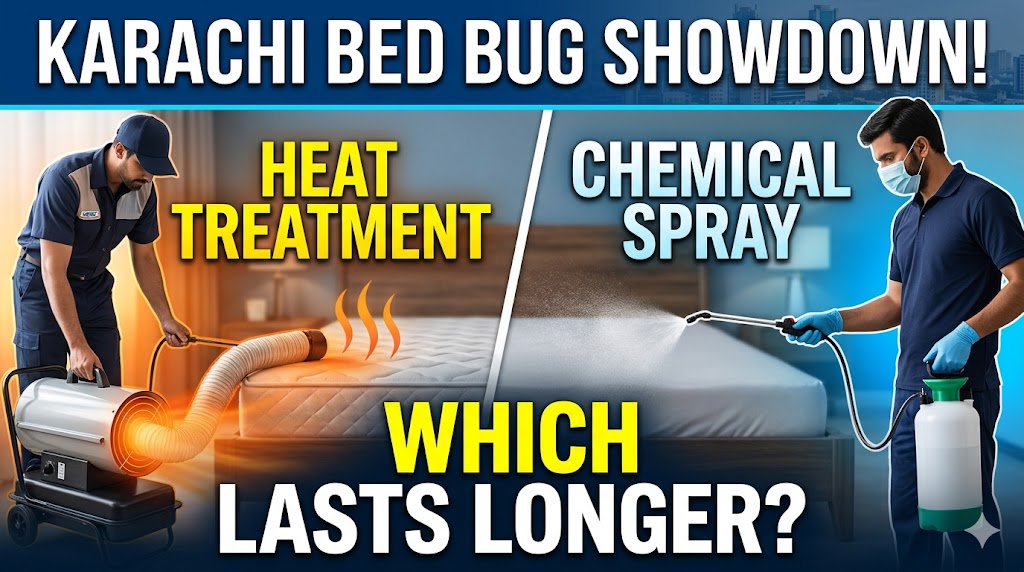
For bed bugs in Karachi, heat treatment usually clears an infestation in a single visit because it kills eggs as well as adults. Chemical spray needs two to three visits, but it leaves residual protection that heat does not. Heat is the stronger one-time knockdown. Chemical treatment is more widely available and better at guarding against re-introduction. For most Karachi apartments, a correctly executed chemical program, or a combination of both, is the practical choice.
Below is an honest comparison of how each method works, which one lasts longer, and how to pick the right one for your property.
Heat vs Chemical Bed Bug Treatment: Side-by-Side
| Factor | Heat Treatment | Chemical Spray |
|---|---|---|
| Kills eggs | Yes, if every area reaches lethal temperature | Mostly no, so a follow-up visit is needed |
| Visits usually needed | One, plus a check-up inspection | Two to three, about two to three weeks apart |
| Residual protection | None once the room cools | Stays active on surfaces for weeks |
| Affected by insecticide resistance | No | Yes, especially pyrethroid-only programs |
| Time out of the home | Most of a day | A few hours per visit |
| Availability in Karachi | Limited; few providers have whole-room equipment | Widely available |
| Relative cost | Usually higher per treatment | Usually lower per visit |
| Main cause of failure | Cold spots where bugs survive | Under-dosing and skipped follow-ups |
Why Are Bed Bugs So Hard to Get Rid of in Karachi?
Karachi’s warm, humid climate lets bed bugs breed all year. Activity picks up in the humid monsoon months of roughly July to September. In winter, indoor temperatures rarely drop low enough to slow them down. Adults can also survive weeks to months without feeding, so leaving a flat empty does not starve them out.
Most infestations arrive on second-hand furniture and mattresses, in luggage after travel or hotel stays, or from shared transport seats. In older apartment blocks, bugs travel between units through shared walls, ducts and wiring runs. That is why bed bug problems in Bahadurabad apartments and similar blocks often return after a single-flat treatment. Catching an infestation early makes either method far more effective, so learn how to identify bed bugs and where they hide.
How Does Chemical Spray Treatment for Bed Bugs Work?
A professional chemical treatment uses two kinds of product. The first is a contact insecticide, usually a pyrethroid such as cypermethrin or deltamethrin. The second is a residual product that keeps working on treated surfaces for weeks, often a combination formulation pairing a pyrethroid with a neonicotinoid such as imidacloprid. Technicians also puff desiccant dusts into wall voids, switch boxes and deep cracks where liquid sprays should not go. Gel baits are sometimes quoted for bed bugs, but they do not work: bed bugs feed only on blood and will not eat bait.
The technician treats a long list of hiding spots, not just the mattress top:
- Mattress seams and piping
- Bed frame joints, headboards and sofa frames
- Skirting, wall cracks and curtain rails
- The areas behind switchboards
Most sprays do not reliably kill eggs. A follow-up visit two to three weeks later catches the nymphs that hatch after the first round, and heavy infestations may need a third. You will need to stay out of the treated rooms for a few hours. Our guide on whether pest control is safe for children and pets covers re-entry in detail.
How Does Bed Bug Heat Treatment Work?
Heat treatment, also called thermal remediation, uses industrial heaters and fans to raise the air in a sealed room to roughly 50–60°C. That temperature is held until probes inside mattresses, cushions and furniture joints confirm the core has stayed above about 48–50°C for long enough. At that level, adults, nymphs and eggs all die, and the heat reaches voids that sprays miss. Medicines, aerosol cans, candles and heat-sensitive plastics or electronics must be removed first.
Be careful with the label. Some operators who advertise “heat treatment” actually mean a handheld steamer. A steamer works on mattress seams, but it is not whole-room treatment, so ask which one you are paying for.
Karachi adds three practical hurdles to heat treatment:
- Power supply. Heaters draw heavy power, so the job needs a generator or dedicated supply. A load-shedding cut mid-treatment lets the room cool and bugs survive.
- Concrete construction. Thick concrete walls and floors absorb heat, which makes skirting and wall edges the hardest spots to bring up to temperature.
- Packed storage. Full almirahs and stacked bedding create cool pockets unless they are opened out before treatment.
Summer weather does not help as much as people assume. A 40°C day is still well short of a sustained 50°C inside a mattress core.
Which Bed Bug Treatment Works Better and Lasts Longer?
Heat wins on single-visit success. It kills eggs, and insecticide resistance does not affect it. Pyrethroid-resistant bed bugs have been documented worldwide. Pakistan-specific data is limited, but Karachi’s informal market relies heavily on cheap pyrethroid-only sprays, which makes resistance a real concern.
Chemical treatment wins on lasting protection. Heat leaves nothing behind, so the next day the room is as open to re-introduction as before. A residual product keeps killing newly arrived bugs for weeks. That matters in guest rooms and hostels, and in flats where neighboring units are also infested. For a wider view of residual life, see how long a fumigation treatment lasts.
In practice, execution matters more than method. Most failed bed bug treatments in Karachi come from a single under-dosed spray with no follow-up, not from choosing the wrong method. Our bed bug fumigation service uses a professional chemical protocol designed around the hiding patterns and resistance issues common in Karachi infestations.
Which Method Suits Your Karachi Property?
Bed bugs are not a sign of an old or dirty property. They are carried in from outside, so new buildings get them too. The right choice depends on how the building is used:
- Flats in shared buildings in Gulshan-e-Iqbal, Gulistan-e-Jauhar or Bahadurabad: choose chemical treatment with a residual product, and encourage neighbors to get inspected. Heat alone will not stop re-entry through shared walls.
- Standalone houses with a heavy, long-running infestation: use whole-room heat if a properly equipped provider is available, followed by residual crack-and-crevice treatment. Otherwise, use a three-visit chemical program.
- Hotels and guest houses along Shahra-e-Faisal and around Karsaz: use chemical treatment with a residual product plus scheduled inspections. This is the approach that helps Karachi hotels pass pest control audits.
- Homes with infants or asthmatic residents: heat avoids chemical residue on sleeping surfaces. If you use chemical treatment, follow the ventilation and re-entry instructions exactly.
- Early infestations after a move or furniture purchase: targeted chemical treatment of the affected room is usually enough. See our checklist for moving into a new Karachi home.
What Must a Professional Bed Bug Treatment Include?
- A full inspection of the bedroom, furniture, skirting, wall cracks and adjacent rooms
- Treatment of every harborage point, not just the mattress
- Written preparation instructions before the visit
- Ventilation and re-entry guidance specific to the product used
- A follow-up visit within two to three weeks for chemical treatment, or a post-heat inspection
- A written treatment report and clear warranty terms
If a quote leaves out inspection, follow-up or paperwork, it is unlikely to give lasting results. Before booking, use these five questions to ask before hiring a fumigation company. Our guide to pest control warranties and guarantees explains what a fair warranty should cover.
Frequently Asked Questions
Can heat and chemical treatment be used together?
Yes. Many professional programs use heat to kill active bugs and eggs, then apply a residual product to frames, cracks and skirting for ongoing protection. This combines the strengths of both methods, though it costs more than either one alone.
Does putting a mattress in the Karachi sun kill bed bugs?
Only partly. Rooftop sun-drying can kill bugs on the exposed surface, but it rarely heats the inner layers to a lethal temperature for long enough. It also does nothing about bugs in the bed frame, walls or other furniture.
Should I throw away my infested mattress?
Usually not. Most mattresses can be treated and then sealed in a bed-bug-proof encasement, which traps any survivors inside. Carrying an infested mattress through stairwells can also spread bugs to other flats. If you do discard it, wrap it fully first.
How should I prepare my home for treatment?
Strip and bag all bedding and wash it on the hottest setting the fabric allows. Pull furniture away from walls and empty bedside drawers. Do not move belongings into other rooms, because that spreads the infestation. For heat treatment, also remove medicines, aerosols and anything that can melt.
How soon will I know if the treatment worked?
Some activity in the first week or two after chemical treatment is normal, as hatching nymphs cross the treated surfaces. If you still find live bugs or fresh spotting after the follow-up visit, ask for a re-inspection. Bites alone are not reliable evidence, since reactions can appear days later.
How much does bed bug treatment cost in Karachi?
Cost depends on the number of rooms, how severe the infestation is, how much furniture needs treating, and the method used. Heat treatment is usually more expensive per visit. See our charges page for current pricing.
The Bottom Line
Heat gives the most complete single-visit kill, including eggs. Chemical spray done properly over two to three visits can also clear an infestation, and it adds residual protection that heat cannot. An incomplete heat job fails just as badly as an under-dosed spray. Choose the provider before the method, and confirm they hold a valid pest control license.
To book a professional bed bug inspection and treatment anywhere in Karachi, contact us.

Rehan Khan is the founder of Accurate Fumigation and an entomologist. He holds an M.Sc. in Entomology and a B.Sc. in Environmental Science, and has worked in pest control in Karachi for three decades. He founded the company in 2005 and writes about the pest and water problems the city deals with each season. Accurate Fumigation is ISO 9001:2015 certified and a member of the National Pest Management Association.
Questions about a service, or need a certificate for an inspection? Call the office on 0330-2533480. Read Rehan’s full profile.