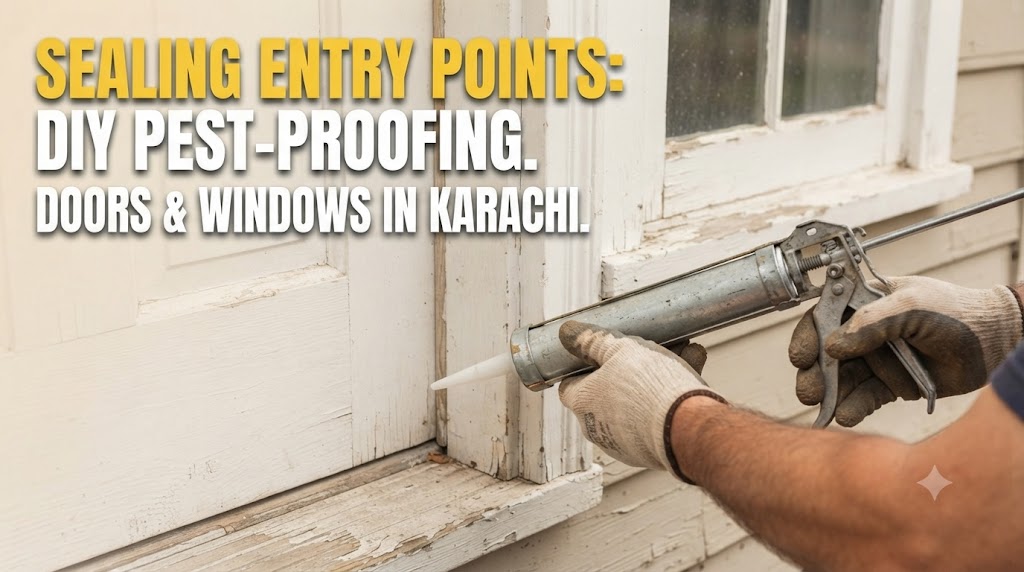
To stop pests getting into a Karachi home, seal every gap you can see daylight through: fit door sweeps on all exterior doors, replace worn window weatherstripping, foam or plate the gaps around pipes and AC lines, and cover vents with mesh. A gap the width of a pencil is enough for cockroaches, and mice can get through openings of about 6 mm, so small gaps matter.
In many of Karachi’s older buildings, doors have shrunk with age, window frames were never properly sealed, and pipe penetrations were left as-is once the plumber left. None of this is unusual, and almost none of it needs a contractor. This is a weekend-sized guide to finding and closing those entry points. It works alongside professional treatment, not instead of it. If pests are already established indoors, pair it with a proper pest control service in Karachi, because sealing alone won’t clear what’s already inside.
Why Does Sealing Entry Points Matter?
Chemical treatments and baits deal with pests already in or near your home, but they don’t stop new ones walking, crawling, or flying in tomorrow. Sealing is the structural half of pest prevention. You won’t notice the benefit quickly, but once done properly it keeps working with no ongoing effort. It is especially worth doing in older properties; our guide to pest control challenges in old Karachi buildings explains why they are so vulnerable.
How Do You Find Pest Entry Points in Your House?
The easiest method is to walk the outside of your house at dusk with a torch, looking for light leaking out from indoors. Or walk indoors during the day looking for daylight around doors and windows. Go slowly, because most gaps are small enough to miss on a quick glance. As a rough guide, anything you can slide a piece of paper through is wide enough for most household insects.
Doors
Check the gap under every exterior door, including the back door, service entrance, and any door to a terrace or garage. A door sweep, a simple strip fitted to the bottom of the door, is the highest-impact fix in most homes because it blocks the most common route for cockroaches, ants, and small rodents. Then check the frame itself. Gaps between the frame and the wall, especially on older wooden frames that have shifted, need caulk or expanding foam depending on their size.
Windows
If the weatherstripping around a window frame is cracked, peeling, or missing in sections, that is an open route for insects. Replacing it is inexpensive and takes an afternoon for a whole house. For gaps in the frame itself, exterior-grade silicone caulk holds up better against Karachi’s heat and humidity than standard interior caulk. Fine mesh screens on opening windows add a second barrier against flies and mosquitoes.
Pipe and Cable Penetrations
Every pipe, cable, or duct that passes through an exterior wall leaves a gap around it, and these are often left unsealed after installation. Expanding foam or a proper escutcheon plate closes them. Check around split AC installations in particular, since the holes are drilled fresh and often left with a visible gap around the pipe. Rodents use these gaps regularly; our guide to rat-proofing your home covers the other places worth checking.
Vents and Exhausts
Kitchen and bathroom exhaust vents, and any open ventilation grille or jali, need a proper mesh or louvre cover. An uncovered vent is an open hole into the house. Check that existing covers haven’t rusted through or come loose, which is common after a few years of Karachi’s coastal air. Never seal or block the flue or ventilation of a gas geyser or other gas appliance. Those need airflow for safety, so use a mesh cover that keeps airflow open.
Foundation and Boundary Wall Gaps
Cracks where the foundation meets the ground, or where a boundary wall joins the main structure, are a common termite route because they connect directly to soil. These are best handled in a professional termite control inspection rather than DIY, since a termiticide barrier does more here than caulk alone. If you’ve spotted mud tubes or hollow-sounding wood, see our guide to identifying termite damage in Karachi homes.
Which Gaps Should You Seal Yourself, and Which Need a Professional?
| Entry point | Fix | DIY or professional |
|---|---|---|
| Gap under exterior doors | Self-adhesive door sweep | DIY |
| Gap between door frame and wall | Caulk for small gaps, expanding foam for larger ones | DIY |
| Worn window weatherstripping | Replace cracked or missing sections | DIY |
| Gaps in window frames | Exterior-grade silicone caulk | DIY |
| Pipe, cable, and AC line penetrations | Expanding foam or escutcheon plate | DIY |
| Exhaust vents and ventilation grilles | Intact mesh or louvre cover; keep gas appliance flues open | DIY |
| Foundation and boundary wall cracks | Termiticide soil barrier, not caulk alone | Professional |
Doing this after a renovation or AC installation? New work creates fresh gaps, which we cover in our guide to post-renovation pest prevention. If you’re preparing for the rains, combine this with our guide to pest-proofing your Karachi home before monsoon season.
What Materials Do You Need?
A basic kit for most homes is a tube of exterior-grade silicone caulk, expanding foam for larger gaps, self-adhesive door sweeps, and replacement window weatherstripping. A caulking gun and a utility knife cover almost every job in the table above.
What Won’t Sealing Fix?
Sealing stops new pests entering, but it does nothing for a population already established behind your walls or under your foundation. If you’ve sealed every obvious gap and still see cockroaches, ant trails, or signs of rodents, the problem is already indoors and needs treatment, not more sealing. The same goes for termites: sealing a crack near the foundation doesn’t remove a colony feeding underground. For help deciding which route suits you, read our comparison of DIY pest control vs professional fumigation.
Frequently Asked Questions: Sealing Entry Points in Karachi Homes
How do I know if a gap is actually letting pests in?
If you can see daylight through it from indoors, or slide a piece of paper through it easily, it is wide enough for most common household insects. Rodents need more room, roughly 6 mm for a mouse and about 12 mm for a rat. Gaps this size are worth sealing even if you haven’t had a pest problem yet.
Will door sweeps stop rats, or only insects?
A good sweep blocks most insects and deters rodents too, but rats and mice can squeeze through surprisingly small openings elsewhere. Pair the sweep with a check of pipe penetrations and vents. If you already have droppings or gnaw marks, rats control treatment is the next step.
Is caulking enough to stop termites?
Caulk helps with small surface cracks but isn’t a termite barrier. Termites travel through soil and can build mud tubes over a caulked gap if a colony is nearby. Foundation-level risk is better handled with a professional soil treatment.
How often should I redo the sealing around my house?
Check weatherstripping and door sweeps once a year, since Karachi’s heat degrades rubber and foam seals faster than in cooler climates. Silicone caulk on window frames typically lasts a few years before it needs reapplying, depending on sun exposure.
I’ve sealed everything I can find but still see cockroaches. What now?
That usually means the population is already established indoors, so sealing alone won’t clear it. A targeted cockroach control treatment aimed at existing harbourage points is the more effective step. Our guide to cockroach control cost in Karachi explains what affects the price.
Will sealing gaps stop ants in the kitchen?
It helps a lot, because ants usually enter through tiny gaps around door frames, windows, and pipes. If trails keep appearing, they’ve found food or an indoor nest, and our guide to ant trails in Karachi kitchens explains how to trace the source.
Seal First, Then Treat If Needed
A thorough sealing pass around doors, windows, and utility penetrations removes most of the easy entry points pests rely on, and it’s a weekend project for most homes. If you’ve done the sealing and still have an active pest problem, or you’d rather have a professional flag the gaps you missed, get in touch and we’ll take it from there.

Rehan Khan is the founder of Accurate Fumigation and an entomologist. He holds an M.Sc. in Entomology and a B.Sc. in Environmental Science, and has worked in pest control in Karachi for three decades. He founded the company in 2005 and writes about the pest and water problems the city deals with each season. Accurate Fumigation is ISO 9001:2015 certified and a member of the National Pest Management Association.
Questions about a service, or need a certificate for an inspection? Call the office on 0330-2533480. Read Rehan’s full profile.