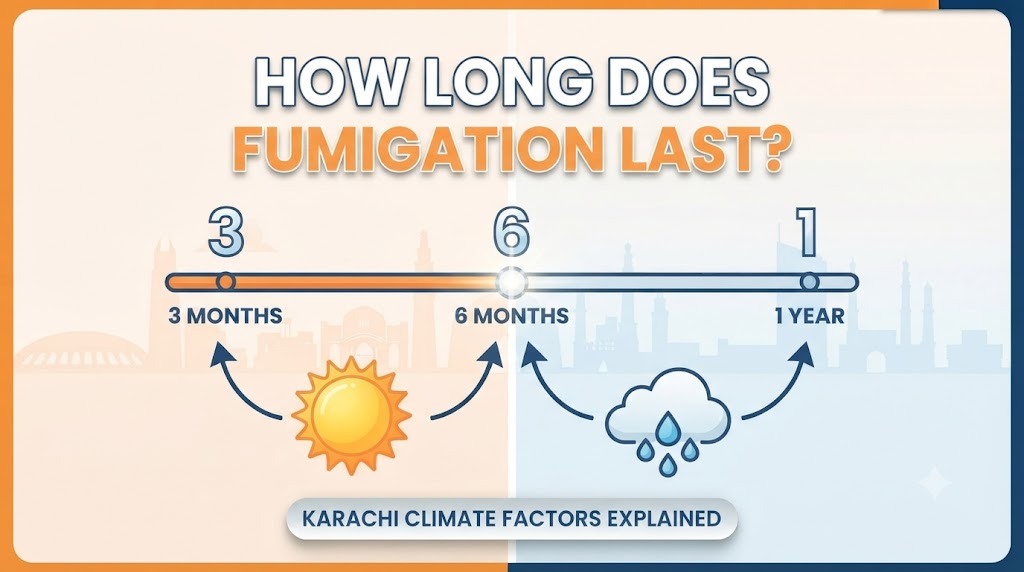
This guide walks through what actually determines how long a fumigation service in Karachi holds up, pest by pest, and why Karachi’s heat, humidity, and monsoon pattern change the maths.
The Two Types of “Lasting” — Elimination vs Prevention
Before comparing treatments, it helps to separate two different things a fumigation is doing:
- Elimination — killing the pests present at the time of treatment
- Residual protection — continuing to kill or repel pests that arrive afterward
Straight fumigation (a sealed-gas treatment) is extremely effective at elimination but, once the gas disperses and the property is aired out, it leaves no residual protection behind. That’s a genuinely important distinction: a fumigated property can be re-infested days later if there’s an active colony nearby, unless it’s paired with a residual barrier treatment. Liquid termiticide sprays and baiting systems work the opposite way — slower to fully eliminate, but they keep working for months or years afterward.
Termite Treatments: What Determines the Lifespan
Professional termiticide barrier treatments, when properly applied around a structure’s foundation, are generally understood to hold up for roughly five years under normal conditions, with high-quality termiticides sometimes extending protection further depending on soil type and moisture exposure. Gas fumigation (tenting) kills existing termites effectively but, as above, provides no lasting barrier — it needs to be paired with soil or wood treatment for lasting protection.
Termite bait stations sit somewhere in between: they take longer to fully eliminate a colony but need routine monitoring and rebaiting every few months to stay effective.
For a proper termite control service in Karachi, most technicians will recommend re-inspection at least once every one to two years given local conditions — more on why below.
Bed Bug Treatments: A Shorter Runway
Bed bug fumigation works differently from termite treatment because bed bugs don’t build a single central colony you can barrier off — they hide in mattress seams, bed frames, wall voids, and shared walls in apartment buildings. A single treatment typically needs a follow-up within two to three weeks to catch eggs that survived the first round, and warranty periods in the industry are commonly 30 to 90 days rather than years, simply because reinfestation risk from a neighbouring unit or a returning traveller is much higher than with a structural pest.
Cockroach, Ant, and General Pest Treatments
Residual sprays for cockroach control generally hold effectiveness for four to twelve weeks depending on the product and how much cleaning/mopping happens on treated surfaces afterward. This is why most reputable providers recommend quarterly rather than one-off visits for kitchens, restaurants, and food storage areas — not because the first treatment failed, but because residual protection naturally fades with normal household activity.
Water Tank Cleaning: A Different Kind of “How Long”
Water tank cleaning isn’t a pesticide treatment, but the same climate logic applies. Karachi’s heat accelerates algae and sediment build-up, and KWSC supply interruptions mean many households store water for longer stretches than they would in cities with continuous supply — both of which shorten the practical interval between cleanings. Most households benefit from cleaning every six months, sooner if the tank sits on an exposed rooftop that gets direct sun for most of the day.
Why Karachi’s Climate Changes the Equation
Karachi’s weather isn’t a minor detail here — it’s a major factor in how long any treatment holds:
Heat and Humidity Most of the Year
Karachi carries high humidity from March through November, with a short, sharply defined monsoon wet season and a longer dry season the rest of the year. That extended warm-humid stretch means pest life cycles — especially cockroaches and bed bugs — never really slow down the way they would in a temperate climate with a true winter reset. Bed bugs in particular rely on humidity to maintain body moisture, and Karachi’s coastal humidity during monsoon months regularly sits in a range that suits them well, which is part of why local infestations can rebound faster than the same treatment would in a drier city.
The Monsoon Window (Late June–Mid September)
Monsoon rain softens soil, floods underground nests, and pushes termites, ants, and cockroaches to seek drier ground — often indoors. Termite colonies frequently release winged swarmers after the first heavy showers, which is often the first visible sign of a nearby colony for homeowners in older housing stock. This is also when subterranean termites can most easily expand mud tubes toward a building’s foundation, since damp soil is easier to tunnel through than dry, compacted ground.
Older Building Stock
Many properties across Saddar, PECHS, Nazimabad, and North Nazimabad were built decades ago, with wall voids, wooden fittings, and plumbing runs that give pests far more hidden pathways than newer construction. That structural reality shortens the effective life of any single treatment, since there are simply more entry points to defend.
How to Extend the Life of a Treatment
- Schedule around the seasons, not just once a year at random — a pre-monsoon inspection catches vulnerabilities before the wettest months arrive
- Fix moisture sources — leaking pipes, poor roof drainage, and AC condensation lines are magnets for termites and cockroaches alike
- Don’t scrub away residual sprays immediately after treatment — ask your technician which surfaces need to stay untouched, and for how long
- Combine treatments where appropriate — a termiticide barrier alongside periodic bait station checks tends to outlast either approach alone
- Get a written treatment record, especially for commercial premises that may need to show a fumigation certificate during an SFA or KMC inspection
Signs Your Treatment Has Already Worn Off
It’s worth knowing what to watch for rather than waiting for an obvious infestation to reappear:
- Winged swarmers appearing near lights or windows, especially just after the first monsoon rains — a strong early indicator of nearby termite activity, even if you don’t see mud tubes yet
- Cockroach sightings during daylight hours, which usually means the population has grown large enough that individuals are being pushed out of their usual hiding spots
- New bite marks appearing after travel or guests, a common sign of reintroduced bed bugs even in a previously treated property
- Visible mud tubes along foundation walls, door frames, or skirting boards, which point to subterranean termites actively rebuilding after rains softened the soil
- A musty or damp smell near walls or under sinks, often linked to the same moisture conditions that shorten treatment lifespan in the first place
Catching these early — rather than waiting for visible damage — is usually the difference between a quick top-up treatment and a full re-treatment.
FAQs
How long does termite fumigation last in Karachi? Straight gas fumigation offers no lasting residual protection — it kills existing termites but needs a follow-up barrier treatment to stop reinfestation, which is especially important given Karachi’s monsoon soil moisture.
Does bed bug treatment need to be repeated? Almost always, yes. A follow-up two to three weeks after the first treatment is standard practice to catch newly hatched bugs the first round missed.
Why do cockroaches come back so quickly in Karachi compared to other cities? Karachi’s extended humid season means cockroach life cycles rarely slow down, so residual treatments naturally face more pressure than in cooler, drier climates.
Should I schedule pest control before or after monsoon season? Ideally both — a pre-monsoon inspection to seal vulnerabilities, and a post-monsoon check since termite and cockroach activity typically spikes once the rains ease.
How often should I get my water tank cleaned in Karachi? Roughly every six months is a reasonable baseline, more often for uncovered or rooftop tanks exposed to direct summer heat.
Does a longer warranty always mean a better treatment? Not necessarily — it depends on what pest is covered and what the warranty actually requires from you (like maintaining moisture control) to stay valid. Ask for the terms in writing before assuming coverage length equals quality.
The Bottom Line
There’s no single answer to “how long will this last” that applies to every pest and every property — but in Karachi, the climate consistently shortens the gap between treatments compared to drier or cooler cities. Building your pest control schedule around the local weather pattern, rather than an arbitrary once-a-year habit, is the single biggest thing you can do to get real value out of a treatment. If you’re not sure what schedule fits your property, reach out for an inspection and get a realistic answer rather than a guess.

Founder, Accurate Fumigation — B.Sc. Environmental Science, M.Sc. Entomology
Most pest control operators in Karachi learn the trade on the job. Rehan studied it first — a B.Sc. in Environmental Science followed by an M.Sc. in Entomology — before spending 30 years applying that background in the field, the last 20 of them running Accurate Fumigation, which he founded in 2005.
That distinction matters more than it sounds. A technician who’s only ever sprayed knows what worked last time. Someone trained in entomology understands why a species nests where it does, how a colony’s life cycle affects treatment timing, and why a generic spray often fails to reach the actual breeding site. It’s the difference between treating symptoms and treating the source — and it’s why Accurate Fumigation’s termite work carries a warranty of up to 5 years rather than the usual 3-month terms most Karachi operators offer.
Rehan’s team is PPMA registered and FBR/SRB compliant, works exclusively with WHO-approved chemicals, and has handled everything from termite proofing in DHA’s older bungalows to full-scale fumigation contracts for restaurants and warehouses in Korangi. Every job — residential or commercial — closes with a written warranty and, where required, a certificate accepted by KMC, WASA, and the Sindh Food Authority.
Questions about a specific pest problem, or want a certificate for a compliance inspection? Reach Rehan’s office directly at 0330-2533480, or visit at Office-307/2, Razeen Blessings, Block 1, Gulistan-e-Johar, Karachi.