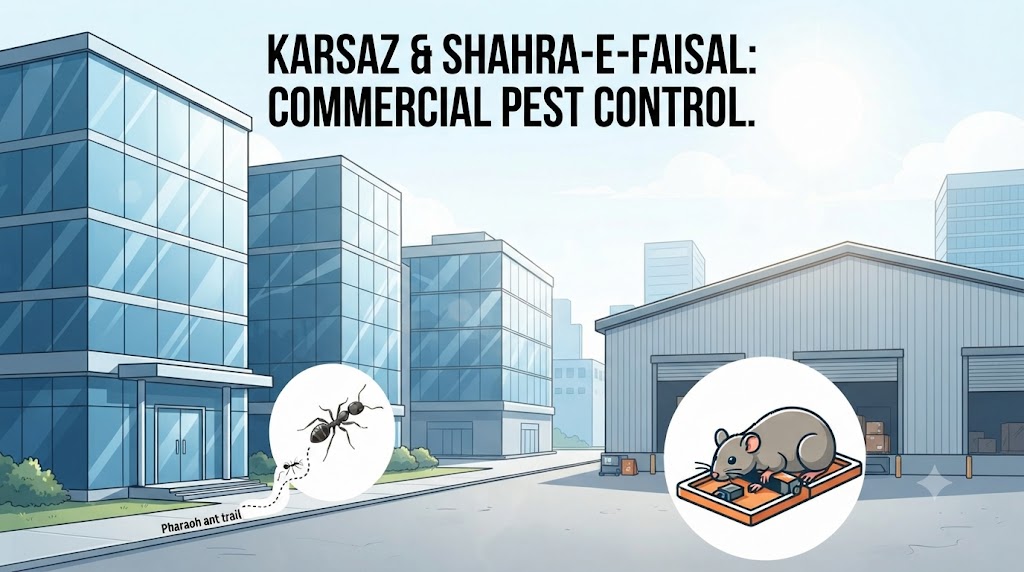
Offices, showrooms, and warehouses along Karsaz and Shahra-e-Faisal need a different pest control approach than a house in a residential lane: treatment scheduled around business hours, phased across large floor plates instead of done in one visit, and documented well enough to satisfy an audit or a health inspection. This corridor is Karachi’s busiest commercial strip — airport-facing offices, corporate towers, logistics warehouses, banks, showrooms, and a steady run of restaurants — and each type of business carries a different pest risk and a different tolerance for disruption.
A pest control service in Karachi that works for a bungalow in DHA doesn’t automatically work for a 40,000 sq ft warehouse near Shahra-e-Faisal. The pests are often the same species, but the scale, the access constraints, and the business risk are not.
Why Karsaz and Shahra-e-Faisal Are a Different Kind of Job
This corridor is a mix of multi-storey office blocks, bank branches, showrooms, hotels, and warehousing that feeds the rest of the city. Buildings here run double shifts, host visiting clients, and often can’t shut down for a treatment the way a home can simply lock a bedroom for a few hours.
The other difference is exposure. A warehouse near Shahra-e-Faisal is receiving trucks, pallets, and packaging from all over the city and sometimes upcountry, and every delivery is a potential entry point for rodents, ants, and stored-product pests — something a typical household never has to think about. An office tower, by contrast, has almost no goods movement but a constant flow of tenants, visitors, and shared service areas like lifts, basements, and cafeterias where one floor’s problem can spread to the next.
Common Pests in Karachi’s Commercial Buildings
A few pests show up again and again in offices, showrooms, and warehouses along this stretch:
- Cockroaches — cockroach control is usually needed around pantries, cafeterias, and basement stores where food waste and moisture collect overnight.
- Rats and mice — rodent control tends to concentrate around loading bays, stockrooms, and false ceilings where cabling runs give them cover.
- Termites — termite control risk climbs wherever there’s wooden paneling, false-ceiling framework, or stored timber pallets sitting against a damp wall.
- Ants — ant control is usually needed where trails run in through cafeteria counters and vending areas once sugar or grease residue builds up.
Warehouse-Specific Risks Worth Taking Seriously
Warehouses carry a different kind of exposure than offices. Stored-product pests can move in with raw material or packaging and spread through pallet stacks before anyone notices. Cardboard boxes stacked directly on the floor, especially near loading dock walls, are a classic rodent and cockroach entry point, and condensation from air conditioning units or poorly sealed roof lines creates the damp pockets that termites and cockroaches both look for. In a warehouse holding paper stock, textiles, or packaged food, that damage isn’t cosmetic — it’s inventory loss. Our warehouse and godown fumigation guide covers how a facility that size should be zoned and treated.
Office and Showroom-Specific Risks
Offices and showrooms don’t have a warehouse’s stock exposure, but they have their own weak points: shared pantries and basement cafeterias that run all day, server rooms and false ceilings that stay warm and undisturbed, and reception or display areas where a single sighting in front of a client does more damage than the pest itself. Multi-tenant towers add a layer most single-owner buildings don’t face — one tenant’s kitchen or storeroom can seed an infestation that spreads through shared risers and ceiling voids to floors that have nothing to do with the source. Building management companies along this corridor are increasingly asking for standing pest control contracts rather than one-off callouts for exactly this reason; our note on corporate office pest control contracts lays out what that arrangement usually covers, and showroom or retail spaces facing similar client-facing pressure can see how audits typically run in our shopping mall and retail pest control audits guide.
Compliance and the Business Reputation Angle
Restaurants and food outlets along Shahra-e-Faisal face real inspection pressure — the Sindh Food Authority has run repeated hygiene crackdowns across Karachi in recent years, and pest presence or a lack of fumigation records is one of the things inspectors flag. A documented pest control schedule isn’t just good practice; it’s often asked for directly when a client, franchisor, or health inspector visits. Our restaurant fumigation certificate guide covers what documentation an SFA visit typically expects.
Offices and showrooms have a softer version of the same problem: client-facing spaces where a visible pest sighting damages trust in a way that’s hard to undo. Building management companies increasingly ask vendors for proof of licensing before signing an annual contract — worth checking our pest control license page, and worth reading our PPMA registered vs unregistered companies comparison before signing with any vendor, since an unlicensed contractor’s paperwork won’t hold up in an audit.
How Often Commercial Spaces on This Corridor Need Treatment
| Business type | Typical treatment pattern |
|---|---|
| Offices & showrooms | Annual contract with quarterly check visits |
| Restaurants & food outlets | Quarterly to monthly, plus records kept for inspections |
| Warehouses & godowns | Quarterly, with extra checks after large or irregular stock deliveries |
| Hotels & banquet/event spaces | Monthly, timed around occupancy and event calendars |
These are general patterns, not fixed rules — the right frequency depends on the building’s age, how much goods movement it sees, and what came up at the last inspection. A standing contract versus a one-time treatment is usually the first decision worth making once a business moves past its first callout.
Scheduling Treatment Without Disrupting Operations
Commercial clients almost always ask the same question first: can this be done without shutting us down? For most office and showroom treatments, the answer is yes — after-hours or early-morning slots let the treatment set in before staff arrive, and low-odour formulations are available for spaces that can’t tolerate a strong smell during business hours.
Warehouses usually need a phased approach — one zone treated while operations continue in another, rather than a single all-at-once shutdown. A pre-treatment walkthrough is worth insisting on so the technician can map loading bays, electrical risers, and storage racks before anything is scheduled. Karachi’s monsoon months (roughly July to September) also tend to push up cockroach and termite activity in this corridor, so buildings due for their quarterly check around then shouldn’t push it back.
A Basic Prevention Checklist for Office and Warehouse Managers
- Keep pallets and boxes off the floor and away from exterior walls — a few inches of clearance breaks the easiest rodent and termite access routes.
- Seal gaps around loading dock doors and cable entry points; these are the two most common entry points in commercial buildings.
- Schedule pantry and cafeteria deep-cleans on a fixed weekly basis, not on an as-needed basis.
- Log every pest sighting with date and location — this is what turns a reactive callout into a pattern management program.
- Renew treatment contracts annually rather than waiting for a visible infestation to trigger action.
Frequently Asked Questions
Can pest control be done in an office without disrupting work hours?
Yes — most office and showroom treatments are scheduled after-hours or early morning specifically so the space is ready before staff return.
Do warehouses need a different treatment approach than offices?
Yes. Warehouses have larger areas, loading dock exposure, and stored goods that need protecting, so treatment is usually phased across zones rather than done in one pass, while offices are treated in a single after-hours visit.
How often should a commercial building in this area be treated?
It depends on the type of business — see the treatment pattern table above. Buildings with heavier goods movement or food handling generally need more frequent visits than a standard office.
Does a restaurant need proof of pest control for health inspections?
Yes, food outlets are commonly asked for a documented treatment schedule during inspections, so keeping records from every visit is worth doing regardless of whether it’s requested that day.
What’s the biggest pest risk specific to warehouses versus homes?
Stored-product pests and rodents entering with incoming stock — a risk homes generally don’t face since goods aren’t moving in and out on pallets daily.
What should I ask a pest control company before signing a commercial contract?
Ask for proof of registration and licensing before anything else — an unregistered contractor’s paperwork won’t satisfy a building management or health audit. Beyond that, ask how zoning works for larger spaces, what’s covered under the annual rate versus billed as extra, and how sightings between visits are handled.
Get a Commercial Assessment Before It Becomes a Bigger Problem
If your office, showroom, or warehouse along Karsaz or Shahra-e-Faisal hasn’t had a proper pest assessment recently, it’s worth getting one done before a client visit or inspection forces the issue. Pricing depends on the property’s size, layout, and how severe the activity already is — our charges page has the breakdown. Get in touch to schedule a walkthrough and a treatment plan that fits your operating hours.

Rehan Khan is the founder of Accurate Fumigation and an entomologist. He holds an M.Sc. in Entomology and a B.Sc. in Environmental Science, and has worked in pest control in Karachi for three decades. He founded the company in 2005 and writes about the pest and water problems the city deals with each season. Accurate Fumigation is ISO 9001:2015 certified and a member of the National Pest Management Association.
Questions about a service, or need a certificate for an inspection? Call the office on 0330-2533480. Read Rehan’s full profile.