Category: Water Tank Cleaning

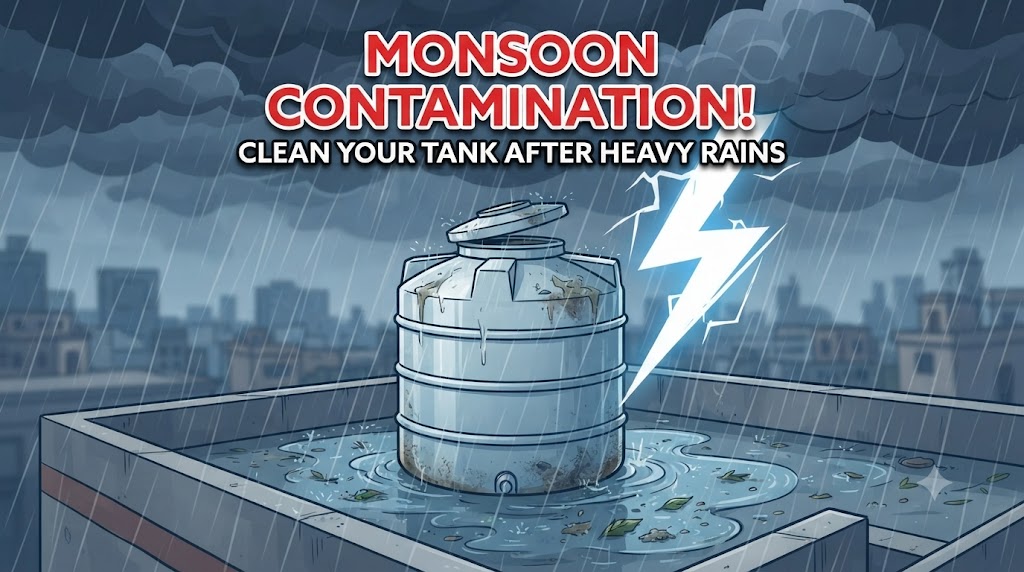
  • Monsoon Water Contamination in Karachi: Why Tanks Need Cleaning After Heavy Rains

    Monsoon Water Contamination in Karachi: Why Tanks Need Cleaning After Heavy Rains

    Every year, the first heavy monsoon spell in Karachi brings the same relief and the same worry. The heat finally breaks, but somewhere on the roof or under the driveway, a water tank that was sealed and safe a week ago is quietly taking on rainwater, silt, and runoff it was never built to handle.

    This isn’t a minor seasonal inconvenience. Karachi’s monsoon has repeatedly been linked to spikes in waterborne illness across the city, and household storage tanks are one of the last points where that contamination can be caught before it reaches a family’s drinking glass or kitchen tap. A proper water tank cleaning service in Karachi after the rains is less about routine maintenance and more about closing that gap.

    This post looks specifically at how monsoon rain compromises a tank, what actually ends up in the water, and what a household or building should do about it before the next spell arrives.

    How Monsoon Rain Actually Gets Into Your Tank

    Most Karachi homes rely on a combination of an underground tank (often called a boring or sump) and a rooftop overhead tank. Each has its own weak points during heavy rain.

    • Rooftop tank lids that have warped, cracked, or lost their rubber seal over years of sun exposure let rainwater — carrying roof dust, bird droppings, and debris — seep straight in.
    • Overflow and vent pipes that aren’t properly capped or angled can act as a direct channel for rain and insects to enter the tank.
    • Underground tanks in low-lying streets can take in floodwater through hairline cracks in ageing concrete, especially where nearby sewage lines run close to the water line.
    • Waterlogged streets increase pressure on the boundary between fresh water lines and sewage lines — in older parts of the city where the two run close together, this is a known route for cross-contamination.

    None of these entry points are visible from the tap. The water can look, and even taste, perfectly normal while carrying a real health risk.

    What’s Actually in Contaminated Monsoon Water

    Health authorities and physicians across Karachi report a consistent rise in waterborne illness during and immediately after the monsoon — typhoid, cholera, hepatitis A and E, and acute gastroenteritis are the ones doctors watch most closely. These aren’t rare, exotic infections; they’re common, preventable ones tied directly to contaminated water and food.

    Water quality studies of Karachi’s household supply have repeatedly found a large share of tested samples carrying coliform bacteria and E. coli — clear markers of sewage contamination. Rain doesn’t create this problem on its own; it accelerates an existing weakness in ageing pipes, tanks, and drainage that gets exposed the moment the system is put under real pressure.

    Sediment and organic debris washed in during rain also feed algae and biofilm growth inside the tank long after the rain itself has stopped, which is why tanks often need attention even a few weeks after the last heavy spell.

    Signs Your Tank Needs Attention After Heavy Rain

    You don’t need a lab test to know something is off. Watch for:

    • Water that looks cloudy, has a slight tint, or leaves a film in a clear glass after it settles
    • A musty, earthy, or faintly sulphurous smell from the tap, especially first thing in the morning
    • Visible sediment or grit settling at the bottom of buckets or in the kettle
    • A noticeable drop in water pressure, which can point to debris partially blocking the outlet pipe
    • Any household member developing repeated stomach upset with no other obvious cause

    Areas of Karachi Where This Risk Runs Higher

    Low-lying and older parts of the city tend to see worse street flooding and slower drainage, which puts more pressure on underground tanks specifically. Homes and businesses in areas like Malir, Landhi, Korangi, Saddar, and Garden often deal with standing water for longer after a spell, and that extended contact time increases the chance of seepage into ageing tank walls and joints.

    That said, this isn’t only an older-infrastructure problem. Newer housing schemes with rooftop tanks that have never been serviced are just as exposed, since the failure point there is usually a degraded lid seal rather than the tank structure itself.

    What Professional Post-Monsoon Cleaning Actually Involves

    A proper post-monsoon clean isn’t a quick rinse. It typically involves draining the tank fully, physically scrubbing sediment and biofilm off the interior walls and floor, removing any debris that’s entered through the lid or overflow pipe, disinfecting the interior, and rinsing thoroughly before the tank is refilled. Underground and overhead tanks are usually treated as separate jobs since sediment builds up differently in each.

    As a pest control company in Karachi that also handles water tank cleaning, we treat this the same way we’d treat any hygiene-critical job — controlled process, proper disinfection, and a tank that’s genuinely safe to refill, not just visibly emptied and rinsed.

    Protecting Your Tank Before the Next Downpour

    • Check the rooftop tank lid and seal before monsoon season starts, not after the first leak is noticed
    • Make sure overflow and vent pipes are capped with a mesh or cover that keeps rain and insects out without blocking airflow
    • Have underground tanks inspected for hairline cracks, especially if the tank is more than a few years old
    • Schedule a full clean both before the monsoon season begins and again after the heaviest spells pass
    • Keep the tank fully covered and secured year-round — an unsecured lid is the single most common entry point we see

    Monsoon Dampness Doesn’t Stop at the Water Tank

    A tank that’s taken on moisture from cracked seals or flooding is usually a symptom of a wider dampness problem, not an isolated one. The same humidity and standing water that push contaminants into a tank also create ideal conditions for termites in wooden fittings and door frames, and for cockroaches breeding in damp, undisturbed corners of the kitchen and bathroom.

    If you’re already having your tank inspected after a heavy spell, it’s worth having someone check for early termite activity around door frames and skirting boards at the same time — termite damage in Karachi’s older housing stock is often first noticed months after the monsoon that actually caused it. The same goes for a sudden cockroach presence indoors, which tends to spike right alongside the rains as insects move in from waterlogged drains and gardens looking for dry ground — a cockroach control service at the same time as your tank clean is a reasonable, efficient pairing rather than two separate call-outs.

    What This Costs Homeowners Who Wait

    The households that end up spending the most on monsoon-related water problems are usually the ones who waited until a visible symptom forced their hand — a child with repeated stomach upset, a tank so sediment-choked that water pressure drops noticeably, or a rooftop tank lid that finally gives way entirely during a storm. Each of these is more disruptive, and often more expensive, to fix once it’s an emergency than it would have been as scheduled maintenance.

    A pre-monsoon inspection and a post-monsoon clean, treated as two fixed dates on the household calendar rather than something to think about only when the water looks wrong, is consistently the cheaper and safer path over a full year.

    Frequently Asked Questions

    How soon after heavy monsoon rain should I get my tank cleaned?

    Ideally within a week or two of the heaviest spell passing, especially if you’ve noticed cloudy water, a change in smell, or if your street experienced visible flooding. Waiting longer gives sediment more time to settle and biofilm more time to establish itself on the tank walls.

    Will boiling the water make it safe if my tank has been contaminated?

    Boiling kills most bacteria and parasites and is a reasonable short-term precaution for drinking water, but it doesn’t remove sediment, physical debris, or the underlying contamination sitting in your tank. It’s not a substitute for cleaning the tank itself.

    Is it the rain that’s unsafe, or the tank?

    Usually it’s a combination — rain introduces contaminants and floodwater pressure, but it’s a compromised tank (a bad lid seal, a cracked wall, an uncapped overflow pipe) that lets that contamination actually reach your stored water.

    How do I know if my underground tank has been affected by street flooding?

    Cloudy or gritty water, a musty smell, or a sudden change in taste after a period of heavy rain are the main warning signs. If your street held standing water for an extended period, it’s worth having the tank inspected even without obvious symptoms.

    Do you clean both overhead and underground tanks?

    Yes — overhead and underground tanks are cleaned as separate processes since they collect different types of sediment and have different access points.

    Getting Ahead of Monsoon Season

    Karachi’s monsoon isn’t going anywhere, and neither is the strain it puts on ageing water infrastructure across the city. A tank that’s cleaned and properly sealed before the rains, and checked again once the heaviest spells pass, is one of the simplest ways a household can protect itself from a genuinely serious health risk.

    If it’s been a while since your tank was last cleaned — or you’re not sure when it last was — get in touch and we’ll help you get ahead of the season rather than reacting to it.

  • Water Tank Cleaning Cost by Tank Size: 1000, 2000 and 5000 Gallon Pricing in Karachi

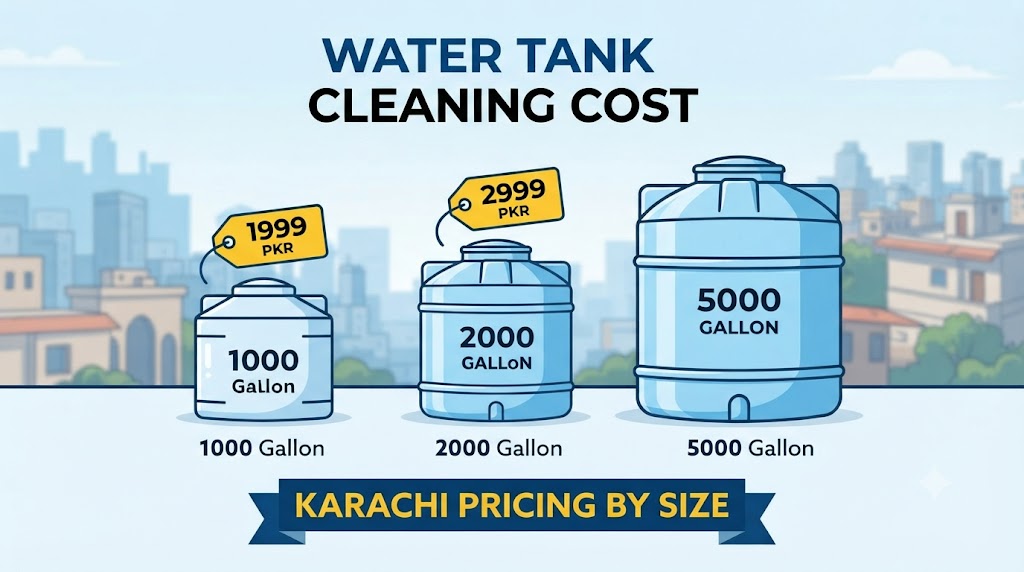
    Water Tank Cleaning Cost by Tank Size: 1000, 2000 and 5000 Gallon Pricing in Karachi

    “How much will it cost?” is usually the first question after “is my tank actually dirty?” — and it’s a fair one, since prices for water tank cleaning in Karachi can look inconsistent from one company to the next if you’re just comparing numbers without knowing what’s behind them. This post breaks down what actually drives cost by tank size, so you know what a quote should reasonably cover before you accept it.

    We won’t quote exact fixed figures here — pricing depends on your specific tank’s condition, material, and accessibility, and you can see our current rates on the charges page or get a quote after a quick site visit. What we can do is explain the pattern.

    Why Size Isn’t the Only Factor

    It’s tempting to assume cost scales purely with gallons — a 5,000 gallon tank should cost roughly five times a 1,000 gallon one. In practice it doesn’t work that cleanly, because several other variables move independently of size:

    • Underground vs overhead — access difficulty affects labour time regardless of tank capacity, which we cover in detail in our comparison of underground and overhead cleaning
    • Tank material — concrete tanks with rough or aged internal surfaces take longer to scrub thoroughly than smooth plastic tanks
    • Condition at time of cleaning — a tank that’s gone well past its recommended interval, with heavy sediment or algae buildup, takes longer to bring back to a clean baseline than one on a consistent schedule
    • Number of tanks on the property — many Karachi homes have more than one storage point, and servicing multiple tanks in a single visit is priced differently than isolated single-tank jobs

    1,000 Gallon Tanks

    This is a common size for smaller homes and apartments. Cleaning typically takes a shorter working window than larger tanks simply because there’s less surface area to scrub and less water volume to drain and refill. It’s usually the lower end of the pricing range for a given tank type (overhead or underground), assuming reasonably normal condition and access.

    2,000 Gallon Tanks

    A step up in both surface area and drain/refill time. This size is common for mid-sized houses and smaller apartment blocks. Pricing sits in the middle of the range, and this is often the size where the difference between overhead and underground access starts to matter more noticeably in the quote, since there’s more sediment volume to remove in a sump of this capacity.

    5,000 Gallon Tanks

    Common for larger homes, small apartment buildings, and some commercial properties. At this size, the labour time for draining, scrubbing, sediment removal, and refilling all scale up meaningfully, and underground tanks of this capacity in particular can take considerably longer to clean thoroughly than a comparable overhead tank because of the sludge volume involved. This is typically the higher end of standard residential pricing before you move into genuinely commercial or industrial tank territory.

    What a Fair Quote Should Include

    Regardless of size, a proper quote should account for:

    1. Drainage of the existing water
    2. Full interior scrubbing — walls and floor, not just a surface rinse
    3. Sediment and sludge removal, appropriate to the tank type
    4. Disinfection with a safe solution and proper contact time
    5. Rinse and refill

    If a quote seems unusually low compared to others you’ve received, it’s worth asking specifically whether it includes disinfection and full sediment removal, or just a drain-and-rinse — a shortcut that leaves biofilm on the walls and doesn’t meaningfully extend the interval before you need cleaning again.

    Getting Multiple Tanks Cleaned Together

    If your property has both an underground and overhead tank — the standard setup for most Karachi homes — it’s worth asking about combined pricing for cleaning both in the same visit rather than booking them separately. Since water flows from the sump into the overhead tank, cleaning both together also makes more practical sense than cleaning one and immediately recontaminating it from the other.

    Red Flags in a Cheap Quote

    A noticeably low quote isn’t automatically a bad deal, but it’s worth checking what’s been left out before accepting one:

    • No mention of disinfection — a drain-and-rinse without a disinfecting solution and proper contact time isn’t a full clean
    • No sediment removal step described, particularly for underground tanks where sludge volume is usually the main job
    • Vague answers about equipment, especially for underground jobs where confined-space handling genuinely matters for safety
    • No inspection component — a proper cleaning visit is also the natural point to flag cracks, seal issues, or other problems, and a rushed job may skip this entirely
    • Pressure to book immediately without a chance to ask questions about what’s included

    None of these automatically mean a quote is dishonest, but they’re worth clarifying before you commit, regardless of tank size.

    Why Getting a Site Visit Matters More Than a Phone Quote

    Because condition affects price as much as size does, a number given over the phone without seeing the tank is necessarily a rough estimate. A short in-person visit lets a technician check sediment depth, tank material, access difficulty, and general condition, and gives you a number you can actually rely on — which is also the point where you’d confirm anything relevant to your building’s pest control license compliance if you’re a commercial property.

    FAQs

    Is a 5,000 gallon tank exactly five times the cost of a 1,000 gallon tank?

    No — cost scales with size but not in a strict linear way, since fixed costs like the disinfection step and initial setup don’t multiply the same way sediment removal or scrubbing time does.

    Does an old tank cost more to clean than a newer one of the same size?

    Often yes, particularly if it’s overdue for cleaning — heavier sediment, more established biofilm, and in some cases minor structural issues that need addressing all add time.

    Should I get more than one quote before booking?

    It’s a reasonable approach, but make sure you’re comparing quotes that include the same scope of work — draining, full scrubbing, sediment removal, and disinfection — rather than comparing a full service against a quick rinse.

    Do commercial properties pay a different rate than residential?

    Commercial and industrial tanks are often larger and may have compliance requirements around documentation or frequency, which can factor into pricing beyond just tank size.

    Is it cheaper to clean the tank myself?

    DIY cleaning avoids a service fee but typically misses biofilm removal, proper disinfection contact time, and — for underground tanks especially — carries real safety risks around confined-space entry that professional equipment is designed to manage.

    Get an Accurate Quote for Your Tank

    Numbers vary enough by condition and access that the most useful next step is a quick assessment rather than guessing from a size alone. Check our charges page for current rates, or contact us to arrange a site visit and get a firm quote for your specific tank.

  • Underground vs Overhead Water Tank Cleaning in Karachi: Process and Price Differences

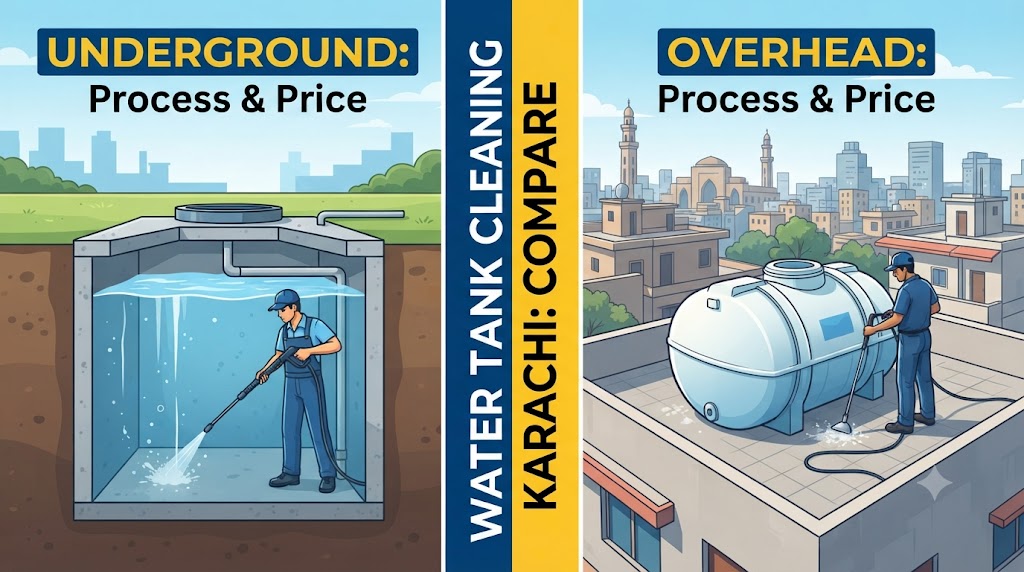
    Underground vs Overhead Water Tank Cleaning in Karachi: Process and Price Differences

    Most Karachi homes and buildings have both — an underground tank (often called a sump) that receives water from the KWSC line or a tanker, and an overhead or rooftop tank that gravity-feeds the taps. They store the same water, but cleaning them is genuinely a different job, with different access challenges, different contamination patterns, and, as a result, different pricing. This post walks through exactly how each process differs and what actually drives the cost difference between them.

    Why the Two Aren’t the Same Job

    An overhead tank sits in the open, usually accessible from a rooftop with a removable lid on top. An underground tank is typically buried or set into a basement or ground-floor utility area, often accessed through a narrow manhole-style opening, sometimes below floor level, with far more limited working room. That single difference in physical access shapes almost everything else about the process.

    Overhead Tank Cleaning: The Process

    1. Draining — the tank is drained down, usually leaving a small amount at the bottom to work with rather than a bone-dry surface
    2. Scrubbing — interior walls and floor are scrubbed to remove algae staining and biofilm, particularly around the waterline where algae growth concentrates
    3. Sediment removal — loose debris and sediment are removed, typically by hand or with a wet-vac for larger tanks
    4. Rinsing — the tank is rinsed at least once, sometimes twice, to clear loosened debris before refilling
    5. Disinfection — a safe disinfecting solution is applied and given contact time before a final rinse and refill

    Because overhead tanks are more exposed to sunlight, the dominant problem is usually algae rather than heavy sediment, which makes the scrubbing stage relatively more important than the sediment-removal stage compared to underground work.

    Underground Tank Cleaning: The Process

    • Access and ventilation — before anyone enters or reaches into a confined underground tank, the space needs to be checked and ventilated; this is a genuine safety step, not a formality, given the risk of oxygen depletion in enclosed tanks
    • Draining — using a pump rather than gravity, since underground tanks can’t simply be drained downward
    • Sludge and sediment removal — underground tanks accumulate heavier sediment loads than overhead tanks because they receive water directly from the supply line with less filtration and don’t benefit from sunlight-driven evaporation that concentrates algae near the surface instead; sludge removal is usually the most labour-intensive part of the job
    • Structural inspection — because underground tanks are harder to inspect casually, professional cleaning is also the main opportunity to check for cracks, seepage points, or wall damage that could let groundwater or contamination in
    • Disinfection and refill — similar disinfection process to overhead tanks, though contact and rinse cycles may take longer given the larger typical volume of underground sumps

    What Drives the Price Difference

    Access difficulty

    Underground tanks generally cost more to clean than overhead tanks of a similar size, primarily because of access. Confined-space entry, ventilation checks, and pump-based draining all add time and labour that an open rooftop tank simply doesn’t require.

    Sediment volume

    Underground tanks typically accumulate more sludge and sediment per cleaning cycle, which extends the sludge-removal stage and can require more disposal effort.

    Tank size

    For both tank types, price scales with capacity — larger tanks take longer to drain, scrub, and refill, and use more disinfectant. We break down typical pricing by tank size (1,000, 2,000, and 5,000 gallon) in a separate post if you want a closer look at the numbers.

    Condition and frequency

    A tank that’s overdue for cleaning by a year or more — with heavy biofilm, structural cracks, or major sediment build-up — will cost more to bring back to a clean baseline than one on a consistent 6-month schedule. This is one of several reasons keeping to the recommended cleaning schedule tends to save money over time rather than costing more.

    A Rough Sense of the Difference

    Exact pricing depends on your specific tank’s size, material, condition, and accessibility, and we’d always recommend a quick site visit or a call before assuming a number — you can see our current rates on our charges page. As a general pattern though: for a comparable capacity, underground tank cleaning in Karachi tends to run noticeably higher than overhead tank cleaning, largely because of the access and sediment factors above, not because the disinfection step itself is different.

    Which One Needs Attention First?

    If you’re only able to prioritise one right now, consider:

    • Prioritise the underground tank if you’re seeing reduced water pressure, unusual turbidity, or your building is in a low-lying area prone to monsoon seepage — these point to sediment or structural issues at the source
    • Prioritise the overhead tank if you’re noticing smell, algae staining near the tank lid, or a musty taste — these are classic signs of sunlight-driven biofilm and algae growth

    In most cases, though, since both tanks are part of the same water system, cleaning one without the other only solves half the problem — contaminated water from an uncleaned sump will simply recontaminate a freshly cleaned overhead tank on the next fill cycle.

    Questions Worth Asking Before You Book Either Job

    Whichever tank you’re getting cleaned, a few questions upfront help avoid surprises:

    1. Does the quote include confined-space safety measures for underground tanks specifically, or just standard equipment?
    2. Is disinfection included, or is it a drain-and-scrub-only service?
    3. How is sediment disposed of, particularly for heavily silted underground tanks?
    4. Will they inspect for structural issues — cracks, seepage points — as part of the underground job, not just clean around them?
    5. What’s the expected turnaround time, so you can plan around reduced water access?

    A service that can answer these clearly, rather than giving vague reassurances, is generally a good sign you’re getting a proper job rather than a quick rinse.

    FAQs

    Do both tanks need to be cleaned at the same time?

    It’s not strictly required, but since water flows from the underground tank up into the overhead tank, cleaning both together gives you a genuinely fresh system rather than moving contamination from one to the other.

    Why is underground tank cleaning more expensive if it’s the same water?

    The cost difference comes from access and labour, not the water itself — confined-space entry, pump-based draining, and heavier sediment removal all take more time and specialised handling than an open rooftop tank.

    Is it dangerous to clean an underground tank yourself?

    Confined spaces can have reduced oxygen or built-up gases, which is a real safety risk, not a minor one. This is one job where professional equipment and ventilation checks genuinely matter rather than being an upsell.

    How long does each type of cleaning take?

    Standard residential tanks generally take a few hours for a thorough clean, with underground tanks typically taking longer than overhead tanks of similar size due to the more involved draining and sediment-removal process. Larger commercial or heavily sedimented tanks can take longer.

    Can I get an accurate quote without an in-person visit?

    A rough estimate is possible based on tank size and type, but because condition and accessibility affect price so much, a short site visit gives a far more accurate number — most services, including ours, offer this as a standard first step.

    Get Both Tanks Assessed Together

    If it’s been a while since either tank was cleaned, it’s worth having both assessed in the same visit rather than tackling them separately. Contact us and we’ll give you a clear picture of what each one needs and what it’ll cost.

  • Water Tank Cleaning for Ramadan: Preparing Your Home’s Water Supply Before Fasting Begins

    Water Tank Cleaning for Ramadan: Preparing Your Home’s Water Supply Before Fasting Begins

    Ramadan changes the rhythm of a Karachi household almost overnight. Sehri starts before dawn, iftar brings the whole family — and often guests — to the table at once, and wudu happens far more often as taraweeh prayers are added to the daily routine. Water usage climbs sharply in a very short window, right when your tank is least convenient to take offline.

    That’s exactly why the week or two before Ramadan begins is the right time for a water tank cleaning service in Karachi — not the middle of the month, when a temporary water stoppage is far more disruptive to a fasting household.

    Why Water Habits Change So Much During Ramadan

    Even though total daily food intake often goes down during Ramadan, water usage tends to go up. Cooking shifts to two concentrated meals rather than being spread through the day, kitchens run harder in the hours before iftar, and wudu is performed more frequently around the additional prayers. Households hosting iftar gatherings see an even sharper spike, with more dishes, more guests, and more demand on the tank in a shorter stretch of hours.

    The timing shifts too, not just the volume. Instead of water use being spread fairly evenly across a normal day, it now concentrates heavily into two windows — the hour or so before sehri ends, and the hour or two around iftar and the evening’s dishes. A tank and pump system that comfortably handles a normal day’s usage pattern can feel noticeably more strained when the same volume, or more, is being drawn in much shorter bursts.

    None of this is a problem on its own — it’s simply more pressure on a system that, in many Karachi homes, hasn’t been cleaned in a year or more.

    Why Pre-Ramadan Is the Right Time to Clean Your Tank

    A full tank clean requires draining the tank, which means the household is without stored water for part of the day. Scheduling that during Ramadan itself — particularly close to sehri or iftar timings — is the last thing a fasting family wants to manage. Doing it in the days before the month begins means the tank is filled with clean water and fully settled well before the first sehri.

    It also means any underlying issue — a cracked lid, a slow leak, sediment buildup from months of use — gets caught and fixed while there’s still time, rather than surfacing as a water-pressure problem halfway through the month.

    What Happens If You Skip It

    A tank that hasn’t been cleaned in a while typically has sediment, biofilm, and in some cases bacterial contamination sitting at the bottom or along the walls. During a normal month, that might just mean slightly cloudy water. During Ramadan, when the same stored water is being used for cooking sehri and iftar meals, making wudu, and hydrating a household that’s already managing long fasting hours in Karachi’s heat, it’s worth taking more seriously than usual.

    This isn’t about making medical claims — it’s simply that a household under more strain from heat and fasting benefits from removing one avoidable source of stomach upset before it becomes an issue.

    Timing the Cleaning Around Your Household’s Schedule

    A professional clean usually takes a few hours, and the tank needs time to refill and settle afterward. The most practical approach is to schedule it:

    • At least 3–5 days before the start of Ramadan, giving the tank time to refill and the household time to store a few days’ backup water in the meantime
    • During daytime hours, well clear of sehri and iftar windows
    • With the household informed in advance about how long the water supply will be interrupted

    If you’re arranging this for a home in areas like Gulshan-e-Iqbal or Bahadurabad, it’s worth booking early — this is a busy period for tank cleaning citywide, and slots close to the start of the month fill up quickly.

    A Quick Pre-Ramadan Checklist

    • Check when your tank was last professionally cleaned — if it’s been over a year, plan for it now
    • Inspect the rooftop tank lid for cracks or a loose seal before the month’s higher water usage begins
    • Confirm with your provider that they hold a proper pest control license and follow a documented cleaning and disinfection process
    • Ask about current charges so there are no surprises on the day
    • Store a few days’ worth of drinking water separately in case the cleaning schedule needs to shift

    For Apartment and Shared-Tank Households

    If you live in a building with a shared tank, this is worth raising with your building committee well before Ramadan rather than waiting for a resident to bring it up mid-month. Shared tanks serve more households and see proportionally higher demand once everyone’s sehri and iftar schedules line up, so a single unclean tank affects far more people at once.

    Common Mistakes Households Make Before Ramadan

    The most common mistake isn’t skipping tank cleaning altogether — it’s leaving it too late and then trying to squeeze it in during the first week of fasting, when everyone’s routine is already stretched thin. The second most common mistake is assuming that because the water looks clear, the tank doesn’t need attention; sediment and bacterial buildup are rarely visible from the tap even when they’re a real problem.

    A third, smaller mistake is forgetting that Ramadan is also when households host the most guests of the year. More people in the house for iftar means more use of bathrooms and kitchens, which is also a sensible time to deal with any pest issues — a stray cockroach in the kitchen during a hosted iftar is a far bigger problem than the same cockroach on an ordinary evening. If you’re already booking a provider for tank cleaning, it’s worth asking whether they can look at cockroach control or general pest prevention for the kitchen and dining areas at the same visit.

    Preparing the Rest of the Home Alongside the Tank

    Tank cleaning is usually just one item on a longer pre-Ramadan household checklist that includes a deep kitchen clean, checking the fridge and pantry are properly organized for the month’s cooking rhythm, and making sure common problem areas — under sinks, behind the stove, storage rooms — are in good shape before guests start arriving regularly. Treating the water tank as part of that same seasonal reset, rather than a separate task that gets remembered later, is the easiest way to make sure it doesn’t slip through the cracks.

    Many households find it more efficient to bundle the tank clean with any other seasonal maintenance — bathroom deep cleans, checking taps and pipes for leaks, and general kitchen hygiene — into a single pre-Ramadan weekend rather than spreading it out.

    Frequently Asked Questions

    How many days before Ramadan should I schedule tank cleaning?

    Aim for at least 3–5 days before the month begins. This gives the tank time to be drained, cleaned, disinfected, refilled, and settled well before sehri routines start.

    Can a water tank be cleaned during Ramadan itself?

    Yes, it can, but it needs to be scheduled carefully around sehri and iftar timings since the tank will be temporarily out of use during the clean. Most households prefer to avoid this disruption by cleaning beforehand.

    Will cleaning the tank affect water used for wudu?

    A professional clean simply removes sediment, biofilm, and contamination from the tank and disinfects it before refilling with fresh water — it doesn’t add anything that would affect the water’s suitability for daily household use, including wudu.

    Does the household need to arrange anything before the cleaning crew arrives?

    Mainly just clear access to the tank and confirmation of how the temporary water stoppage will be managed. Your provider should walk you through timing and access requirements when booking.

    Is it worth cleaning the tank again partway through Ramadan?

    For most homes, a thorough clean shortly before the month begins is enough for the full 29–30 days. If your household is hosting frequent large iftars or you notice a change in water quality mid-month, a mid-Ramadan check is a reasonable precaution.

    Start the Month With One Less Thing to Worry About

    Ramadan already asks a lot of a household’s routine. A clean, properly sealed water tank is one variable you can take off the table entirely, well in advance, instead of discovering a problem with it during the month’s busiest days.

    Get in touch now to book your pre-Ramadan tank cleaning before slots fill up.

  • Water Tank Cleaning for Apartment Buildings: Managing Shared Tanks and Committee Coordination

    Water Tank Cleaning for Apartment Buildings: Managing Shared Tanks and Committee Coordination

    A single-family home in Karachi has one household to coordinate with when it’s time to clean the water tank. An apartment building might have thirty. The tank is bigger, the contamination sources are more varied, and getting everyone’s water supply interrupted at the same time — even briefly — takes real planning.

    This is where most of the friction around a water tank cleaning service in Karachi shows up for apartment buildings: not the cleaning itself, but the coordination around it. This post is written for building committees, managing agents, and caretakers who are responsible for getting it right.

    Why Shared Tanks Need a Different Approach

    Apartment buildings in Karachi typically run on a combination of a large underground tank and one or more overhead tanks feeding different floors or blocks. Because more people draw from the same source, more entry points exist for contamination — multiple lids, multiple access hatches, sometimes multiple booster pumps — and any sediment or bacterial buildup affects every unit on the line, not just one household.

    Scale also changes the cleaning process itself. A large underground tank serving a building can hold many times the volume of a single home’s tank, which means more sediment accumulates between cleanings, drainage takes longer, and disinfection has to be dosed correctly for a much bigger volume of water rather than simply scaled up by guesswork. This is part of why treating a building’s tank as a bigger version of a home job, rather than its own category of work, tends to produce disappointing results.

    It also means the stakes of getting the cleaning wrong, or skipping it, are proportionally higher. A single unclean tank in an older building in DHA or Clifton can be a shared health risk across dozens of families rather than one.

    What the Committee Needs to Organize

    The cleaning crew’s job is straightforward once they’re on site. The committee’s job — getting everyone ready for that — is the part that actually determines how smoothly the day goes.

    • Notify all residents well in advance, with a clear window for when water will be interrupted
    • Arrange access to the tank area, including any keys, locks, or roof access that only the caretaker or a committee member holds
    • Decide, and communicate, how the cost will be split across units before the work is booked
    • Confirm whether the building has both underground and overhead tanks, since both usually need to be scheduled
    • Ask residents to store a few hours’ worth of water in advance, particularly for units on higher floors that rely on booster pumps

    Scheduling the work for a lower-use window — a weekday mid-morning rather than a weekend, for instance — tends to generate far fewer complaints than cleaning during peak usage hours.

    Underground vs Overhead Tanks in Multi-Unit Buildings

    Underground tanks in apartment buildings tend to collect heavier sediment simply because of their size and the volume of water passing through them daily. Overhead tanks are more exposed to heat, dust, and lid-related contamination from years of sun and monsoon exposure on the roof. Because they fail in different ways, both need their own inspection and cleaning rather than treating the building’s water system as a single job.

    Buildings in areas like Gulshan-e-Iqbal or Bahadurabad with older overhead tanks that have never been resealed are a common case where the rooftop tank turns out to need more attention than the underground one.

    How Often Should a Building Clean Its Tanks

    There’s no single number that fits every building — it depends on tank size, how exposed it is to heat and monsoon rain, and how many units draw from it daily. As a general guide, most buildings benefit from a full clean roughly once or twice a year, with an additional check after any period of heavy monsoon flooding in the area. A committee that’s never scheduled one, or can’t recall the last date, should treat that as reason enough to book one now rather than wait for a specific interval to pass.

    Documentation Matters for Committees

    Unlike a single homeowner, a committee is answerable to dozens of residents and often needs a paper trail — for transparency, for future reference, and sometimes for handovers when committee membership changes. Ask your provider for a proper invoice and a record of what was done and when, and check their track record with other clients handling similar multi-unit properties before booking.

    This is also a good moment to confirm the provider is properly licensed — for a building serving many families, that’s not a box-ticking exercise, it’s a real safeguard.

    Choosing a Provider for Multi-Unit Buildings

    Not every provider that services individual homes is set up to handle a large apartment building’s tanks efficiently. Look for a team that can quote clearly against your building’s actual tank sizes rather than a flat per-unit rate, that has handled comparable buildings before, and that’s transparent about charges before work begins — not after the tank is already drained.

    Common Problems Specific to Multi-Unit Buildings

    Buildings tend to run into a handful of recurring issues that single homes rarely see. Booster pumps that push water up to higher floors can mask a drop in water pressure caused by a partially blocked tank outlet, so residents on upper floors may not notice a problem until it’s fairly advanced. Shared tank rooms and pump rooms, especially in older buildings, are also common spots for rodent activity given the combination of dark, undisturbed space and a nearby water source — if your building’s tank room hasn’t been checked in a while, it’s worth asking your cleaning provider to also look for signs of rodent entry, and flagging it for rodent control if needed.

    Corrosion and mineral buildup on pipe fittings near the tank outlet is another issue that’s easy to miss in a large building where no single resident feels directly responsible for reporting it. A periodic tank inspection is a natural point to catch this before it becomes a bigger plumbing repair.

    The Caretaker’s Role Between Scheduled Cleanings

    Most buildings don’t have someone checking the tank between scheduled cleanings, which means small problems — a slightly loose lid, a new crack, early signs of algae — often go unnoticed until the next full clean. Giving the building caretaker or security staff a simple, short checklist to glance at monthly (Is the lid secure? Any smell? Any visible debris near the tank?) costs nothing and can catch a developing problem well before it affects residents.

    Frequently Asked Questions

    Who is typically responsible for paying for tank cleaning in an apartment building?

    This is usually covered by the building’s maintenance fund or split across units through the managing committee, similar to other shared building maintenance costs. The exact arrangement depends on your building’s bylaws or committee decisions.

    How much advance notice should residents get before a water stoppage?

    A few days’ notice is standard practice, giving residents time to store water for cooking, cleaning, and other needs during the interruption. Posting a notice in common areas alongside a direct message to unit owners tends to work best.

    Can only one part of the building’s water supply be cleaned at a time?

    It depends on the building’s plumbing layout. Some buildings can isolate underground and overhead tanks separately, minimizing disruption; others share a single line, in which case the whole building is affected during the clean. Ask your provider to walk through your building’s specific setup.

    How can a committee verify the cleaning was actually done properly?

    Ask for a written record of the work performed, request photos or a walkthrough if possible, and choose a provider willing to explain their process rather than one that treats it as a black box.

    Do larger buildings need cleaning more often than smaller ones?

    Not necessarily more often, but the consequences of skipping it are larger since more households are affected. Frequency should be based on tank exposure and usage, not building size alone.

    Get Your Building Sorted Before It Becomes a Complaint

    Shared tanks are easy to overlook until a resident complains about the water — at which point the committee is scheduling reactively instead of on its own terms. Getting ahead of it with a planned, well-communicated cleaning is simpler for everyone involved, including the committee.

    Reach out and we’ll help you plan a cleaning schedule that works around your building’s layout and your residents’ routines.

  • How Often Should You Clean Your Water Tank in Karachi? A Recommended Schedule

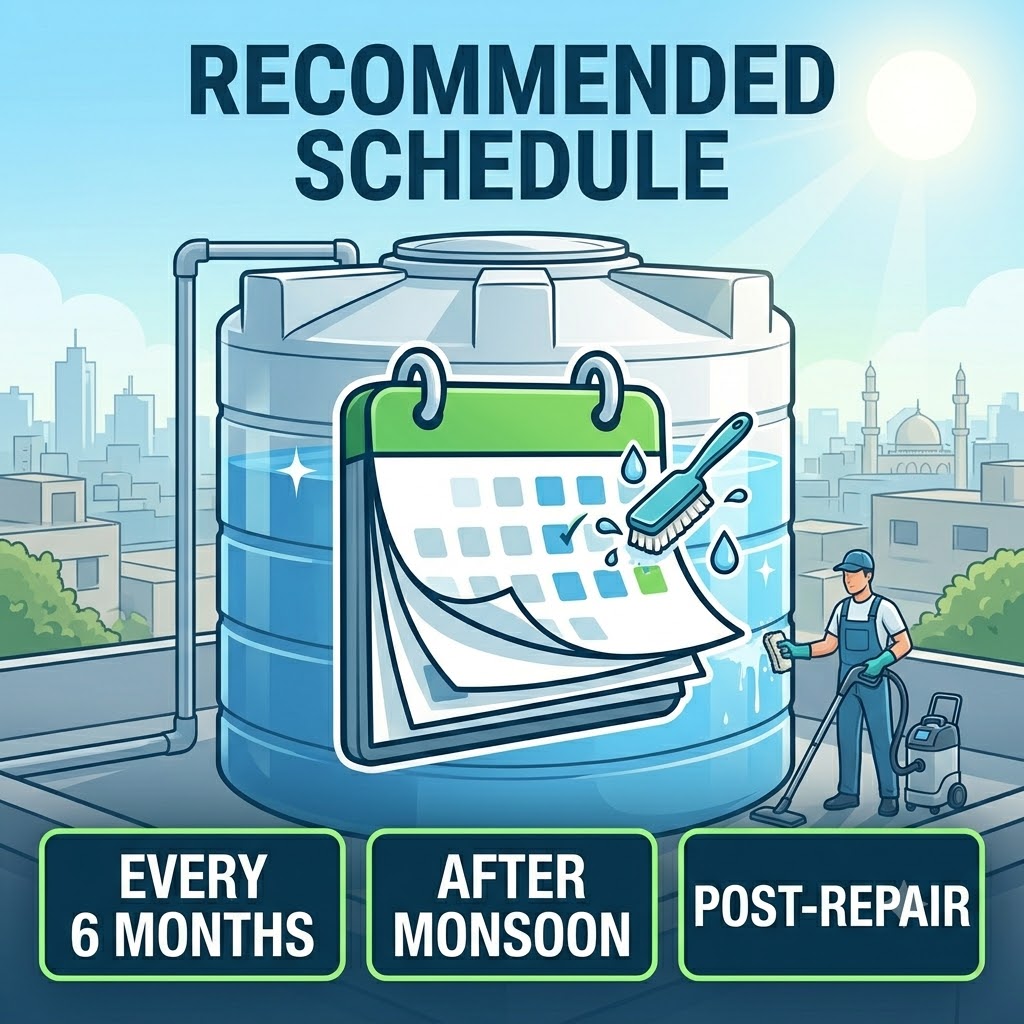
    How Often Should You Clean Your Water Tank in Karachi? A Recommended Schedule

    “How often” is one of the most common questions we get, and it doesn’t have a single universal answer — a lot depends on tank type, water source, and how heavily it’s used. But it doesn’t need to stay vague either. This post lays out a practical schedule for Karachi households, apartment buildings, and businesses, based on how tanks in this city actually get used and contaminated.

    If you haven’t yet checked whether your tank shows signs of needing attention right now, it’s worth reading our checklist of warning signs alongside this schedule — the two work together: a schedule for routine maintenance, and a checklist for catching problems that show up early.

    The General Baseline

    Across most guidance on tank maintenance, the widely repeated baseline is cleaning every 6 months for residential overhead tanks under normal conditions. Some sources recommend once a year as a minimum, others suggest every 3-4 months for higher-risk situations. For Karachi specifically — with high year-round temperatures, an inconsistent municipal supply, and heavy reliance on tanker water in many areas — we recommend treating 6 months as the outer limit, not the target, for most households.

    A Practical Schedule by Situation

    Standard residential household (municipal supply, normal usage)

    Every 6 months. This applies to a typical house or apartment on a fairly consistent KWSC or piped supply, without major water quality complaints.

    Households or buildings relying heavily on tanker water

    Every 3-4 months. Tanker-sourced water quality in Karachi varies significantly depending on the source and whether the tanker is registered, so tanks fed primarily by tankers should be cleaned more frequently as a precaution — sediment and contamination tend to build up faster.

    Apartment buildings and housing societies

    Every 6 months, tracked on a committee schedule. Shared tanks serve more people drawing water more often, and a missed cleaning affects an entire building rather than one household. Building committees are often the ones who end up managing this — our about us page has more on how we work with committees and larger properties.

    Restaurants, hotels, and schools

    Every 3-4 months, or per your inspection requirements. Businesses serving food or water to the public should treat tank cleaning as a compliance matter as much as a hygiene one — inspections from bodies like the Sindh Food Authority increasingly look at water source hygiene as part of food safety checks, alongside your general pest control programme.

    Underground tanks (sumps)

    Every 6 months, potentially more often in monsoon-prone or low-lying areas. Underground tanks don’t get direct sunlight, so algae growth is usually slower than in rooftop tanks, but they’re more exposed to groundwater seepage, cracked seals, and silt build-up — especially in areas near Malir, Korangi, or other low-lying parts of the city where monsoon flooding is a recurring issue. Our guide comparing underground and overhead tank cleaning covers the practical differences in more detail.

    Overhead / rooftop tanks

    Every 6 months, or every 3-4 months if the tank sits in direct, unshaded sun for most of the day. Sun exposure is the single biggest driver of algae growth in overhead tanks, so a tank on an exposed rooftop in areas like DHA or Clifton with less shade cover may need more frequent attention than one in a shaded stairwell enclosure.

    What Changes the Recommended Frequency

    A few factors should push you toward the shorter end of any range above:

    • Source water quality — tanker-fed tanks, especially from unregistered sources, generally need more frequent cleaning than tanks on a stable piped supply
    • Tank material and age — older concrete tanks with rough or cracked internal surfaces trap sediment and biofilm more easily than newer, smooth-lined tanks
    • Sun exposure — a fully exposed rooftop tank in Karachi’s summer heat accelerates algae growth compared to a shaded one
    • Household size and usage — tanks serving more people, or with frequent low-water periods where sediment gets disturbed, need more frequent attention
    • Monsoon season — post-monsoon, many households notice a jump in sediment and turbidity, which is a reasonable trigger for an off-schedule clean

    Signs You Shouldn’t Wait for the Next Scheduled Clean

    Even with a set schedule, don’t treat it as rigid if you notice smell, discolouration, taste changes, or unexplained illness in the household before the next planned date — our full checklist of these warning signs is worth bookmarking.

    Mapping a Schedule Onto Karachi’s Calendar

    Rather than picking two arbitrary dates six months apart, it can help to anchor your cleaning schedule to points in the year that already mean something in Karachi:

    • Pre-summer (around March-April), before peak heat accelerates algae growth in overhead tanks and before Ramadan increases household water usage for many families
    • Post-monsoon (around September), once the rainy season has passed and any sediment or turbidity it introduced has had a chance to show up
    • A mid-year check for higher-risk setups — tanker-dependent households, restaurants, or buildings with visible warning signs — rather than waiting a full 12 months between the two anchor points above

    This gives you a schedule that’s easy to remember precisely because it’s tied to things that already happen every year, rather than an abstract “every six months from whenever we last did it.”

    Setting Up a Reminder System

    The easiest way most households and building committees fail at this isn’t disagreement about the right interval — it’s simply forgetting. A few practical approaches:

    1. Tie your tank cleaning to a fixed calendar point, like the start and middle of the year, or align it with Ramadan and post-monsoon season, two points many Karachi households already associate with home maintenance
    2. For buildings, assign it to the committee’s existing maintenance calendar rather than leaving it to individual residents to request
    3. Keep a simple log of the last cleaning date and who performed it, so there’s no ambiguity about whether it’s due

    FAQs

    Is once a year enough for a Karachi household?

    It’s the outer limit we’d recommend, and only for households on a stable, good-quality piped supply with no visible warning signs. Given Karachi’s climate and variable water sources, 6 months is a safer default for most homes.

    Do smaller tanks need cleaning more often than larger ones?

    Generally yes — smaller tanks have less water volume to dilute sediment and contaminants, so buildup becomes noticeable faster relative to a large tank holding the same contamination load.

    Should I clean the tank before or after monsoon season?

    Both have value: a pre-monsoon clean reduces the sediment load going into the rainy season, and a post-monsoon clean addresses any turbidity or debris that got in during heavy rain.

    Does a new tank need cleaning right away, or can I wait the full interval?

    New tanks should be cleaned and disinfected before first use to remove any manufacturing residue or dust from storage and transport, then follow the normal schedule from that point.

    How do I know if my building’s shared tank is being cleaned on schedule?

    Ask your building committee or management office for the maintenance log. If one doesn’t exist, that’s worth raising — a shared tank without a documented cleaning schedule is a common gap in Karachi apartment buildings.

    Ready to Get on a Schedule?

    Whether you need a one-off clean or want to set up a recurring schedule for your home or building, get in touch and we’ll help you figure out the right interval for your specific setup.

  • Health Risks of Dirty Water Tanks in Karachi: Bacteria, Algae and Waterborne Diseases

    Health Risks of Dirty Water Tanks in Karachi: Bacteria, Algae and Waterborne Diseases

    Water in Karachi rarely travels a clean, simple path from source to tap. It moves through an ageing KWSC pipe network, sometimes through private tankers, into rooftop or underground storage tanks, and finally into your kitchen. Every one of those steps is a chance for contamination — but the tank itself is the stage where problems are most likely to grow, quite literally, over time.

    Unlike a pipe, a tank is a closed, still body of water sitting for days or weeks at a stretch, often warmed by direct sun. That combination — warmth, stillness, organic debris, and darkness in underground tanks — is exactly what bacteria and algae need to establish themselves. This post looks at what actually grows inside a neglected tank, and the specific health risks that come with it, so you understand why regular water tank cleaning matters beyond just “clearer looking” water.

    What Actually Grows Inside a Dirty Tank

    Bacteria

    Stagnant, contaminated water is a known environment for bacteria such as E. coli, Salmonella, and Vibrio species — the organisms behind typhoid, bacterial diarrhoea, and cholera. These bacteria typically enter a tank through contaminated inlet water, cracks or gaps that let in dust and debris, or an improperly sealed lid that allows insects, birds, or rodents access.

    Karachi’s tanker-dependent water supply adds another layer of risk. When water is sourced from unregistered or poorly monitored tankers rather than the treated municipal line, the water entering your tank may already carry contamination before it even reaches your rooftop — which is one reason water quality complaints tend to spike in areas most reliant on tanker delivery.

    Algae

    Algae needs light, warmth, and standing water to grow — conditions an exposed rooftop tank provides for most of the year in Karachi. Algae growth shows up as green or brown staining on interior walls and a musty smell, and while algae itself isn’t always directly disease-causing, it changes the taste and odour of water, provides a food source for bacteria, and can clog filters and outlet pipes over time.

    Biofilm and sediment

    Biofilm is the slimy layer that forms on tank walls and the underside of lids when bacteria colonise a surface and build a protective layer around themselves. It’s harder to remove than loose dirt because it clings to surfaces, and it acts as a long-term reservoir for bacteria even after the visible water looks clear. Sediment — dust, rust flakes, and mineral deposits — settles at the tank floor and gets disturbed and pulled into the supply line whenever water levels drop low, which is common during Karachi’s frequent supply gaps.

    The Specific Health Risks

    Gastrointestinal illness

    The most common and immediate risk from contaminated tank water is gastrointestinal illness — diarrhoea, vomiting, cramping, and in more serious bacterial infections, prolonged fever. Diarrhoeal illness linked to contaminated water disproportionately affects young children and elderly household members, and repeated exposure in a household with a persistently dirty tank can mean recurring “stomach bugs” that never seem to fully go away.

    Typhoid fever

    Typhoid, caused by Salmonella Typhi, is spread through contaminated water and food and is a genuine ongoing public health concern in Pakistan. Symptoms include a persistent high fever, headache, and abdominal discomfort, and it requires medical treatment — this is not something to self-diagnose or manage at home. If you or a family member develop a prolonged fever alongside gastrointestinal symptoms, see a doctor rather than assuming it will pass.

    Skin and eye irritation

    Bathing with contaminated water — even if you’re not drinking it — can cause skin irritation, itching, and in some cases allergic reactions, particularly with prolonged or repeated exposure. This is often overlooked because people assume bathing water is “safer” than drinking water, but a tank doesn’t distinguish between the two; it’s the same contaminated source either way.

    Naegleria and Karachi’s specific risk profile

    Karachi has, in recent years, dealt with cases linked to Naegleria fowleri — a microorganism that can enter the body through the nasal passage during activities like ablution or bathing with contaminated, unchlorinated water, and that has been associated in public health reporting with unregulated tanker-supplied water in the city. This is a serious, and rare but potentially fatal, risk specifically tied to unchlorinated or poorly treated water — one more reason not to assume tap or tank water is automatically safe simply because it looks clear.

    Who’s Most at Risk

    Contaminated water doesn’t affect everyone in a household equally. A few groups warrant extra caution:

    • Young children, whose immune systems are less developed and who are more vulnerable to dehydration from diarrhoeal illness
    • Elderly household members, who may take longer to recover from bacterial infections and are at higher risk of complications
    • Anyone with an existing immune condition, for whom even relatively mild bacterial exposure can pose a bigger risk
    • Pregnant women, for whom certain waterborne infections carry additional risk and warrant extra caution around water source and hygiene

    If your household includes anyone in these groups, it’s worth treating tank maintenance as a higher priority rather than something to get to eventually — the margin for “it’s probably fine” is genuinely smaller.

    Why “The Water Looks Fine” Isn’t Reassurance

    Most of the organisms and contaminants described above are invisible without lab testing. Clear-looking water can still carry bacteria; a tank can look fine from the outside while the underside of the lid and the tank floor are coated in biofilm and sediment. This is exactly why cleaning on a schedule — rather than only when something looks or smells wrong — matters. We cover recommended cleaning intervals for Karachi conditions in a separate guide, and if you’re weighing whether your setup needs attention sooner, our checklist of warning signs is a good starting point.

    Reducing the Risk

    • Keep tank lids sealed and in good condition — gaps are an open door for contamination
    • Don’t wait for visible signs before scheduling a clean; sediment and biofilm build up long before symptoms appear
    • If your building relies on tanker-delivered water, be aware that source water quality varies significantly and isn’t something a household can control directly
    • Get tanks professionally drained, scrubbed, and disinfected rather than relying on a quick rinse, which doesn’t remove biofilm from tank walls
    • If anyone in the household develops persistent fever, diarrhoea, or unexplained skin irritation, see a doctor — don’t wait to see if it resolves on its own

    FAQs

    Can boiling water make up for a dirty tank?

    Boiling kills most bacteria and is a reasonable precaution for drinking water in the short term, but it doesn’t address sediment, algae, or the ongoing contamination source — the tank itself still needs cleaning.

    Is bathing water from a dirty tank as risky as drinking it?

    It’s generally lower risk for gastrointestinal illness but not risk-free — skin irritation and, in rare and specific circumstances involving nasal exposure to unchlorinated water, more serious infection risks exist. It shouldn’t be assumed “safe” just because it’s not for drinking.

    How quickly can bacteria build up in a cleaned tank?

    This varies with water source, temperature, and tank exposure to sunlight, but noticeable biofilm and algae can begin forming within weeks in Karachi’s climate, which is part of why a fixed cleaning schedule rather than a “clean once and forget it” approach is recommended.

    Are plastic tanks safer than concrete ones for bacteria growth?

    Both can support bacterial and algae growth if not cleaned regularly. Concrete tanks with cracks or rough internal surfaces can be harder to fully clean and may harbour biofilm in surface pores, while plastic tanks exposed to direct sun for years can degrade and affect water taste.

    Should I get my tank water tested?

    If your household has had recurring, unexplained gastrointestinal illness, it’s reasonable to ask a professional service about testing options alongside a full clean, rather than relying on visual inspection alone.

    A note on health symptoms: this article covers general, well-established information about waterborne illness risk. It isn’t medical advice — if you or someone in your household is experiencing persistent symptoms, please consult a doctor.

    Don’t Wait for Symptoms to Show Up

    Contamination inside a tank is invisible until it isn’t — by the time you notice a smell, a taste change, or someone in the house feels unwell, the problem has usually been building for a while. If it’s been more than six months since your last clean, or you’re not sure when it was last done, get in touch and we’ll assess it properly.

  • Signs Your Water Tank Needs Cleaning: A Karachi Homeowner’s Checklist

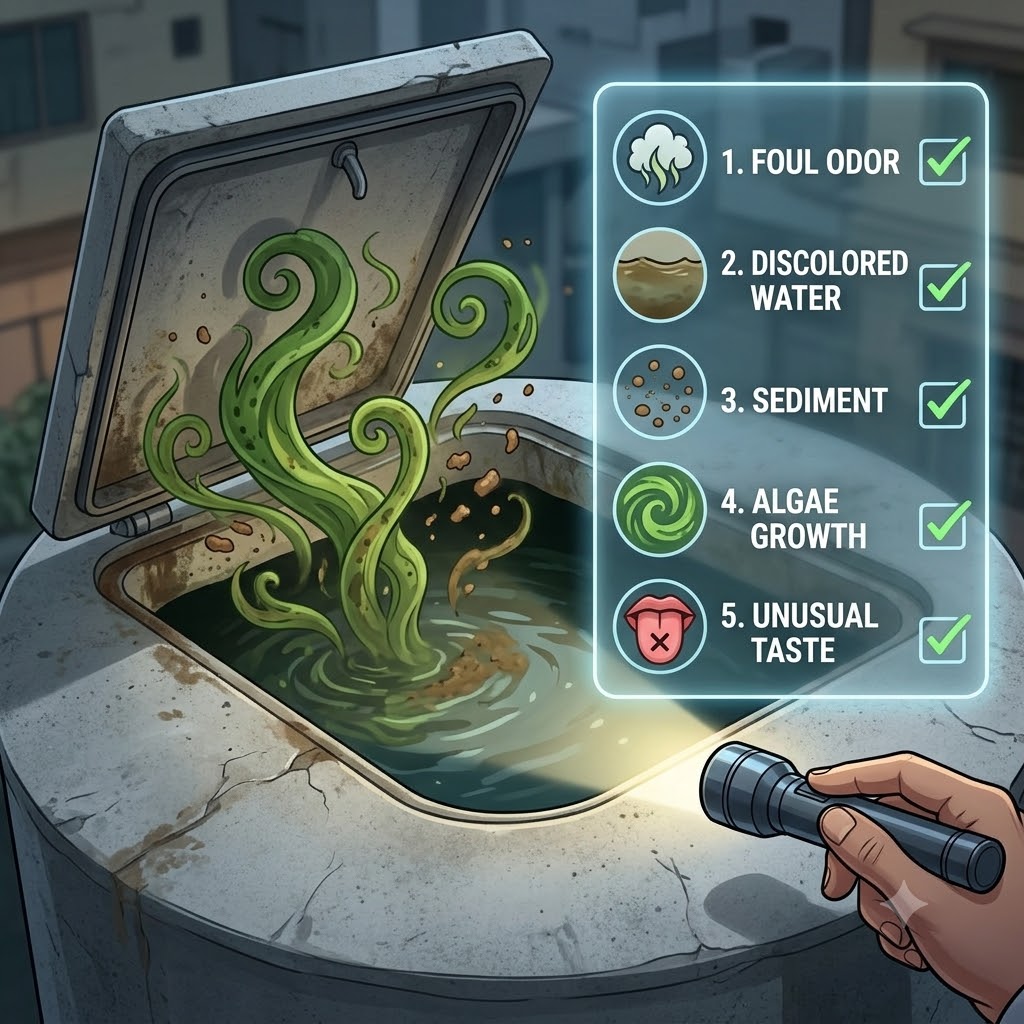
    Signs Your Water Tank Needs Cleaning: A Karachi Homeowner’s Checklist

    Most people in Karachi only think about their water tank when something goes wrong — a foul smell coming from the tap, water that looks slightly yellow, or a stomach bug that won’t go away. By the time you notice these things, the tank has usually been overdue for a clean for months.

    The good news is that a dirty tank almost always gives warning signs before it becomes a real health problem. You just have to know what to look for, especially if you’re relying on water tank cleaning once or twice a year rather than checking the tank yourself in between.

    This checklist walks through the signs — from obvious to easy-to-miss — that your overhead or underground tank needs attention now, not at the next scheduled service.

    1. Look at the Water Itself

    Colour and clarity

    Clean tank water should be completely clear with no tint. If water coming from the tap looks pale yellow, brownish, or slightly cloudy, that’s usually rust from an ageing tank lining, sediment stirred up from the tank floor, or organic matter breaking down inside.

    Visible particles

    Hold a glass of tap water up to the light. Specks of grit, tiny flakes, or a fine film floating on top are signs that sediment has built up at the bottom of the tank and is now being pulled into your supply line — common in older Karachi homes with tanks that haven’t been drained and scrubbed in a year or more.

    2. Smell Before You Use It

    A properly maintained tank produces water with little to no smell. If you notice any of the following, treat it as a clear signal:

    • A musty, “stagnant pond” smell — usually algae or bacterial growth on the tank walls
    • A rotten-egg or sulphur smell — often linked to bacterial activity in low-oxygen water
    • A chemical or plasticky smell — can point to a degrading plastic tank liner, especially in tanks that sit in direct sun for years

    If you’re also dealing with pests near the tank area, it’s worth having a professional look at both issues together rather than assuming they’re unrelated — cockroaches and rodents are drawn to damp, undisturbed spaces exactly like tank rooms and rooftop tank stands. Our cockroach control and rats and rodent control teams often get called out to the same buildings that need tank cleaning.

    3. Taste Changes

    If drinking water suddenly tastes metallic, “flat,” or faintly bitter, and nothing else in your supply chain has changed (no new filter, no change in KWSC supply timing), the tank itself is the most likely culprit. Taste is often the earliest sign residents notice, well before smell or colour become obvious.

    4. Physical Signs on the Tank Itself

    Not every warning sign shows up in the water — some are visible on the tank.

    • Algae staining on the inside walls near the waterline, especially in overhead tanks exposed to sunlight
    • Slimy residue on the underside of the lid, a strong indicator of biofilm build-up
    • Cracks or gaps in the lid seal, which let in dust, insects, and rainwater during monsoon season
    • Rust streaks running down the outside of metal tanks or fittings
    • Reduced water pressure or flow, which can mean sediment is partially blocking the outlet pipe

    5. Health Symptoms in the Household

    This is the sign nobody wants, but it matters most. If more than one person in the house has had unexplained stomach upset, diarrhoea, or skin irritation after bathing, and there’s no other obvious cause, get the tank checked. Contaminated tank water is a common and under-suspected cause of recurring stomach illness in Karachi households, particularly during summer and after monsoon flooding disrupts the water supply. We cover this in more detail in our post on the health risks of dirty water tanks.

    6. It’s Simply Been Too Long

    Even if none of the above signs are present yet, time alone is a reason to clean. Sediment, biofilm, and microbial growth build up gradually and invisibly long before they produce a smell or a symptom. As a general rule for Karachi’s climate — hot for most of the year, with a humid monsoon stretch — overhead tanks should be cleaned roughly every 6 months, and underground tanks can need it slightly more often depending on usage. We go into the reasoning behind this schedule in a separate post.

    Underground vs Overhead: Different Tanks, Different Warning Signs

    Overhead tanks sit exposed to Karachi’s sun for most of the year, which accelerates algae growth on interior walls — so staining and smell tend to show up first. Underground tanks, by contrast, are more prone to silent sediment build-up and groundwater seepage, especially in low-lying areas or during monsoon season, so cracked seals and gradually dropping water pressure are often the first clue. If you’re not sure which category your setup falls into, our guide comparing underground and overhead tank cleaning breaks down the practical differences.

    A Simple Monthly Check You Can Do Yourself

    You don’t need to wait for a professional visit to catch problems early. A short monthly habit is enough to catch most of the warning signs above before they become serious:

    1. Open the lid and look inside (with the lights off and a torch, if it’s dark) — check for staining, slime on the underside of the lid, or anything floating on the surface
    2. Run the tap and fill a clear glass — check colour, clarity, and let it sit for a minute to see if anything settles at the bottom
    3. Smell the water before using it for cooking or drinking that day
    4. Check the lid seal for cracks, gaps, or signs it’s no longer sitting flush
    5. Note the date of the last professional clean somewhere you’ll actually see it — a sticky note near the tank access point works fine

    This isn’t a substitute for a full professional clean, but it’s the difference between catching a problem in week two and not noticing until month five.

    DIY Cleaning vs Calling a Professional

    Some homeowners try to manage light cleaning themselves — a quick scrub near the lid, topping up chlorine, or rinsing out visible debris. This can help in between scheduled cleans, but it rarely reaches biofilm that’s established on tank walls, and underground tanks in particular carry real safety risks around confined-space entry that aren’t worth taking on without the right equipment. If you’re seeing two or more warning signs from this checklist, that’s the point to call a professional rather than continue with DIY measures.

    What to Do If You Spot Any of These Signs

    Don’t wait for the next scheduled cleaning if you notice two or more signs from this list. A professional inspection takes very little time and will tell you exactly what’s going on inside the tank — sediment depth, algae coverage, structural condition — before you commit to a full clean.

    FAQs

    How do I know if my water tank has algae without opening it?

    A musty smell from the tap, greenish tint to the water, or visible green staining near the tank’s waterline (if you can see inside through an inspection point) are the clearest signs without a full inspection.

    Is it safe to keep using water from a tank that smells bad?

    It’s best to avoid drinking or cooking with it until the tank has been checked. Bathing water with a mild odour is generally lower risk, but persistent smell usually means bacterial or algae growth that’s worth addressing quickly.

    Can a water filter fix a dirty tank problem?

    A filter at the tap can reduce some sediment and improve taste, but it doesn’t address the source — biofilm and contamination inside the tank itself. Cleaning the tank is the only real fix.

    How often should apartment building tanks be checked versus houses?

    Apartment and building committee tanks generally see heavier daily usage and should be inspected at least as often as household tanks — every 6 months is a reasonable baseline, adjusted based on the number of units drawing from it.

    Does monsoon season make tanks dirtier faster?

    Yes. Heavy rain increases the chance of water seeping into underground tanks and can introduce dust and debris into overhead tanks through worn seals, so many Karachi households notice more sediment and smell issues right after monsoon.

    Get Your Tank Checked Before It Becomes a Health Problem

    If you’ve spotted even one or two of these signs — funny smell, cloudy water, visible staining, or a household member who’s been unwell for no clear reason — it’s worth getting a proper inspection rather than waiting. Get in touch with our team and we’ll take a look before it turns into a bigger issue.