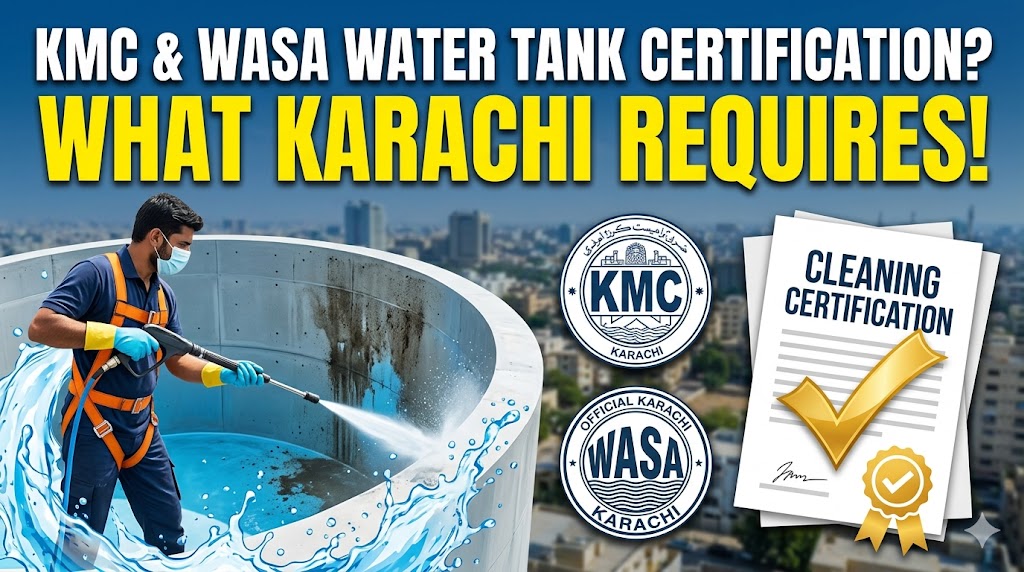
In Karachi, a water tank cleaning certificate does not come from KMC or from the water utility. It is a signed service record issued by the company that cleaned your tank, and it is what you produce when a food inspector, a hospital or hotel auditor, a landlord or a corporate client asks for proof that your stored water is hygienic. One correction before going further: Karachi has no WASA. The city’s water utility is the Karachi Water and Sewerage Corporation (KWSC), known as KWSB until 2023.
Do KMC and WASA Require a Tank Cleaning Certificate in Karachi?
Not in the way most people assume. WASA is the water utility in Lahore, Faisalabad and Rawalpindi, so when a form, tender or client in Karachi asks for “WASA compliance”, the body they mean is KWSC. Here is who actually has a say over your tank:
| Authority | What it does | What it means for your tank |
|---|---|---|
| KWSC (formerly KWSB) | Supplies and chlorinates water up to your connection | Advises cleaning underground and overhead tanks every six months. Storage inside your boundary is your responsibility. |
| KMC | Municipal services; its mayor chairs the KWSC board | Not the water supplier. Your proof of cleaning is the contractor’s certificate. |
| SBCA | Approves building plans under the Karachi Building and Town Planning Regulations 2002 | Covers how a tank is designed and built. Upkeep after occupation is the owner’s or management’s job. |
| Sindh Food Authority (SFA) | Licenses and inspects food businesses, including drinking-water plants | Restaurants, bakeries, caterers and food factories should be able to show that their water storage is clean. |
For a private home, none of these bodies asks you to submit a certificate. For commercial premises the requirement arrives indirectly — through SFA hygiene inspections, hospital and hotel audits, and the vendor or tenancy contracts that larger companies sign. Food outlets should keep it in the same file as their fumigation certificate for Karachi restaurants.
What Does a Tank Cleaning Certificate Include, and Who Issues It?
The certificate is issued by the cleaning company, so it is only as credible as the work behind it. A cleaning that justifies a certificate follows these steps:
- Draining the tank and removing sludge and sediment from the floor
- Inspecting the interior for cracks, seepage, broken covers, algae and biofilm
- Scrubbing or high-pressure washing the walls, floor and ceiling
- Disinfecting with chlorine at the correct concentration
- Flushing out the residue before the tank is refilled
The certificate itself should be on company letterhead with a stamp and signature, and should state the property address, the cleaning date, each tank’s type and capacity, the method and disinfectant used, the technician’s name and the next due date. A handwritten receipt or a WhatsApp screenshot will not satisfy an auditor.
The work differs by tank type: underground tanks collect more silt and are exposed to seepage, while rooftop tanks suffer from heat and algae. Our comparison of underground vs overhead water tank cleaning covers both. You can book a professional tank cleaning with full certification through our water tank cleaning service page.
How Often Should Tanks Be Cleaned to Stay Compliant?
KWSC’s own guidance, repeated in July 2026 during its Naegleria prevention drive, is to clean underground and overhead tanks in homes and residential buildings every six months, and to dose stored water with one chlorine tablet per 1,000 gallons. Our guide on how often to clean your water tank in Karachi goes through the schedule in more detail.
Commercial sites need a tighter cycle. For hotels, hospitals, restaurants and food processing facilities we recommend quarterly cleaning under a service contract, because auditors look for a consistent record rather than a single certificate.
The monsoon, roughly July to September, overrides any schedule. When streets flood, sewage and rainwater seep into underground tanks through cracked walls and loose covers, so a tank cleaned in June can need cleaning again in August. Our post on monsoon water contamination in Karachi explains what to check after heavy rain.
Residents in Gulshan-e-Iqbal and North Nazimabad often deal with heavier sediment because of the age of the supply lines in these areas, so six months is the outer limit there.
Which Records Should You Keep on File?
| Property type | Keep on file |
|---|---|
| House or portion | The latest cleaning certificate, dated within the last six months |
| Apartment building or commercial plaza | A cleaning log for every tank, certificates for the last two years, the contractor’s details and the next scheduled date |
| Restaurant, hotel, hospital, school or factory | Everything above, plus the service contract and any water test reports your auditor or client asks for |
Building managers carry the most exposure. If residents fall ill or file a water quality complaint, an organized file is your proof that the tanks were maintained. Unions and management committees will find the scheduling and cost-sharing side in our guide to water tank cleaning for apartment buildings.
Why Does Tank Hygiene Matter More in Karachi?
Supply here is intermittent, so tanks are drawn down and refilled constantly, which stirs up sediment each time. Many households top up with tanker water of unknown quality, and decades-old lines let sewage mix into the supply after heavy rain. Contaminated storage is linked to typhoid, gastroenteritis and hepatitis A and E. Unchlorinated tank water is also where Naegleria fowleri survives — the amoeba that enters through the nose during ablution or bathing and has caused deaths in the city in recent years. We cover these in detail in our article on the health risks of dirty water tanks in Karachi.
Buildings in PECHS, Bahadurabad and similar older commercial zones frequently have tanks that haven’t been opened in years. If you are unsure about yours, check for the signs your water tank needs cleaning — discolored water, a musty smell, slime on the walls — and act before anyone asks for paperwork.
Frequently Asked Questions
How long is a tank cleaning certificate valid?
There is no official validity period. A certificate is treated as current until the next cleaning is due: six months for a home, or the interval written into your service contract for a commercial site. An auditor will expect the most recent certificate to fall inside that cycle.
Can I clean the tank myself and still get a certificate?
No. A certificate records work that a company carried out and stands behind, so a self-cleaned tank produces no document. Underground tanks are also confined spaces with poor air, which makes entering one without equipment risky.
Is a cleaning certificate the same as a water test report?
No. The certificate confirms that the tank was cleaned and disinfected on a given date. A laboratory report confirms the quality of the water at the moment it was sampled. Some audits ask for both, so check what yours requires before the visit.
How much does a certified tank cleaning cost in Karachi?
It depends on the tank’s capacity, whether it is underground or overhead, and how much sludge has built up. The certificate is part of the service, not a separate purchase. Our breakdown of water tank cleaning cost by tank size shows how the price is worked out.
Book a Certified Tank Cleaning in Karachi
Get your water tank cleaned by an experienced, registered team and receive a proper cleaning certificate with the details inspectors and auditors look for. Book through our contact page and review service rates on our charges page. We cover residential buildings, apartment complexes, commercial premises and industrial sites across Karachi.

Rehan Khan is the founder of Accurate Fumigation and an entomologist. He holds an M.Sc. in Entomology and a B.Sc. in Environmental Science, and has worked in pest control in Karachi for three decades. He founded the company in 2005 and writes about the pest and water problems the city deals with each season. Accurate Fumigation is ISO 9001:2015 certified and a member of the National Pest Management Association.
Questions about a service, or need a certificate for an inspection? Call the office on 0330-2533480. Read Rehan’s full profile.