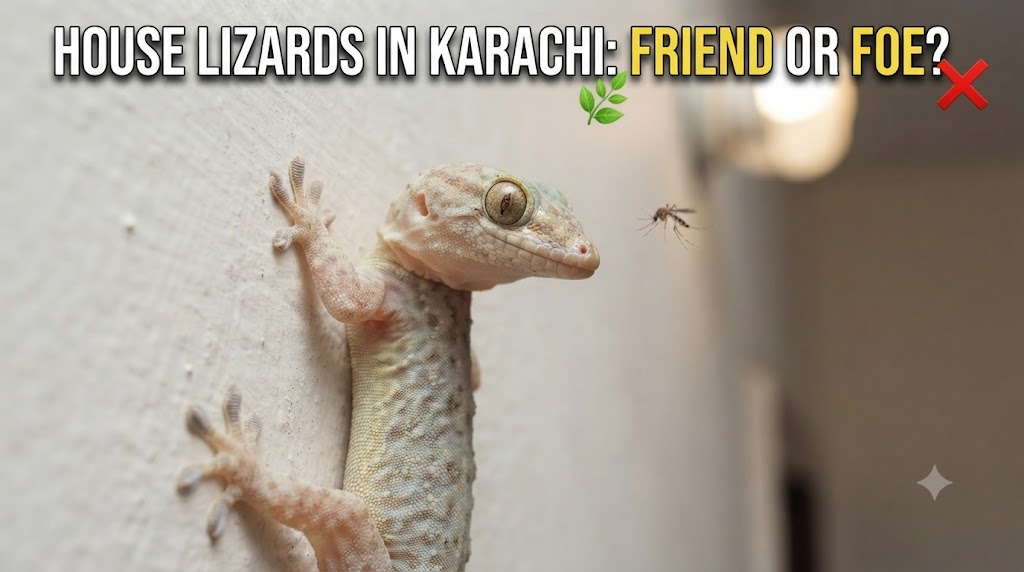
The common house gecko (chipkali) found in Karachi homes is harmless to people. It isn’t venomous, it almost never bites, and it spends its nights eating mosquitoes, moths and other small insects. The real issues are hygiene around droppings, geckos slipping into switchboards, and what a sudden increase in their numbers says about the insects living in your home.
From Clifton flats to older bungalows in Nazimabad, almost every Karachi home has one or two waiting beside the tube light. Before you book a pest control service in Karachi, it’s worth knowing whether the gecko is the problem — or a sign of one.
Which Lizard Is Living in Your Karachi Home?
The lizard on your wall is almost certainly a house gecko — in Karachi most often the yellow-bellied house gecko (Hemidactylus flaviviridis), the familiar pale grey-to-beige chipkali with a lighter underside. Adults are usually 10–15 cm long including the tail. Large lidless eyes and ridged toe pads let it run straight up walls and across ceilings, and like most geckos it can drop its tail to escape a threat and grow a new one.
It’s nocturnal, so you’ll mostly see it after dark near lights where insects gather. Geckos move freely between flats, stairwells, courtyards and gardens, so you’ll never fully “clear” a building of them. The realistic goal is to make the inside of your home less rewarding than the outside.
Why Do Karachi Homes Have So Many Geckos?
- Warm weather almost year-round. Geckos are cold-blooded, and Karachi’s mild winters mean they stay active for most of the year, slowing down only on cooler December–January nights.
- A steady insect supply. Mosquitoes, moths and small flies breed around standing water and open nallahs, peaking during and after the July–September monsoon — our Karachi monsoon pest guide explains that seasonal surge.
- Older buildings with small gaps. Many homes in North Nazimabad, Garden and the old city have hairline cracks around window frames, AC pipe holes and utility openings. The same gaps let in roaches and ants, which is why pest control in old Karachi buildings usually means dealing with several pests at once.
Lighting ties it together. Porch lights, veranda bulbs and shop signboards pull in flying insects every night, and geckos station themselves right beside them. A bright white tube light next to an open window is effectively a gecko feeding station.
Do Geckos Actually Help With Pest Control?
Yes, within limits. Geckos eat mosquitoes, moths, small flies, spiders, ants and occasionally young cockroaches, and one active gecko can work through a steady stream of small insects near a light each night. In a flat beside a monsoon-flooded street, that’s genuinely useful.
But geckos only eat what comes to them. They don’t go into drain pipes, cabinet hinges or wall voids where roaches and ants actually breed, and they’re no real defence against the mosquitoes behind dengue outbreaks — our guide to mosquito and dengue risk in Karachi covers what does work. Think of a gecko as a bonus, not a pest control plan.
Are House Geckos Dangerous? The Real Risks
Not dangerous, but not perfectly clean either. These are the concerns that actually matter:
- Droppings. Small dark pellets with a white tip on sills, walls and behind furniture. Like other reptiles, geckos can carry Salmonella bacteria, so wipe droppings up with a disinfectant rather than dry-sweeping them, and keep kitchen counters clear of them.
- Electrical fittings. Geckos squeeze into switchboards, meter boxes and AC indoor units for warmth and shelter. A gecko bridging live terminals can cause a short circuit or trip — a real risk in older houses with ageing wiring.
- Kitchens and food areas. Many people simply don’t want a lizard near food preparation, and for hygiene reasons that’s a sensible standard, not an overreaction.
What Does a Sudden Rise in Geckos Mean?
If you’re suddenly seeing far more geckos than usual, the lizard usually isn’t the problem — its food supply is. Remove the insects and gecko numbers fall on their own. Here’s how to read what you’re seeing:
| What you’re noticing | What it usually points to | What to do |
|---|---|---|
| One or two geckos near a light at night | Normal behaviour — they’re feeding on flying insects drawn to the light | Nothing; just clean droppings as you find them |
| Many more geckos after rain | Mosquitoes and moths breeding in standing water nearby | Clear water from pots, roofs and blocked drains |
| Geckos plus small roaches around kitchen or bathroom pipework | Cockroaches breeding in drains, cabinets or pipe gaps | Professional cockroach control targeting harbourage points |
| Geckos hanging around kitchen counters and ant trails | An ant colony feeding on food residue or sugar | Find and treat the nest — see our ant control service |
| Droppings or eggs inside switchboards or behind the AC | Geckos sheltering and breeding in warm fixtures | Have an electrician check the fitting, then seal the openings |
Geckos plus roaches is the combination to take most seriously, especially in ground-floor units near open drains in Saddar and Liaquatabad. If you’re unsure what you’re dealing with, our guide to cockroach species in Karachi helps you tell the small German roach from the larger American one. For ants, the pattern of ant trails in Karachi kitchens usually tells you where the colony is.
How to Keep Geckos Out Without Killing Them
- Seal entry points. Caulk cracks around window frames and AC pipe holes, fit door sweeps, and put fine mesh on vents and exhaust openings. Our DIY guide to pest-proofing doors and windows walks through each step.
- Cut off their food supply. Fewer indoor insects means fewer reasons for geckos to come inside. Covered bins, sealed containers and fixing damp patches all help — see our tips on storing food and waste correctly.
- Change the lighting. Move bright bulbs away from doors and windows, and swap cool white tube lights near openings for warm yellow LEDs, which attract fewer insects.
- Clear clutter. Geckos rest and lay eggs in dark, undisturbed spots — behind almirahs, stacked boxes, picture frames and storeroom shelves. Regular cleaning removes those hiding places.
What not to use: naphthalene balls give off fumes that aren’t safe to breathe in closed rooms, especially around children, and won’t reliably repel geckos. Glue traps are cruel and usually leave a dead gecko stuck behind furniture. Popular home tricks like eggshells, peacock feathers or coffee-tobacco balls have no reliable evidence behind them. Geckos aren’t classified as harmful pests, so nothing should be aimed at killing them.
When Should You Call a Pest Control Company?
An occasional gecko on the wall doesn’t need a professional. If your home matches anything beyond the first row of the table above — especially geckos appearing alongside roaches or ants — it’s time for an inspection. That visit isn’t really about the geckos; it’s about finding and treating the insect population feeding them, plus checking damp areas and drainage.
This matters most in ground-floor homes and older buildings in DHA, Clifton and Gulshan-e-Iqbal, where humidity and ageing infrastructure support several pests at once. Cost depends on property size and how severe the insect problem is — our breakdown of cockroach control cost in Karachi and our charges page give you a realistic picture before you book.
Frequently Asked Questions
Are house geckos poisonous?
No. House geckos in Karachi have no venom. They bite only when grabbed, and a bite is tiny and harmless — just wash it with soap and water.
What happens if a lizard falls into food?
It’s a common fear that a chipkali makes food poisonous, but geckos aren’t venomous. Their skin and droppings can carry bacteria, though, so throw away any food a gecko has fallen into, and keep cooked food covered, especially in the kitchen at night.
Do geckos lay eggs inside the house?
Yes. Females lay small, hard white eggs, usually two at a time, tucked into cracks, behind frames, inside switchboards or in storage boxes. Finding eggs means geckos are breeding indoors, so remove them and seal the gap they were in.
Why does a gecko make a clicking sound at night?
House geckos communicate with short chirps and clicks, mostly to mark territory or attract mates. The sound is harmless, though a lot of clicking usually means several geckos are sharing the same space.
Will fumigation kill the geckos in my house?
A proper insect treatment isn’t aimed at geckos. It targets the cockroaches, ants and other insects they feed on. Once that food supply drops, geckos gradually move elsewhere on their own.
Why do I see fewer geckos in winter?
On cooler December and January nights, geckos become less active and shelter inside wall gaps. They haven’t left — you’ll see them back near the lights as temperatures rise in spring.
The Bottom Line
Geckos aren’t the enemy — in most Karachi homes, they’re quietly keeping insect numbers down. But if you’re seeing far more of them than usual, don’t chase the lizard; look at what’s feeding it. If that points to cockroaches, ants or a wider insect problem, book an inspection with Accurate Fumigation and we’ll find and treat the actual source.

Rehan Khan is the founder of Accurate Fumigation and an entomologist. He holds an M.Sc. in Entomology and a B.Sc. in Environmental Science, and has worked in pest control in Karachi for three decades. He founded the company in 2005 and writes about the pest and water problems the city deals with each season. Accurate Fumigation is ISO 9001:2015 certified and a member of the National Pest Management Association.
Questions about a service, or need a certificate for an inspection? Call the office on 0330-2533480. Read Rehan’s full profile.