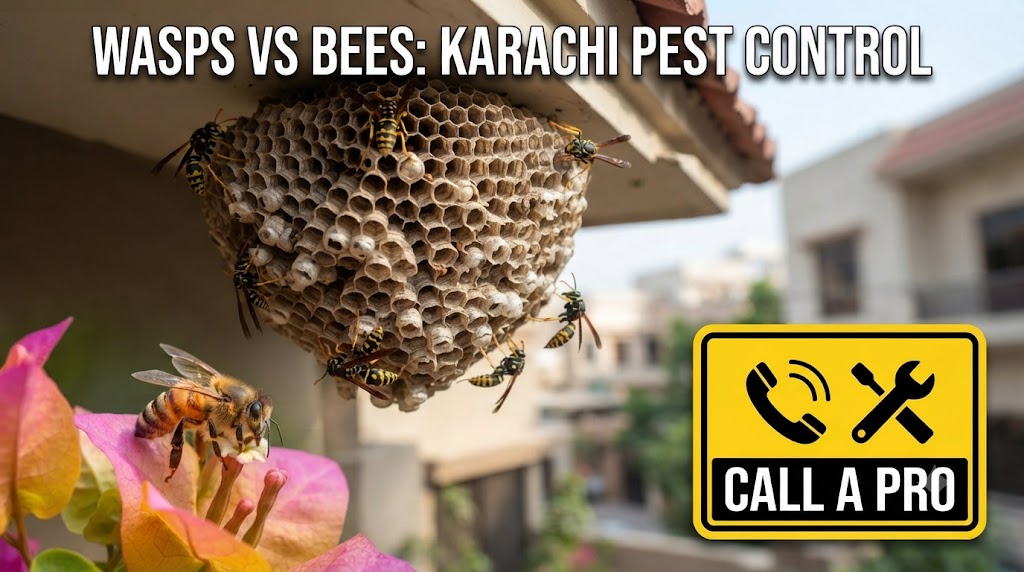
Wasps and bees need different handling. A small nest far from where people walk can often be left alone, especially a bee colony, but a nest near an entrance, inside a wall or tank enclosure, or in a home with a sting allergy should be removed by a professional.
Every year, as temperatures climb through spring and stay high into summer, Karachi homeowners start noticing papery, honeycomb-shaped nests under balcony ledges, inside AC units or along boundary walls. Some are harmless. Others are a genuine safety risk that shouldn’t be handled with a rolled-up newspaper and good intentions. Treating wasps and bees the same way is exactly how people get stung. This guide covers what is nesting on your property, when to leave it and when to call a proper fumigation service in Karachi instead of climbing a ladder yourself.
How Do You Tell Wasps From Bees?
Identify what you are looking at before deciding anything. Misidentification is one of the most common reasons DIY removal goes wrong, because the right level of caution differs for each.
| Feature | Honeybees | Paper wasps | Mud daubers |
|---|---|---|---|
| Appearance | Rounder and fuzzier | Slim, smooth body with a defined waist | Slim, with a very narrow waist |
| Nest | Waxy, layered comb in wall cavities, tree hollows or enclosures; some South Asian species, such as the giant honeybee, build one large open comb hanging from a building | Open, umbrella-shaped papery nest under eaves, balconies and stairwells | Small tube-like mud nests on walls and window frames |
| Temperament | Generally calm unless the hive is disturbed, though some species are very defensive | Defensive of the nest | Solitary and generally docile |
| Sting | Barbed stinger, so a honeybee usually stings once | Can sting repeatedly | Can sting repeatedly but rarely does unless handled |
| Role | Pollinator | Hunts caterpillars and other insects | Hunts spiders |
Where Do Wasps and Bees Nest in Karachi Homes?
Karachi’s mix of balconies, water tanks and older masonry gives both plenty of options:
- Underneath balcony railings and window AC units
- Inside or around rooftop water tanks and their surrounding brickwork
- Gaps in boundary walls and parapets
- Garden trees and hedges, especially in bungalow-style homes in DHA and Clifton
- Ventilation shafts and unused rooms in apartment blocks, such as those in Gulshan-e-Iqbal
Nests near water tanks deserve special attention. A compromised or poorly sealed tank enclosure is not just a wasp risk; it is also a contamination concern for your water supply, one more reason to watch for the signs your water tank needs cleaning. Apartment dwellers can find more building-specific advice in our Gulshan-e-Iqbal and Gulistan-e-Johar apartment pest guide.
How Dangerous Are Wasp and Bee Stings?
For most people, a sting means brief pain, redness and swelling that settles within a day or two. The bigger concern is a known sting allergy, where a sting can trigger swelling beyond the sting site, difficulty breathing, dizziness or a rapid drop in blood pressure. That is a medical emergency and needs immediate attention, not home remedies.
Even without an allergy, a disturbed nest is dangerous because of numbers. A paper wasp nest that looks small can release a dozen or more defensive wasps in seconds if it is knocked or sprayed incorrectly. If anyone in your household has a sting allergy, take any nest on the property seriously before someone is stung.
Activity rises through spring and peaks in the hottest months, as covered in our summer heatwave pest surge post. It can pick up again after the rains; see the Karachi monsoon pest guide.
Should You Remove a Nest Yourself or Call a Professional?
| Situation | What to do |
|---|---|
| Small, early-stage nest far from doors, windows and walkways | Monitor from a distance |
| Bee colony in a spot nobody needs to use | Leave it alone; bees are useful pollinators and rarely a threat if undisturbed |
| Mud dauber tubes on a wall | Low risk; usually safe to leave or scrape off |
| Very small, easily reachable wasp nest in a low-traffic area, with no sting allergy in the household | DIY removal is reasonable, with care |
| Nest near an entrance, window, balcony or daily path | Call a professional; proximity alone raises the risk of an accidental sting |
| Nest inside a wall cavity, ceiling void or tank enclosure | Call a professional; the structure has to be opened, not just the visible entrance sprayed |
| Anyone in the home has a known sting allergy | Call a professional; don’t take chances |
| Large or highly active colony | Call a professional |
| Your own spraying failed, or the insects seem more aggressive since | Call a professional |
| You can’t tell whether it’s bees or wasps | Call a professional |
A trained technician has the right protective equipment, knows the safest time to treat a nest (usually early morning or dusk, when activity is lowest) and can clear the whole nest instead of just knocking down the visible part. Done badly, that often relocates the colony a few feet away or makes it more defensive. Cost depends on the size and location of the nest and whether structural access is needed; see our service charges rather than relying on a general figure.
What Should You Do While You Wait for Help?
- Keep children, pets and other household members away from the area
- Don’t spray, poke or throw anything at the nest
- Don’t block the entrance to a nest inside a wall, which can push the insects into your living space
- Close nearby windows if the nest is close to the house
- Avoid strong perfumes and brightly colored clothing near the nest, which can draw the colony’s attention
- If someone is stung and shows signs of a severe reaction (swelling of the face or throat, difficulty breathing, dizziness), treat it as a medical emergency and get help immediately
Why Does Professional Removal Matter Long-Term?
A professional visit also addresses why the nest formed there. A can of spray may clear what you can see, but it won’t seal the crack in your parapet or the gap around your tank enclosure that made the spot attractive, so a new colony can appear in the same place next season. Proper removal plus sealing entry points is what keeps them from returning; our DIY guide to pest-proofing doors and windows shows how. If children or pets use the area, read whether pest control is safe for children and pets before the treatment.
Frequently Asked Questions
What should I do if I get stung?
Move away from the nest, wash the area with soap and water, and apply a cold compress to reduce swelling. If a honeybee stinger is still in the skin, scrape it out quickly. If there is swelling of the face or throat, difficulty breathing or dizziness, or the person has a known allergy, seek emergency medical help immediately.
Should I kill a bee colony or have it removed safely?
Where possible, bees are best relocated rather than destroyed, since they are important pollinators. If a colony is somewhere that genuinely needs to be clear, such as near a doorway or inside a wall, a professional can assess the safest and most humane approach.
Can wasps or bees get into my water tank?
They are more likely to nest in the surrounding brickwork or enclosure than in the tank itself. A poorly sealed tank area is still a concern for pest activity and water cleanliness, and worth checking during routine water tank cleaning.
What time of year are wasps and bees most active in Karachi?
Activity typically increases from spring through the hot summer months as colonies grow, and it can rise again after monsoon rains when insects, which wasps hunt, become more abundant.
Why do wasps keep building in the same spot?
Sheltered, dry spots with an easy access gap, such as under a balcony ledge or behind an AC unit, keep attracting new colonies. Removing the nest without sealing the gap or crack leaves the spot just as appealing next season.
The Bottom Line
A small, out-of-the-way nest can often be left alone. But once a nest is close to where people move through the property, inside a wall or tank enclosure, or there is any allergy risk in the household, it isn’t worth handling yourself. Contact Accurate Fumigation for a safe, complete removal, and to make sure the same spot doesn’t attract a new colony next season.

Rehan Khan is the founder of Accurate Fumigation and an entomologist. He holds an M.Sc. in Entomology and a B.Sc. in Environmental Science, and has worked in pest control in Karachi for three decades. He founded the company in 2005 and writes about the pest and water problems the city deals with each season. Accurate Fumigation is ISO 9001:2015 certified and a member of the National Pest Management Association.
Questions about a service, or need a certificate for an inspection? Call the office on 0330-2533480. Read Rehan’s full profile.