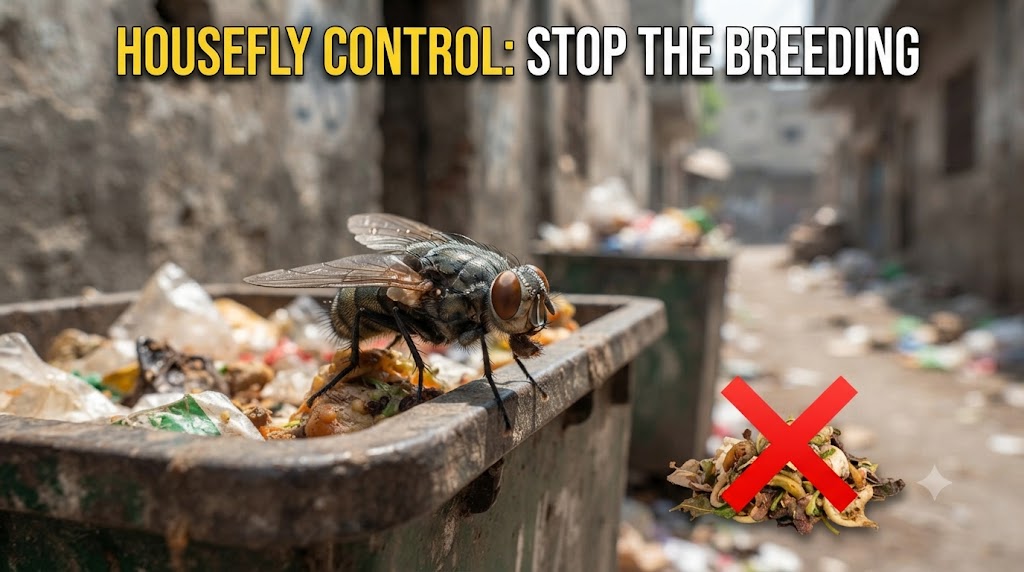
Why are there so many flies in your kitchen? Because a breeding source is nearby: rotting food, uncollected garbage, animal waste or a grease-filled drain. Houseflies breed in decaying organic matter, so covering the source, not swatting or spraying, is what stops them.
A stray fly or two on your food isn’t cause for alarm. A kitchen full of them, or flies that return no matter how often you swat them away, almost always means a source somewhere nearby hasn’t been dealt with. Karachi’s warm climate, dense population and, in some neighborhoods, irregular waste collection make it easy for houseflies to establish themselves. Knowing where they come from is the difference between a quick fix and a problem that returns every few weeks.
Why Do Houseflies Multiply So Fast in Karachi?
Houseflies (Musca domestica) go through four stages: egg, larva (maggot), pupa and adult. In warm conditions, which covers most of Karachi’s year outside the cooler winter months, the cycle can finish in as little as a week to ten days. A female lays roughly a hundred eggs per batch, and any pocket of decaying organic matter will do.
That speed is why “a few flies near the bin” can become “flies everywhere in the kitchen” within days if the source isn’t found and removed. It also explains why fly activity peaks in the hot months and after the rains; our Karachi monsoon pest guide covers what else the season brings.
Where Do Houseflies Breed in Karachi Homes and Businesses?
Garbage is the biggest driver in most neighborhoods, but it is rarely the only one. Match what you see to the likely source:
| Breeding source | Where it shows up in Karachi | What to do |
|---|---|---|
| Open or overflowing garbage | Household bins left too long, uncollected street piles, areas with irregular waste collection; also a sanitation red flag during SFA inspections of food outlets | Use covered bins and empty them regularly |
| Clogged drains and monsoon puddles | Waterlogged streets and blocked gutters holding leaves and dirt after heavy rain | Clear drains and gutters, especially after rain |
| Animal waste | Homes near livestock or poultry and stray-animal areas, such as parts of Malir, Landhi and Korangi; any home with pets | Clean up promptly and dispose of it in sealed bags |
| Rotting food and produce | Open kitchen bins, overripe fruit, spoiled stock in restaurant and grocery store rooms | Remove spoiled items quickly and never leave them in an open bin |
| Kitchen drains and grease traps | Restaurants and commercial kitchens, where buildup is easy to overlook | Clean drains and traps on a routine schedule |
Animal waste spikes around Eid al-Adha, when large volumes of waste build up in a short time; see our note on the Eid pest surge in Karachi. For daily habits that keep waste from becoming a breeding site, read storing food and waste correctly. Area-specific advice for one of Karachi’s most affected neighborhoods is in our Malir pest control guide.
Can Houseflies Make You Sick?
Yes, indirectly. Houseflies don’t bite, but they are mechanical vectors of disease. They pick up bacteria, viruses and parasites on the tiny hairs of their legs and bodies from garbage, waste and decaying matter, then transfer them to the next surface they land on, including your food, utensils and kitchen counters.
That is a real route for foodborne illness, and it is why fly control is a standard part of food safety for restaurants, hotels and commercial kitchens in Karachi. If you run a food business, our guide to fumigation certificate requirements for Karachi restaurants explains what inspectors expect. Households should take it seriously too, particularly around food prep areas and anywhere children eat.
How Do You Get Rid of Houseflies for Good?
Fix the source first (see the table above). No amount of spraying or swatting works while a breeding site is still active. After that, layer these measures:
Use Physical Barriers
Fly screens on windows and doors, and self-closing doors in kitchens and food storage areas, cut down how many flies get in. This helps most in ground-floor units and homes near open drains or waste collection points. Our DIY guide to pest-proofing doors and windows shows how to seal the gaps.
Keep a Cleaning Routine
Regularly clean counters, bins, drains and any surface where food residue collects, which removes both the food and the breeding material. Restaurants and commercial kitchens also need routine grease trap and drain cleaning, not just surface cleaning. More kitchen habits are in our kitchen pest prevention guide.
Check Water Sources
Flies are drawn to any damp, organic-rich spot, so look for leaks, clogged drains and dirty water tanks. A poorly maintained tank area can quietly add the damp conditions flies and several other pests like. Cockroaches are often found in the same spots; you can compare the cockroach species in Karachi if you are seeing both.
Use Traps and Targeted Treatment
Fly traps, light-based or otherwise, help monitor and reduce numbers, but they work best alongside sanitation, not instead of it. For an established infestation, professional treatment that targets both the adult flies and the breeding site is usually needed to break the cycle rather than temporarily knock down the visible population.
When Should You Call a Professional?
Sanitation handles most minor fly problems. Call a professional service when:
- Flies keep returning despite consistent cleaning and covered bins
- You can’t identify or reach the source, such as a neighboring plot or a blocked drain under a slab
- You run a restaurant, hotel or food business and need to meet food safety standards consistently
- DIY sprays and traps are no longer making a visible difference
A professional visit starts by identifying the actual breeding source, which is often not where the flies are most visible, then applies targeted treatment and gives practical advice to stop a recurrence. Cost depends on the size of the property and how established the problem is; see our service charges for details.
Frequently Asked Questions
Why do I have so many flies even though my house is clean?
The breeding source doesn’t have to be inside your home. A neighboring uncollected garbage pile, a blocked street drain or waste accumulation nearby can support a fly population that moves indoors, however clean your own kitchen is.
Can houseflies actually make you sick?
Yes, indirectly. They don’t bite, but they carry bacteria and other pathogens from contaminated surfaces and transfer them to food or utensils they land on, which is a real route for foodborne illness.
Do fly problems get worse after monsoon rain in Karachi?
Often, yes. Waterlogged streets, blocked drains and accumulated organic debris create ideal breeding conditions, so many households and businesses notice more flies during and just after the monsoon.
Are fly traps enough to solve an infestation?
Traps reduce numbers and help monitoring, but they don’t address the breeding source. Until you fix where the flies come from, new ones keep replacing those caught.
How quickly can a fly problem develop?
Very quickly. In warm weather the life cycle can finish in about a week to ten days, and each female lays roughly a hundred eggs per batch, so a small issue can escalate within days if the source isn’t addressed.
Is professional fly control necessary for a home, or only for restaurants?
It depends on the scale of the problem. Restaurants and food businesses need consistent control to meet food safety expectations, but a household with a persistent, recurring fly problem, especially one tied to a source it can’t reach, also benefits from a professional inspection.
The Bottom Line
Houseflies are a sanitation problem before they’re a pest control problem: find the breeding source and the flies mostly take care of themselves. If you’ve covered the basics and still have a persistent fly issue, or you need reliable ongoing control for a restaurant or commercial kitchen, get in touch with Accurate Fumigation to have the source identified and treated properly.

Rehan Khan is the founder of Accurate Fumigation and an entomologist. He holds an M.Sc. in Entomology and a B.Sc. in Environmental Science, and has worked in pest control in Karachi for three decades. He founded the company in 2005 and writes about the pest and water problems the city deals with each season. Accurate Fumigation is ISO 9001:2015 certified and a member of the National Pest Management Association.
Questions about a service, or need a certificate for an inspection? Call the office on 0330-2533480. Read Rehan’s full profile.