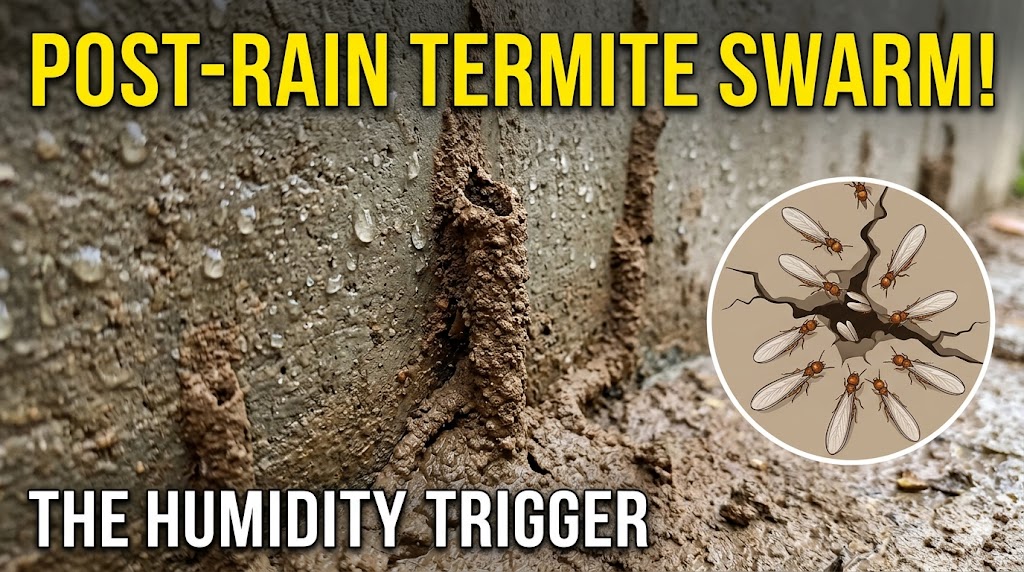
Monsoon is the main trigger for termite trouble in Karachi. Heavy rain saturates the soil around buildings, and the moisture that lingers afterwards helps subterranean termites forage upward and establish new colonies. The safest time to inspect is after the rains, roughly September to November. Look for mud tubes, hollow-sounding wood and discarded wings, and book a professional inspection if you find any.
Every year after the rains the same scene plays out in homes across the city. A homeowner notices what looks like a crack in the wall, but it is thin brown tubes running along the skirting board. A door frame that was fine in June sounds hollow when knocked. By the time these signs show, termites have often been active inside the structure for months. This guide explains why the post-monsoon weeks matter, which buildings are most exposed, and what to do about it. For the wider picture, see our Karachi monsoon pest guide.
Why Does Monsoon Trigger Termite Infestations in Karachi?
Subterranean termites, the type most often found in Karachi homes, need consistent moisture to survive and spread. They nest underground and forage upward for cellulose-rich materials: timber, wooden furniture, door frames, cardboard and even paper inside walls.
After heavy rain, the soil under and around buildings stays saturated. That moisture seeps into foundations and cracks in ground-floor slabs and creates the humid conditions termites need to expand. Because soil stays damp long after the rain stops, the weeks and months following the monsoon are the high-risk period, not just the rainy days themselves.
Winged swarmers, the reproductive caste, typically leave their colony around warm, humid, rainy weather to start new ones. If you see small winged insects gathering around lights on rainy evenings, a colony may be active nearby. See our note on spring pest activity in Karachi for why the dry weeks before the rains are the ideal time to prevent this.
Which Karachi Buildings Are Most at Risk?
Older construction in areas like PECHS, Nazimabad and North Nazimabad often has timber-framed doors, wooden window shutters and wooden ceiling beams that were standard several decades ago. That is plenty of food for termites, and infestations are often advanced before any outside sign appears. Our PECHS pest control guide covers what we see there.
In areas like Garden and Liaquatabad, dense housing and older drainage can keep soil moisture elevated for longer after rain, which extends the window of vulnerability. See our guide to termite and rodent risks in Garden and the Old City. Across the city, ground-floor units in older buildings, properties with basement storage and homes with wooden furniture standing directly on the floor carry the highest risk.
What Are the Warning Signs of Termites?
Termites are secretive and damage wood from the inside out, so watch for these signs, and see our guide to identifying termite damage in Karachi homes for more detail:
- Mud tubes: pencil-thin tubes of dried mud along walls and skirting boards, or running from the floor to wooden structures. These are among the most reliable signs of active termites.
- Hollow-sounding wood: knock on door frames, window frames and wooden furniture; a hollow sound means the interior may be eaten away.
- Bubbling or uneven paint on walls and woodwork, which can point to moisture and hidden activity.
- Frass: small pellet-like droppings near wooden structures, sometimes mistaken for fine sawdust.
- Soft or sagging wooden floors that feel springy underfoot in serious infestations.
- Discarded wings near windows and doors after a swarm.
What Do Termites Attack First in a Karachi Home?
| Where | Why it’s vulnerable |
|---|---|
| Wooden door and window frames | Often set directly into masonry with no moisture barrier |
| Timber ceiling joists | Common in older buildings and hard to inspect |
| Kitchen cabinets | Especially those against exterior or wet walls |
| Sofas, beds, wardrobes and bookshelves | Standing directly on tiled or concrete floors, close to damp ground |
| Cardboard boxes in storerooms | Cellulose on lower shelves, undisturbed for months |
| Staircase balusters and handrails | Wood in multi-storey homes, often near ground-level entry points |
What Can You Do Yourself to Reduce Termite Risk?
There is no effective DIY cure for an active infestation, but these steps lower your risk. For a wider checklist, see how to pest-proof your Karachi home before monsoon season.
- Fix leaks around pipes, AC drainage and the roof promptly after the rains, since termites are drawn to moisture first.
- Ventilate storage areas, the space under stairs and ground-floor rooms.
- Keep cardboard, newspapers and wooden items off storeroom floors.
- Keep firewood, timber offcuts and building materials away from exterior walls.
- Check furniture for mud tubes and hollow sounds whenever you move it during seasonal cleaning.
- Seal cracks in walls and around utility pipes in the slab, especially after rain.
Why Does Termite Treatment Need a Professional?
Unlike cockroaches or rodents, termites can’t be controlled with surface sprays or traps. A colony can hold a very large number of individuals and lives deep in the soil or inside wall cavities, where hardware-store products can’t reach.
A professional termite control service in Karachi generally uses two approaches. Pre-construction anti-termite soil treatment stops colonies establishing while a building is going up. Post-construction treatment typically involves drilling into the floor slab and injecting termiticide into the soil beneath, combined with a chemical barrier along the perimeter and injection into affected wooden structures. This creates a treated zone that kills workers returning to the colony and blocks new entry.
A qualified technician can judge the extent of an infestation, find entry points specific to your building’s construction and recommend the right method. Check our pest control license for our credentials and our about us page for how we approach termite management. Ask about aftercare too; our guide to pest control warranty and guarantee explains what to look for.
Frequently Asked Questions
When should I inspect for termites after the monsoon?
Soon after the rains ease, while the soil is still damp, is a sensible window; roughly September to November covers most Karachi homes. If you see swarmers or mud tubes at any time, don’t wait for a season.
Are flying termites the same as flying ants?
No. Termite swarmers have two pairs of wings of equal length and a thick, straight body, while flying ants have a pinched waist and unequal wings. If you’re unsure, a professional inspection is the safest way to confirm.
Does property insurance cover termite damage?
Pest damage is commonly excluded from standard property insurance, but policies differ, so check yours or ask your insurer. Either way, early detection is far cheaper than repairing frames, joists or flooring.
How much does termite treatment cost in Karachi?
It depends on the property size, the extent of the infestation and the treatment method. Our breakdown of termite treatment cost in Karachi explains what drives the price, and our charges page has current pricing.
Can a new building get termites?
Yes. Termites live in the soil, so even newly built homes can be affected if the ground wasn’t treated during construction. Pre-construction soil treatment is the standard way to prevent this.
Act Before the Damage Becomes Structural
Early detection and treatment is almost always cheaper than remediation, and repairs to door frames, ceiling joists or flooring can be expensive. If you’ve seen any of the signs above, or your property is in an older neighborhood and has never had a termite inspection, contact Accurate Fumigation for a professional assessment, and review our service charges before you call.

Rehan Khan is the founder of Accurate Fumigation and an entomologist. He holds an M.Sc. in Entomology and a B.Sc. in Environmental Science, and has worked in pest control in Karachi for three decades. He founded the company in 2005 and writes about the pest and water problems the city deals with each season. Accurate Fumigation is ISO 9001:2015 certified and a member of the National Pest Management Association.
Questions about a service, or need a certificate for an inspection? Call the office on 0330-2533480. Read Rehan’s full profile.