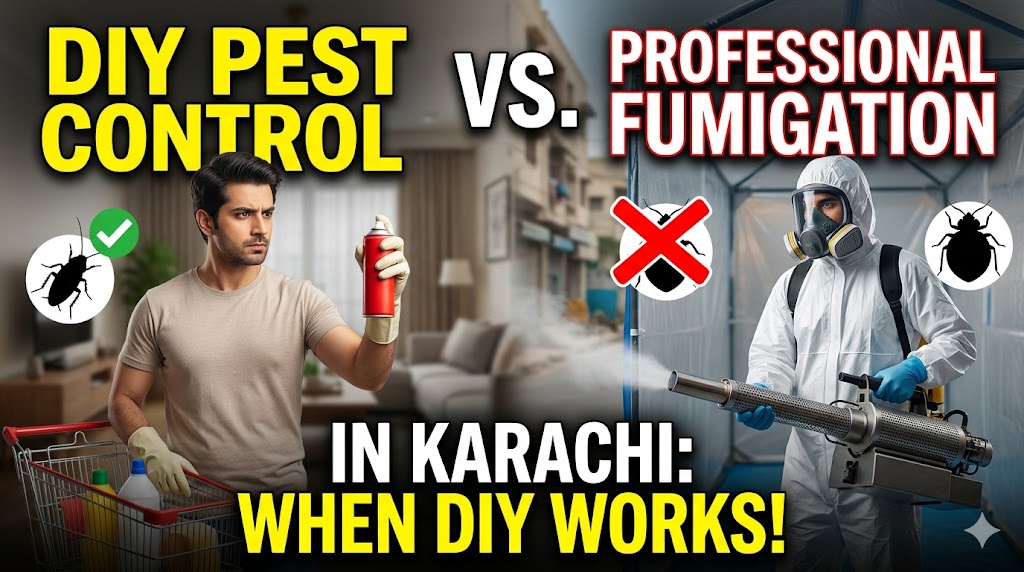
DIY pest control works in Karachi when the infestation is recent, localized and caught early — a few cockroaches in a new flat, a thin ant trail, seasonal mosquito prevention. It fails, and often makes things worse, once the problem reaches walls, mattresses, the building slab or an active rodent colony. This guide gives you an honest breakdown of exactly where that line falls, so you don’t waste weeks on retail sprays while an infestation spreads.
Any Karachi hardware market or pharmacy has a shelf full of options — spray cans, gel baits, coil traps, ultrasonic devices and loose chemical concentrates. Sometimes reaching for them is the right call. Often it isn’t, and knowing the difference saves both money and months.
DIY vs Professional: Which Pests Fall Where
| Pest / situation | DIY or professional? | Why |
|---|---|---|
| Cockroaches, early & localized | DIY can work | Correctly placed fipronil or hydramethylnon gel baits handle a handful of roaches — placement and patience matter more than the product |
| Minor ant trail | DIY can work | Retail ant gel plus sealing the entry point works if the colony isn’t nested in the wall |
| Flies & mosquitoes (prevention) | DIY can work | Screens, standing-water removal and vaporizers are genuine environmental controls, not infestation treatments |
| Established cockroaches | Professional | Once the colony is in wall voids, surface sprays scatter it instead of killing it |
| Bed bugs | Professional | Eggs and bugs hide in seams, cracks and outlets that aerosols never reach — it rebounds in weeks |
| Termites | Professional | Subterranean colonies need soil injection under the slab; no retail product reaches them |
| Active rodents | Professional | An entry point in an older property needs exclusion work, not just traps |
| Fleas & ticks | Professional | Pet, bedding and premises must be treated together — a coordination DIY rarely gets right |
When DIY Is a Reasonable First Step
DIY suits a recent, localized problem where the pest responds to retail-grade products. For early-stage cockroaches, gel baits work if you place them precisely — under the sink, behind appliances, along plumbing runs — and give them several days rather than expecting an overnight fix. Our kitchen pest prevention guide covers where these baits do the most good.
A small ant trail entering through a window or door gap can usually be broken with a retail ant gel or by sealing the entry and laying a boric-acid barrier — provided the colony isn’t nested inside the wall cavity. Seasonal fly and mosquito pressure, which peaks in Karachi during and after the monsoon from July through September, responds well to mesh screens, standing-water removal and coil or electric vaporizers. These are prevention, not treatment, and there’s a real mosquito and dengue risk in Karachi that makes the prevention worth doing properly.
When DIY Fails — and Makes Things Worse
The failure modes are predictable. Scattering without eliminating: spraying a visible cockroach trail disperses the colony into wall voids and other rooms, spreading the population across more of the property and making it harder to treat.
Treating symptoms, not the source: bed bugs in a mattress need heat or chemical treatment that penetrates seams and joints. A retail aerosol kills exposed adults but not eggs or bugs in cracks, outlets and adjacent furniture, so the infestation rebounds within two to three weeks — the reasoning behind choosing heat versus chemical bed bug treatment is worth understanding before you attempt anything yourself.
Incorrect dilution or application: unlabeled chemical concentrates from local markets are frequently misused. Overdilution makes them useless; underdilution creates a genuine hazard in enclosed, poorly ventilated flats — especially dangerous in Karachi’s April-to-June heat when windows stay shut against dust. This is exactly where the difference between registered and unregistered operators shows up, since correct chemical handling is the whole point of registration.
For cockroach and bed bug problems past the early stage, our cockroach control service and bed bug fumigation service pages show what professional treatment involves.
The Pests You Should Never DIY
The table above flags these, but they’re worth spelling out because DIY attempts on them consistently waste money: subterranean termites need soil injection under the slab that no retail product reaches; established bed bugs across multiple furniture pieces or wall cracks need professional treatment; an active rodent colony in an older property needs exclusion work, not traps; and fleas and ticks require pet, bedding and premises to be treated at once. Our rats control service and fleas and ticks service pages explain the scope for the last two.
The Hidden Cost of Failed DIY
The most expensive DIY mistake is delayed professional treatment. Spray a cockroach infestation with surface products for six to eight weeks without success and the colony simply grows — and treating a large, scattered infestation is far more intensive and costly than treating the same problem early.
In Karachi’s older apartment buildings, where infestations travel between units through shared plumbing and wall voids, a delayed response in one flat often becomes a building-wide problem within months — a pattern our guide to pest control challenges in old Karachi buildings looks at in detail.
DIY Prevention That Actually Works Long-Term
Prevention is where DIY genuinely beats professional treatment on cost-effectiveness. Done consistently, these measures cut infestation risk sharply:
- Seal gaps around kitchen and bathroom pipes with silicone or cement
- Fix dripping taps and standing water — moisture draws cockroaches and mosquitoes year-round
- Store dry food in sealed containers, not open bags
- Empty kitchen bins daily, especially in summer when decomposition is fast
- Check second-hand furniture and clothing for bed bugs before bringing them inside
- Keep under-bed and storage areas clear of cardboard boxes, a favored cockroach harborage
For natural, low-chemical options that suit a home with children or pets, our guide to natural and home remedies for common Karachi pests is a useful companion to this list.
Location Considerations Across Karachi
Ground-floor units, basement-level spaces and properties beside open drains — common in areas like Korangi and Landhi — face higher structural pest pressure. DIY prevention still helps here, but periodic professional treatment is usually needed to hold the line.
Frequently Asked Questions
Is DIY pest control ever enough on its own?
Yes, for recent, localized problems and for prevention — a few early cockroaches, a minor ant trail, seasonal mosquito control. Once a pest reaches walls, mattresses, the slab or an active colony, DIY stops working and professional treatment becomes the cheaper route overall.
Why do cockroaches come back after I spray them?
Surface sprays kill the roaches you see and scatter the rest into wall voids, where they keep breeding. Gel baits work better because roaches carry them back to the colony — but once an infestation is established, professional treatment is what actually clears it.
Can I treat bed bugs myself?
Rarely successfully. Bed bugs hide in seams, cracks and outlets that retail aerosols can’t reach, so surface spraying leaves eggs behind and the problem returns in two to three weeks. Established bed bugs need professional heat or chemical treatment.
Are market chemical concentrates safe to use at home?
They’re risky. Unlabeled concentrates are easy to misjudge — too weak and they do nothing, too strong and they become a health hazard in an enclosed flat, which is worse in Karachi’s heat with the windows shut. Correct chemical handling is exactly what a registered operator provides.
When should I stop DIY and call a professional?
When the pests return after two or three attempts, when they spread to new rooms, or when it’s a termite, bed bug, rodent or flea problem from the start. Delaying past that point only makes the eventual professional job larger and more expensive.
Tried DIY and It Didn’t Work?
If you’ve worked through the retail options and the problem persists, that’s the signal to bring in a professional before it spreads further. Contact us through our contact page for an assessment, and review our service charges to see what professional treatment costs relative to what you’ve already spent on sprays and baits.

Rehan Khan is the founder of Accurate Fumigation and an entomologist. He holds an M.Sc. in Entomology and a B.Sc. in Environmental Science, and has worked in pest control in Karachi for three decades. He founded the company in 2005 and writes about the pest and water problems the city deals with each season. Accurate Fumigation is ISO 9001:2015 certified and a member of the National Pest Management Association.
Questions about a service, or need a certificate for an inspection? Call the office on 0330-2533480. Read Rehan’s full profile.