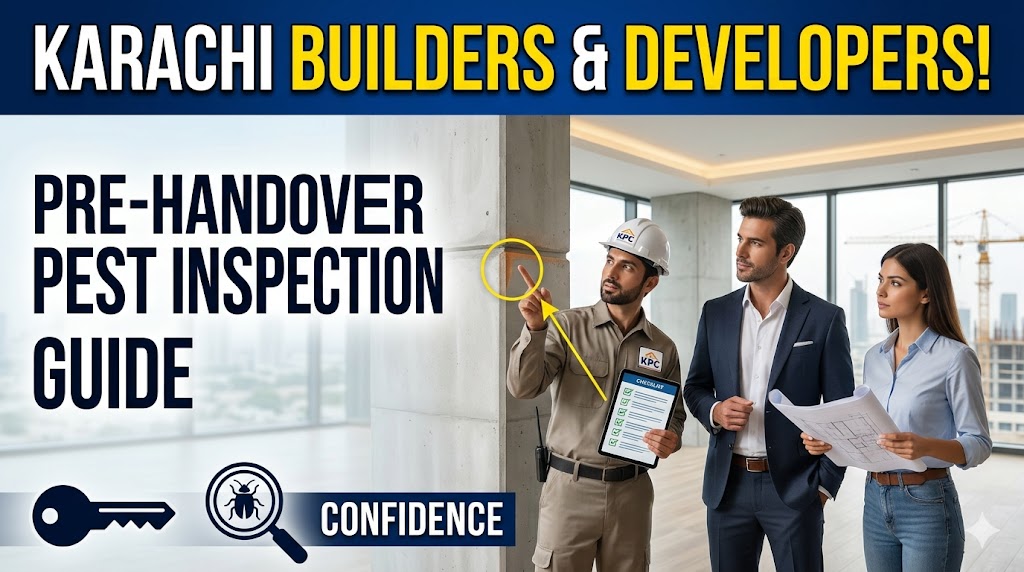
A pest infestation discovered by a buyer within weeks of handover is a warranty nightmare. In Karachi’s real estate market, where buyer confidence is already fragile and word-of-mouth travels fast, the reputational damage from a poorly managed pre-handover process can cost a developer far more than the treatment itself. Pre-handover pest inspection and treatment is one of the few things developers can do that directly protects both the buyer experience and the developer’s liability exposure.
This guide is for builders, project managers, and real estate developers who want to understand what a credible pre-handover pest program looks like — not a checkbox exercise, but something that actually works.
Why New Construction in Karachi Is Already Pest-Prone
New builds in Karachi face pest pressure from day one for structural reasons. Construction sites attract rodents and cockroaches through exposed food waste left by laborers, open drainage connections, and the moisture conditions created during concrete curing. Termites are attracted to timber formwork, wood debris embedded in soil during construction, and the disturbed earth around foundation work.
By the time a building reaches handover stage, the pest population that established itself during construction is already in the walls, under the slab, and inside service ducting. Buyers don’t see it until they move in and start using the space — at which point they’re calling you.
Termite control is a particular priority in Karachi’s soil conditions. See our termite control service for details on treatment methods suited to new construction.
What a Pre-Handover Pest Inspection Should Cover
A thorough pre-handover inspection goes beyond a quick visual walk-through. It should systematically examine:
- All accessible void spaces: beneath raised flooring, behind dry-wall cavities, above false ceilings, inside electrical conduit runs
- Drainage penetration points: where pipes enter the slab or walls, which are the most common rodent and cockroach entry paths
- External perimeter: garden areas, boundary walls, basement ramps, and any areas with exposed soil near the building footprint
- Stairwells and service areas: lift motor rooms, generator rooms, and common corridors often get overlooked during construction cleaning
- Individual units: kitchen and bathroom areas, under-sink cabinets, behind utility meters, and any storage areas
The inspection should produce a written report with findings, risk areas identified, and recommended treatment prior to handover. This document becomes part of your handover package.
Termite Pre-Treatment: The One Thing Developers Most Often Skip
Soil pre-treatment for termites must happen before the slab is poured — not after the building is complete. If your project didn’t include a pre-construction soil barrier treatment, you’re now dealing with a reactive situation where post-construction anti-termite treatment is your only option. This is still effective but more expensive and more disruptive than pre-treatment would have been.
Post-construction anti-termite treatment involves drilling through the floor slab at regular intervals around the perimeter and injecting termiticide into the soil beneath. It’s effective and can form part of your pre-handover package, but it needs to be done properly — using an underdose or skipping sections will leave gaps that termites find within months.
For any future projects, build soil pre-treatment into the construction schedule immediately after excavation and before concrete is poured. The cost is a fraction of post-construction treatment and produces a far more reliable barrier.
Cockroach and Rodent Control Before Buyers Move In
Construction sites are magnets for rodents. Once the building enters its finishing stage — when laborers’ food waste is cleared but there are still open entry points — rodents often move from the site into the structure itself. Pre-handover rodent control should include bait station placement in basement areas, service corridors, and utility rooms, along with physical exclusion work to close access points before occupation.
Cockroach treatment for a pre-handover scenario typically uses gel bait in kitchen and bathroom areas of individual units, combined with a residual spray treatment in common areas and drainage points. This is far more practical than a full fumigation at this stage, and it won’t leave odor or residue that affects the first few days after the buyer moves in.
For cockroach gel bait and residual treatment options, see our cockroach control service, and for rodent management see our rats control service.
What to Include in the Buyer’s Handover Package
Providing pest-related documentation at handover signals professionalism and limits your future liability. Include:
- Signed pest inspection report showing what was found and what was treated
- Fumigation or treatment certificate covering the date, chemical used, and areas treated
- Anti-termite treatment certificate if applicable, showing the treatment method and warranty period
- Guidance note for the buyer on maintaining the treatment (ventilation after gel bait application, tank inspection for water hygiene, etc.)
- Contact information for the pest control provider for any follow-up warranty claims
Buyers who receive this package feel protected. Buyers who discover cockroaches in week two and have no documentation to reference will go straight to social media.
Developers in Gulistan-e-Jauhar and Scheme 33 — areas with high-volume residential development — should standardize this documentation as part of every project handover.
Anti-Termite Treatment Warranties: What’s Realistic
Be honest with buyers about what a warranty covers. A post-construction anti-termite treatment can realistically warrant a barrier effectiveness for five years with periodic inspections. It is not a lifetime guarantee. Any warranty needs to be backed by the pest control company, not just stated in the sales brochure — confirm your pest control provider issues a formal written warranty that you can transfer to the buyer.
If a pest control company is offering a 10-year or lifetime termite warranty without annual inspection requirements, be skeptical. The chemistry doesn’t support that claim without ongoing maintenance.
Get a Pre-Handover Inspection Scheduled
For pre-handover pest inspections and treatment across Karachi, contact us through our contact page. We provide written inspection reports, treatment certificates, and can coordinate across multiple units and project phases. Review pricing on our charges page, or visit our locations hub to confirm coverage for your project area.

Founder, Accurate Fumigation — B.Sc. Environmental Science, M.Sc. Entomology
Rehan founded Accurate Fumigation in 2005 and has spent 20 years building it into one of Karachi’s most trusted names in pest control and water tank cleaning. He holds a B.Sc. in Environmental Science and an M.Sc. in Entomology, and his team operates under PPMA registration, FBR/SRB compliance, and WHO-approved chemicals across every service — from termite proofing to tank sanitation. Every job closes with a written warranty and, where required, a certificate accepted by KMC, WASA, and the Sindh Food Authority.
Questions about a service or need a compliance certificate? Reach the office at 0330-2533480, or visit Office-307/2, Razeen Blessings, Block 1, Gulistan-e-Johar, Karachi.