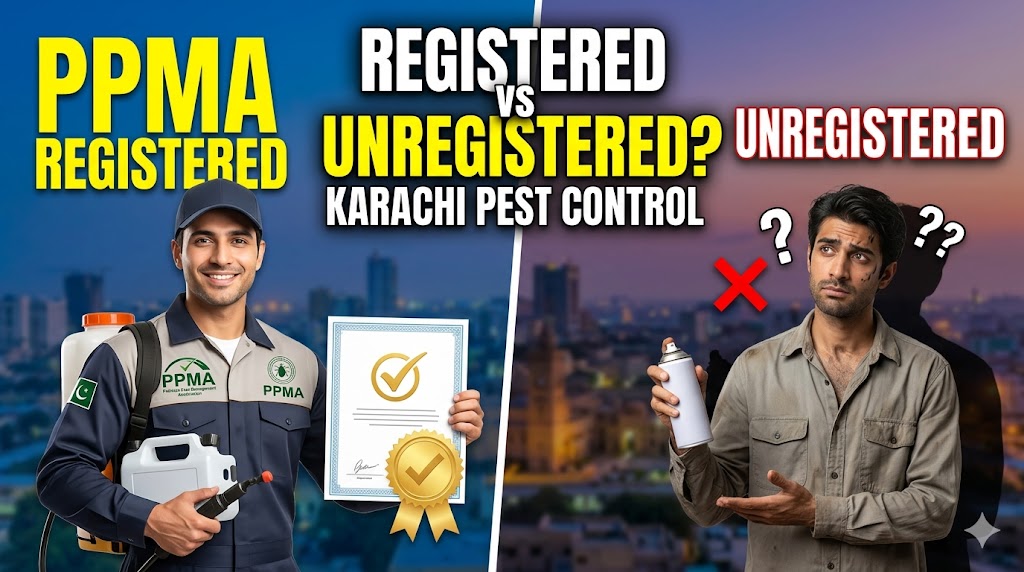
Choosing a PPMA-registered pest control company over an unregistered roadside sprayer isn’t just a bet on quality — it’s a decision about your family’s safety. Registered operators are bound to use approved chemicals at correct concentrations, employ trained technicians and carry liability; unregistered ones carry none of those obligations. This guide explains what PPMA registration means, why it matters, and exactly how to verify a company’s credentials before you let anyone into your home.
When cockroaches hit the kitchen or termites start on the walls, the instinct is to call whoever answers fastest — a WhatsApp contact, a hand-painted van, the cheapest number you can find. That speed is exactly where most Karachi households get it wrong.
Registered vs Unregistered: The Difference at a Glance
| What matters | PPMA-registered company | Unregistered operator |
|---|---|---|
| Chemicals | Approved, licensed pesticides bought from licensed distributors | May use expired, generic or agricultural-grade chemicals |
| Technicians | Trained in dilution ratios, application and safety | Often untrained; guesses concentrations |
| Documentation | Written report of chemicals and dosages per treatment | Verbal assurances only |
| Liability | Carries liability for chemical or health incidents | None — no recourse if something goes wrong |
| Price | Higher — reflects correct chemicals and safe process | Cheaper upfront, costlier when pests return |
| Result | Colony targeted at the source with follow-up | Surface knockdown; pests often return worse |
What Is PPMA and Why Does It Exist?
PPMA stands for the Pakistan Pest Management Association — the industry body that sets professional standards for pest control operators across Pakistan, covering licensing, chemical-handling protocols and ethical service practices. Because pest control chemicals are classified as hazardous substances, these standards exist to make sure they’re used safely rather than sprayed by guesswork in an enclosed home.
A company listed on Accurate Fumigation’s pest control license page has passed baseline checks that unregistered operators simply bypass.
What Registration Actually Requires
Staying registered and compliant means far more than filling out a form. A registered company must:
- Use only approved, licensed pesticides that meet regulatory standards
- Employ trained technicians who understand dilution ratios, application methods and safety protocols
- Keep proper documentation for every treatment, including chemicals used and dosages
- Follow pesticide label instructions to the letter — misusing a registered product is itself a violation
- Carry liability in case of chemical damage or a health incident
Unregistered operators carry none of these obligations. They can use expired chemicals, wrong concentrations, or even industrial-grade substances meant for open agricultural fields rather than enclosed living spaces — a distinction that matters even more when you’re weighing up chemical versus herbal pest control and whether a treatment is safe indoors at all.
The Real Risks of Hiring Unregistered Operators
The most common risk is simply ineffective treatment. Cheap generic sprays at the wrong concentration knock down what you can see and disturb the colony without eliminating the source, so the pests are back within days — sometimes worse than before.
The second risk is chemical harm. Incorrect use of organophosphates or pyrethroid compounds in enclosed flats — especially in older housing stock in areas like Saddar or Liaquatabad — can cause respiratory irritation, neurological symptoms in children and contamination of food surfaces, and Karachi’s summer heat worsens chemical evaporation in poorly ventilated rooms. This is the whole reason people ask whether pest control is safe for children and pets — with a registered operator it’s a controlled process, and with an unregistered one it’s a genuine gamble.
If you’re dealing with a severe infestation right now, our cockroach control service and termite control service pages show what a properly documented professional treatment actually involves.
How to Verify a Company’s Registration Status
Don’t rely on a logo on a van or a certificate printed on paper — both are easy to fake. Verify it properly:
- Ask for the PPMA membership number and cross-check it directly with PPMA
- Ask to see pesticide purchase receipts — registered companies buy from licensed distributors
- Ask which active ingredient is being used and at what concentration — a trained technician answers without hesitating
- Check that the company has a physical office address, not just a mobile number
- Insist on a documented treatment report, not just verbal assurances
These overlap closely with the five questions worth asking before hiring any fumigation company — run through both before you commit to anyone.
Price Differences: What You’re Actually Paying For
Unregistered operators are cheaper, often by a lot. A registered company charges more because it absorbs the cost of proper chemicals, trained staff, equipment upkeep and documentation — that gap isn’t profit margin, it’s the cost of doing the job correctly and safely. It’s also why a suspiciously low quote is a warning sign in itself, as our look at DIY versus professional fumigation in Karachi spells out.
For a clear picture of what professional fumigation costs, our charges page breaks it down transparently.
Registered Coverage Across Karachi
Registered operators generally cover wider areas with consistent standards — whether you’re in a high-rise in DHA or a ground-floor unit in Federal B Area, the treatment protocol should be identical. We serve clients across Karachi, including DHA, Federal B Area and Gulshan-e-Iqbal, with the same trained technicians and documented process at every location. Older buildings in particular reward this consistency, as our guide to pest control challenges in old Karachi buildings explains.
Frequently Asked Questions
What does PPMA registration actually mean?
It means a company operates under the professional standards of the Pakistan Pest Management Association — using approved pesticides, employing trained technicians, documenting treatments and carrying liability. Registration is a baseline of accountability that unregistered operators skip entirely.
How can I check if a pest control company is registered?
Ask for the PPMA membership number and cross-check it with PPMA directly, ask to see pesticide purchase receipts, and confirm the company has a physical office rather than just a mobile number. A trained technician will also tell you the active ingredient and concentration on the spot.
Why are unregistered operators so much cheaper?
Because they skip the costs that make treatment safe and effective — licensed chemicals, trained staff, documentation and liability. The saving is real until the pests return or a chemical incident occurs, at which point you pay again with no recourse.
Is it actually dangerous to use an unregistered sprayer?
It can be. Wrong chemicals or concentrations in an enclosed home can cause respiratory and neurological symptoms — a particular concern for children — and contaminate food surfaces. In poorly ventilated rooms in Karachi’s heat, that risk rises further.
What if a treatment goes wrong with an unregistered operator?
You usually have no recourse. Without documentation, liability cover or a follow-up guarantee, there’s no one accountable for a failed treatment or a health incident — which is the core reason to choose a registered company in the first place.
The Bottom Line
The difference between registered and unregistered isn’t about brand names or marketing — it’s about accountability. When something goes wrong with an unregistered operator, and it often does, there’s no documentation, no liability and no follow-up. Registered companies work under standards that protect both the client and the technician, and in a city where infestations are a year-round reality, that protection is the whole point.
Ready to book a treatment from a licensed team? Visit our contact page to schedule a service, review our pricing before you call, or learn more about our credentials on the about us page.

Rehan Khan is the founder of Accurate Fumigation and an entomologist. He holds an M.Sc. in Entomology and a B.Sc. in Environmental Science, and has worked in pest control in Karachi for three decades. He founded the company in 2005 and writes about the pest and water problems the city deals with each season. Accurate Fumigation is ISO 9001:2015 certified and a member of the National Pest Management Association.
Questions about a service, or need a certificate for an inspection? Call the office on 0330-2533480. Read Rehan’s full profile.