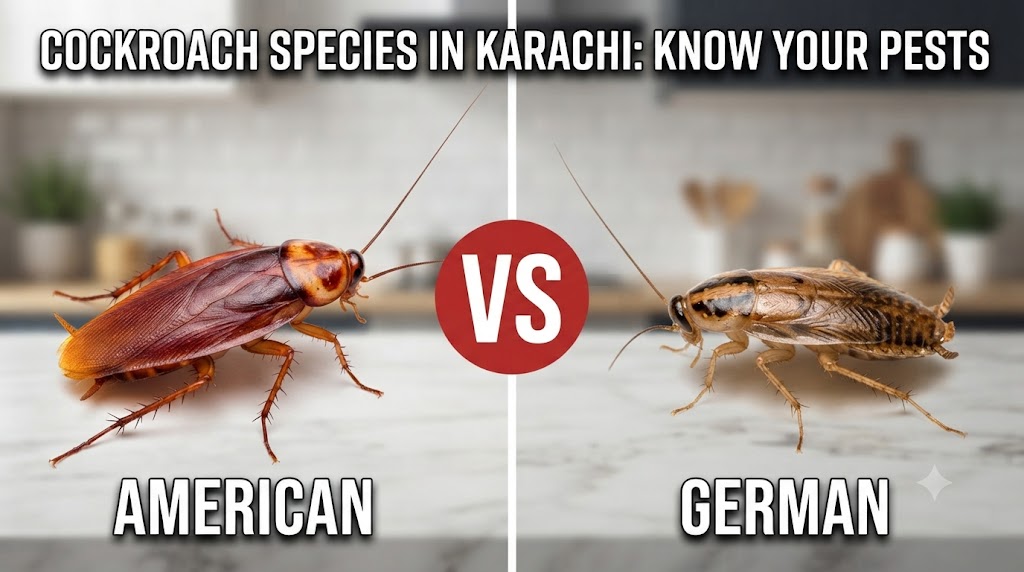
Almost all cockroach problems in Karachi come from two species. The German cockroach is small (about 1.5 cm), tan, marked with two dark stripes behind the head, and it breeds entirely indoors, mostly in kitchens. The American cockroach is large (up to about 5 cm), reddish-brown, and comes in from drains and sewers. Because one breeds inside your home and the other invades from outside, they need different treatment, and confusing them is one of the main reasons shop-bought sprays fail.
This guide explains how to tell the two apart, where each one really comes from, and what that means for getting rid of them. If you already know you have roaches and want them handled, go straight to our cockroach control service in Karachi.
German vs American Cockroach: Quick Comparison
| German cockroach | American cockroach | |
|---|---|---|
| Size | About 1.1–1.6 cm | About 3–5 cm |
| Colour and markings | Light tan; two dark parallel stripes on the plate behind the head | Reddish-brown; pale yellowish border around a darker patch behind the head |
| Flight | Has wings but almost never flies | Makes short flights, especially in hot weather |
| Where it lives | Indoors — kitchens, appliances, cabinet hinges | Drains, sewers, manholes, gully traps, damp basements |
| Egg case | Female carries it until the eggs are about to hatch; around 30–40 eggs each | Female drops or glues it in a hidden spot; around 14–16 eggs each |
| Droppings | Tiny specks like ground pepper or coffee grounds | Larger, ridged, cylindrical pellets |
| How it gets in | Carried in with groceries, cardboard boxes and used appliances | Walks or flies in through drains, pipe gaps and door gaps |
German Cockroach: The Kitchen Breeder
The German cockroach (Blattella germanica) rarely comes from outside. Once inside, it lives and breeds entirely indoors in warm, humid spots close to food and water:
- Behind the stove and under the sink
- Inside cabinet hinges and drawer runners
- Around fridge motors
- Inside warm electronics such as microwaves, routers and water dispensers
It usually arrives hidden in grocery bags, cardboard delivery boxes or secondhand appliances.
Its biggest advantage is breeding speed. Because the female carries her egg case until just before hatching, the eggs stay protected from sprays and cleaning. One female can quickly turn into hundreds of roaches, and an unchecked population can reach thousands within months. That’s why “just one or two in the kitchen” should never be dismissed. In apartment blocks, German roaches also spread between flats through shared plumbing and service ducts, and numbers surge when cockroaches take over Karachi apartments in summer.
American Cockroach: The Drain Invader
The American cockroach (Periplaneta americana) is the large roach most people picture crawling out of a bathroom drain. Its main populations live in sewers, storm drains, manholes and damp spaces below ground. It enters homes through floor drains, dry gully traps, gaps around pipework and worn door seals.
Karachi’s July–September monsoon makes this worse. Flooded drains push American roaches up and indoors in large numbers, which is why sightings spike after heavy rain. They cluster around drains, ground-floor bathrooms and basements in areas like Clifton and DHA. German roach problems, by contrast, concentrate in kitchens regardless of neighbourhood or building age.
Why the Species Changes the Treatment
German cockroaches have to be treated where they breed: inside cabinets, appliance gaps and cracks near food areas. Professional control relies mainly on gel baits placed in those harbourage points. The roaches carry the bait back and spread it through the colony.
Household sprays often make things worse. They kill only the roaches they touch, miss the egg cases females are carrying, and scatter the survivors deeper into walls or into the flat next door. Many German cockroach populations have also developed resistance to common insecticides.
American cockroaches need treatment at the source and the entry points: drain lines, gully traps, manholes, pipe penetrations and the perimeter of the building. Spraying indoors alone doesn’t help much, because new roaches keep walking in from the drains. Frequent American roach sightings usually mean a drain seal, gully trap or foundation gap needs repair alongside the pest treatment.
Older buildings and commercial kitchens often have both species at once. That’s why an inspection is worth more than guessing from a single sighting.
Are Cockroaches a Health Risk?
Yes. Both species pick up bacteria such as Salmonella and E. coli while moving through drains and rotting waste, then spread them onto counters, utensils and uncovered food just by walking across them. Cockroach droppings and shed skins are also a well-documented trigger for asthma and allergies, especially in poorly ventilated kitchens.
For restaurants, hotels and school kitchens, regular cockroach control is part of basic hygiene compliance. Our guide to fumigation certificate requirements for Karachi restaurants covers what food businesses should keep on record.
Signs of a Growing Infestation
Beyond the droppings in the table above, watch for:
- A smell that won’t go away. An oily, musty odour that lingers after cleaning usually means a heavy German roach population.
- Empty egg cases and shed skins. Look in cabinet corners, behind appliances and under sinks.
- Dark smear marks. These appear along wall edges and cabinet frames where roaches travel regularly.
- Roaches out in daylight. Cockroaches hide by day, so seeing them in the open usually means the hiding places are already full.
Prevention Steps While You Wait for Treatment
Prevention won’t undo an infestation that’s already there, but it slows the spread and makes professional treatment work better.
For German Cockroaches (Kitchen-Focused)
- Store atta, rice, daal and snacks in sealed containers, not open packets or paper bags.
- Degrease the stove, backsplash and exhaust hood regularly. Cooking oil residue is a major food source, and it draws ant trails in Karachi kitchens too.
- Unpack cardboard delivery boxes outside or on the balcony, and inspect secondhand appliances before bringing them in.
- Fix drips under sinks. Even a small leak can keep a colony going. Our kitchen pest prevention guide covers the rest.
For American Cockroaches (Drain-Focused)
- Fit tight drain covers with fine mesh in ground-floor bathrooms, kitchens and courtyards.
- Pour water down rarely used drains every few days so gully traps don’t dry out and open a path from the sewer.
- Seal gaps where pipes pass through external and basement walls.
- Keep bins covered and away from walls, and do drain and gap checks before the rains — see how to pest-proof your Karachi home before monsoon season.
What to Do Next
Because treatment differs by species, the most efficient first step is an inspection rather than a generic spray from the nearest shop. As a local pest control service in Karachi, we identify which species (or combination) you have, then target breeding sites and entry points instead of just spraying visible surfaces.
Cost depends on property size and how severe the infestation is. Our breakdown of cockroach control cost in Karachi and our charges page give you a realistic picture. Restaurants, hotels and commercial kitchens can also see our client base to see the businesses we already support with routine cockroach control.
Frequently Asked Questions
Which cockroach is more common in Karachi homes?
Both are common, but German cockroaches cause most persistent kitchen infestations because they breed indoors all year. American cockroaches are more visible seasonally, especially around drains during and after the monsoon.
What do baby cockroaches look like?
Nymphs are wingless and look different from adults. German cockroach nymphs are dark brown to black with a pale stripe down the back. American nymphs are reddish-brown and grow larger with each moult. Small nymphs in bedrooms are sometimes confused with bed bugs; our guide to bed bug identification helps you tell them apart.
Can cockroaches come from my neighbour’s flat?
Yes, German cockroaches especially. They move through shared drain stacks, service ducts and wall gaps, so treating one flat while the neighbours don’t can mean repeat infestations. Our Gulshan-e-Iqbal and Gulistan-e-Johar apartment pest guide covers how building-wide treatment solves this.
Do cockroaches bite?
Very rarely. Bites have been reported only in severe infestations where food is scarce. The real risk is contamination of food and surfaces, not bites.
How long after treatment do cockroaches disappear?
It depends on the species and the size of the infestation. With German cockroaches, bait-based treatment reduces numbers progressively as the bait spreads through the colony, and a follow-up visit is usually needed to catch roaches from egg cases that hatch afterwards. American roach sightings drop once drains and entry points are treated and sealed.
Book a Proper Cockroach Inspection
If you’re seeing cockroaches regularly — in the kitchen, near drains, or both — get the species and the source identified before the infestation grows. Contact Accurate Fumigation for an inspection anywhere in Karachi, from Saddar and PECHS to Gulistan-e-Jauhar and beyond.

Rehan Khan is the founder of Accurate Fumigation and an entomologist. He holds an M.Sc. in Entomology and a B.Sc. in Environmental Science, and has worked in pest control in Karachi for three decades. He founded the company in 2005 and writes about the pest and water problems the city deals with each season. Accurate Fumigation is ISO 9001:2015 certified and a member of the National Pest Management Association.
Questions about a service, or need a certificate for an inspection? Call the office on 0330-2533480. Read Rehan’s full profile.