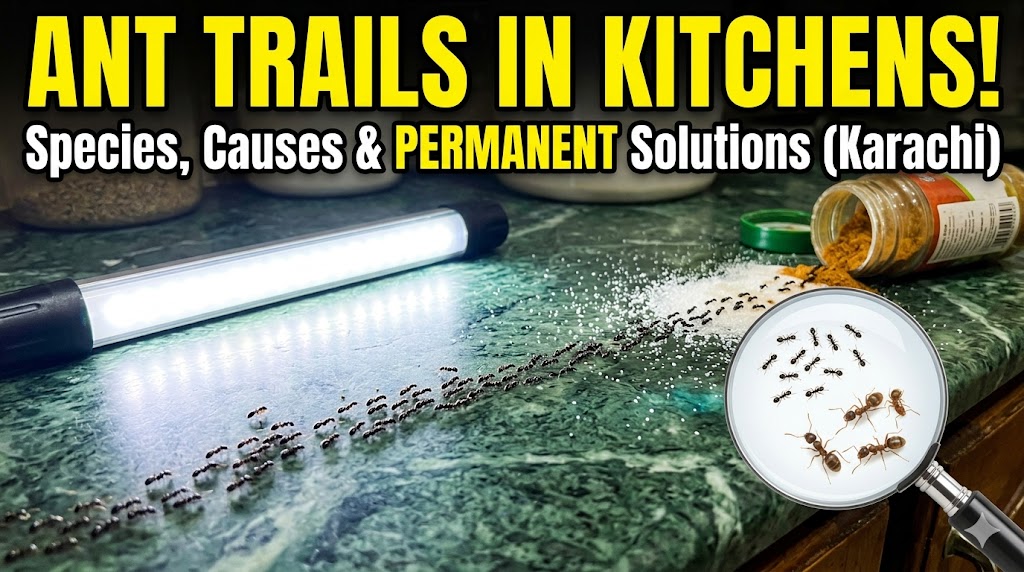
If ants keep coming back to your Karachi kitchen no matter how often you spray or wipe the counter, it’s because the workers you’re killing are a tiny scouting fraction of a colony that can number in the thousands — hidden inside a wall void, under a tile, or along a garden nest you’ve never seen. Ants are active for most of the year in Karachi’s climate, and treating the visible trail instead of the colony is exactly why the problem never actually goes away. This guide covers which ant species you’re likely dealing with, why they keep returning, and what actually stops them.
Which Ant Is in Your Kitchen? Common Species in Karachi Homes
Correctly identifying the species matters — the wrong control method can make some infestations worse, not better.
| Species | Size & Colour | Where It Nests | How to Spot It |
|---|---|---|---|
| Pharaoh ant | 1.5–2mm, yellowish-brown | Inside wall voids, behind tiles, under appliances | Fine trails indoors year-round, multiple queens |
| Black garden ant | Larger, solid black | Outdoor soil, under paving, compound walls | Trails coming in from outside toward sweet foods |
| Carpenter ant | 6–12mm, black or dark brown | Damp wooden frames, beams (not eaten, just nested in) | Coarse sawdust-like frass near entry points |
| Fire ant | Reddish-brown, aggressive | Mounds in compounds, gardens, boundary walls | Sharp, burning sting; raised itchy welt |
Pharaoh ants are the species most commonly found inside Karachi apartments and kitchens, and they’re notoriously hard to eliminate because of a behaviour called “budding” — when the colony is threatened, for example by a surface insecticide, it splits into multiple sub-colonies that relocate deeper into the structure. Spraying a Pharaoh ant trail can spread the infestation rather than end it.
Carpenter ants are a different kind of warning altogether: they excavate galleries in damp wood to nest, not to feed, so their presence near a door frame, window frame, or roof beam almost always signals a moisture problem in that wood, not just an ant problem.
Why Ants Keep Coming Back Into Your Kitchen
Worker ants follow pheromone trails left by scouts who found food or water — invisible to you, but precise for other workers. Killing the visible workers or wiping down the trail only forces scouts to lay a new route; the colony itself is untouched. In Karachi kitchens, a few conditions reliably keep that cycle going:
- Open or loosely covered food storage — uncovered sugar, atta, biscuits, dates, and rice are the most targeted items
- Moisture — a dripping tap, condensation under the sink, or water pooled under the fridge gives ants a reliable water source regardless of food availability
- Cooking residue on counters, behind the stove, and under appliances — even tiny amounts of oil or sugar maintain a pheromone trail
- Gaps and cracks in kitchen tiles, skirting boards, and the space behind fitted cabinets, which become nest sites and trail routes
Heat accelerates all of this. For what else surges alongside ants once temperatures climb, see our summer heatwave pest surge guide.
Signs You Have a Serious Infestation, Not Just Stray Ants
- Ants appearing in multiple separate locations at once, not just one trail
- Ants inside containers that weren’t tightly sealed — meaning they’ve nested very close to the food source
- Small piles of sandy or granular material near wall junctions or under appliances — excavated soil from a nest inside the wall
- Winged ants (alates) appearing indoors before monsoon — a mature colony about to swarm and establish new nests
- Activity that continues despite repeated spraying — a sign the nest is well-established inside the structure
DIY Prevention Steps That Actually Help
These reduce ant activity significantly but won’t eliminate a colony already established inside your walls. For a fuller room-by-room checklist, see our kitchen pest prevention guide.
- Store sugar, atta, grains, lentils, biscuits, and dried fruit in airtight glass or hard-plastic containers — never open bags or loosely folded packaging. See our guide on storing food and waste correctly for more.
- Fix dripping taps and pipes under the sink immediately, and keep that area wiped dry
- Clean behind and under appliances weekly — grease and food particles collect there, invisible from above
- Wipe counters with a mild detergent solution after cooking to break down pheromone trails
- Seal gaps in tiles, the counter-to-wall junction, and visible cracks with waterproof sealant or silicone
- Don’t leave dirty dishes or wet dishcloths out overnight
- Keep outdoor garbage bins away from the kitchen wall with tight-fitting lids
For Pharaoh ants specifically: don’t spray a visible trail. That triggers budding and worsens the infestation. Bait is the right tool here, but given how easily the wrong placement spreads the colony instead of killing it, professional bait application is worth it for this species.
Why Over-the-Counter Sprays Don’t Solve It
Chalk lines, surface sprays, and aerosol cans are contact insecticides — they kill the ants they touch and do nothing to reach the colony, and for Pharaoh ants they actively make things worse. Permanent control means getting toxicant to the queen or queens, the reproductive source of all workers, which requires bait: a slow-acting toxicant mixed into food that workers carry back and share with the colony. Getting the bait formulation and placement right depends on species identification and experience — a protein-based bait that works on one species is ignored by another. Our DIY vs. professional fumigation comparison covers this trade-off across pests, not just ants.
Our ants control service in Karachi identifies the species involved, targets the colony with the right bait or treatment, and seals the entry points workers are using. Ant activity often coincides with cockroaches in Karachi kitchens — if you’re seeing both, our cockroach control service can be scheduled alongside ant treatment, and our guide to cockroach species in Karachi can help you tell the two problems apart. Pricing for either depends on the extent of the infestation — our ant control cost guide breaks down what drives that, and our charges page has upfront rates.
Seasonal Patterns: When Karachi Ant Problems Peak
Ant activity tracks temperature and moisture. The main surge starts in April and peaks between May and August, as colony growth and foraging range both expand — ants that were never seen in winter suddenly show up in numbers. A second, smaller surge often follows monsoon, when moisture in the walls combines with lingering food odours from Eid-ul-Adha preparations; see our Eid pest surge guide for what else spikes in that window.
We provide ant control across Karachi, including Gulistan-e-Jauhar, Scheme 33, and Shahra-e-Faisal, tailoring treatment to your building type and the species involved.
Frequently Asked Questions
Why do ants come back right after I spray them?
Spray kills the workers you can see but doesn’t touch the colony or the queen, so scouts simply lay a new trail. For Pharaoh ants, spraying can even split the colony into new sub-colonies elsewhere in the structure.
What’s the most common ant species in Karachi kitchens?
Pharaoh ants — small, yellowish-brown, and found nesting inside wall voids and behind tiles in most apartments and kitchens across the city.
Can I bait ants myself instead of calling a professional?
For black garden ants with a single outdoor nest, over-the-counter bait can work if placed correctly. For Pharaoh ants, the wrong bait or placement risks triggering budding and spreading the colony, so professional application is the safer route.
Are carpenter ants a sign of a bigger problem?
Yes. Carpenter ants nest in wood that’s already damp or damaged, so treating the ants without fixing the underlying moisture means the colony re-establishes or another pest moves into the same weak spot.
When is ant activity worst in Karachi?
April through August is the main surge, driven by rising temperatures. A second, smaller peak often follows monsoon into September and October, tied to residual wall moisture and Eid-ul-Adha food residue.
Can ant and cockroach treatment be done at the same time?
Yes — the two often infest the same kitchens for the same reasons (food residue, moisture, gaps), so combining treatment in one visit is generally more effective and more cost-efficient than treating them separately.
Get Permanent Ant Control
If you’ve tried spraying, chalk lines, and home remedies and the ants keep coming back, the colony is established inside your structure and surface-level products won’t reach it. Contact Accurate Fumigation to book a professional assessment before a problem that looks small today colonises your entire kitchen wall cavity.

Rehan Khan is the founder of Accurate Fumigation and an entomologist. He holds an M.Sc. in Entomology and a B.Sc. in Environmental Science, and has worked in pest control in Karachi for three decades. He founded the company in 2005 and writes about the pest and water problems the city deals with each season. Accurate Fumigation is ISO 9001:2015 certified and a member of the National Pest Management Association.
Questions about a service, or need a certificate for an inspection? Call the office on 0330-2533480. Read Rehan’s full profile.