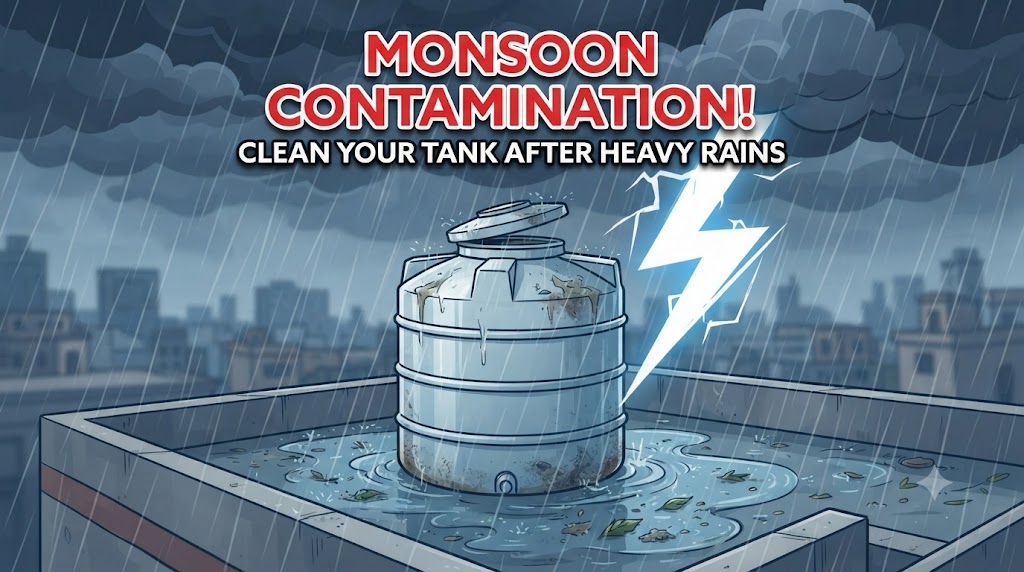
Every year, the first heavy monsoon spell in Karachi brings the same relief and the same worry. The heat finally breaks, but somewhere on the roof or under the driveway, a water tank that was sealed and safe a week ago is quietly taking on rainwater, silt, and runoff it was never built to handle.
This isn’t a minor seasonal inconvenience. Karachi’s monsoon has repeatedly been linked to spikes in waterborne illness across the city, and household storage tanks are one of the last points where that contamination can be caught before it reaches a family’s drinking glass or kitchen tap. A proper water tank cleaning service in Karachi after the rains is less about routine maintenance and more about closing that gap.
This post looks specifically at how monsoon rain compromises a tank, what actually ends up in the water, and what a household or building should do about it before the next spell arrives.
How Monsoon Rain Actually Gets Into Your Tank
Most Karachi homes rely on a combination of an underground tank (often called a boring or sump) and a rooftop overhead tank. Each has its own weak points during heavy rain.
- Rooftop tank lids that have warped, cracked, or lost their rubber seal over years of sun exposure let rainwater — carrying roof dust, bird droppings, and debris — seep straight in.
- Overflow and vent pipes that aren’t properly capped or angled can act as a direct channel for rain and insects to enter the tank.
- Underground tanks in low-lying streets can take in floodwater through hairline cracks in ageing concrete, especially where nearby sewage lines run close to the water line.
- Waterlogged streets increase pressure on the boundary between fresh water lines and sewage lines — in older parts of the city where the two run close together, this is a known route for cross-contamination.
None of these entry points are visible from the tap. The water can look, and even taste, perfectly normal while carrying a real health risk.
What’s Actually in Contaminated Monsoon Water
Health authorities and physicians across Karachi report a consistent rise in waterborne illness during and immediately after the monsoon — typhoid, cholera, hepatitis A and E, and acute gastroenteritis are the ones doctors watch most closely. These aren’t rare, exotic infections; they’re common, preventable ones tied directly to contaminated water and food.
Water quality studies of Karachi’s household supply have repeatedly found a large share of tested samples carrying coliform bacteria and E. coli — clear markers of sewage contamination. Rain doesn’t create this problem on its own; it accelerates an existing weakness in ageing pipes, tanks, and drainage that gets exposed the moment the system is put under real pressure.
Sediment and organic debris washed in during rain also feed algae and biofilm growth inside the tank long after the rain itself has stopped, which is why tanks often need attention even a few weeks after the last heavy spell.
Signs Your Tank Needs Attention After Heavy Rain
You don’t need a lab test to know something is off. Watch for:
- Water that looks cloudy, has a slight tint, or leaves a film in a clear glass after it settles
- A musty, earthy, or faintly sulphurous smell from the tap, especially first thing in the morning
- Visible sediment or grit settling at the bottom of buckets or in the kettle
- A noticeable drop in water pressure, which can point to debris partially blocking the outlet pipe
- Any household member developing repeated stomach upset with no other obvious cause
Areas of Karachi Where This Risk Runs Higher
Low-lying and older parts of the city tend to see worse street flooding and slower drainage, which puts more pressure on underground tanks specifically. Homes and businesses in areas like Malir, Landhi, Korangi, Saddar, and Garden often deal with standing water for longer after a spell, and that extended contact time increases the chance of seepage into ageing tank walls and joints.
That said, this isn’t only an older-infrastructure problem. Newer housing schemes with rooftop tanks that have never been serviced are just as exposed, since the failure point there is usually a degraded lid seal rather than the tank structure itself.
What Professional Post-Monsoon Cleaning Actually Involves
A proper post-monsoon clean isn’t a quick rinse. It typically involves draining the tank fully, physically scrubbing sediment and biofilm off the interior walls and floor, removing any debris that’s entered through the lid or overflow pipe, disinfecting the interior, and rinsing thoroughly before the tank is refilled. Underground and overhead tanks are usually treated as separate jobs since sediment builds up differently in each.
As a pest control company in Karachi that also handles water tank cleaning, we treat this the same way we’d treat any hygiene-critical job — controlled process, proper disinfection, and a tank that’s genuinely safe to refill, not just visibly emptied and rinsed.
Protecting Your Tank Before the Next Downpour
- Check the rooftop tank lid and seal before monsoon season starts, not after the first leak is noticed
- Make sure overflow and vent pipes are capped with a mesh or cover that keeps rain and insects out without blocking airflow
- Have underground tanks inspected for hairline cracks, especially if the tank is more than a few years old
- Schedule a full clean both before the monsoon season begins and again after the heaviest spells pass
- Keep the tank fully covered and secured year-round — an unsecured lid is the single most common entry point we see
Monsoon Dampness Doesn’t Stop at the Water Tank
A tank that’s taken on moisture from cracked seals or flooding is usually a symptom of a wider dampness problem, not an isolated one. The same humidity and standing water that push contaminants into a tank also create ideal conditions for termites in wooden fittings and door frames, and for cockroaches breeding in damp, undisturbed corners of the kitchen and bathroom.
If you’re already having your tank inspected after a heavy spell, it’s worth having someone check for early termite activity around door frames and skirting boards at the same time — termite damage in Karachi’s older housing stock is often first noticed months after the monsoon that actually caused it. The same goes for a sudden cockroach presence indoors, which tends to spike right alongside the rains as insects move in from waterlogged drains and gardens looking for dry ground — a cockroach control service at the same time as your tank clean is a reasonable, efficient pairing rather than two separate call-outs.
What This Costs Homeowners Who Wait
The households that end up spending the most on monsoon-related water problems are usually the ones who waited until a visible symptom forced their hand — a child with repeated stomach upset, a tank so sediment-choked that water pressure drops noticeably, or a rooftop tank lid that finally gives way entirely during a storm. Each of these is more disruptive, and often more expensive, to fix once it’s an emergency than it would have been as scheduled maintenance.
A pre-monsoon inspection and a post-monsoon clean, treated as two fixed dates on the household calendar rather than something to think about only when the water looks wrong, is consistently the cheaper and safer path over a full year.
Frequently Asked Questions
How soon after heavy monsoon rain should I get my tank cleaned?
Ideally within a week or two of the heaviest spell passing, especially if you’ve noticed cloudy water, a change in smell, or if your street experienced visible flooding. Waiting longer gives sediment more time to settle and biofilm more time to establish itself on the tank walls.
Will boiling the water make it safe if my tank has been contaminated?
Boiling kills most bacteria and parasites and is a reasonable short-term precaution for drinking water, but it doesn’t remove sediment, physical debris, or the underlying contamination sitting in your tank. It’s not a substitute for cleaning the tank itself.
Is it the rain that’s unsafe, or the tank?
Usually it’s a combination — rain introduces contaminants and floodwater pressure, but it’s a compromised tank (a bad lid seal, a cracked wall, an uncapped overflow pipe) that lets that contamination actually reach your stored water.
How do I know if my underground tank has been affected by street flooding?
Cloudy or gritty water, a musty smell, or a sudden change in taste after a period of heavy rain are the main warning signs. If your street held standing water for an extended period, it’s worth having the tank inspected even without obvious symptoms.
Do you clean both overhead and underground tanks?
Yes — overhead and underground tanks are cleaned as separate processes since they collect different types of sediment and have different access points.
Getting Ahead of Monsoon Season
Karachi’s monsoon isn’t going anywhere, and neither is the strain it puts on ageing water infrastructure across the city. A tank that’s cleaned and properly sealed before the rains, and checked again once the heaviest spells pass, is one of the simplest ways a household can protect itself from a genuinely serious health risk.
If it’s been a while since your tank was last cleaned — or you’re not sure when it last was — get in touch and we’ll help you get ahead of the season rather than reacting to it.

Founder, Accurate Fumigation — B.Sc. Environmental Science, M.Sc. Entomology
Rehan founded Accurate Fumigation in 2005 and has spent 20 years building it into one of Karachi’s most trusted names in pest control and water tank cleaning. He holds a B.Sc. in Environmental Science and an M.Sc. in Entomology, and his team operates under PPMA registration, FBR/SRB compliance, and WHO-approved chemicals across every service — from termite proofing to tank sanitation. Every job closes with a written warranty and, where required, a certificate accepted by KMC, WASA, and the Sindh Food Authority.
Questions about a service or need a compliance certificate? Reach the office at 0330-2533480, or visit Office-307/2, Razeen Blessings, Block 1, Gulistan-e-Johar, Karachi.